





Most B2B teams pay for three SEO tools that all see the same thing.
A research suite, a rank tracker, and a crawler each look at the blue links from a slightly different angle. Meanwhile, the three things that actually decide a B2B deal sit outside the frame: the 40-search-a-month query your buyer types, the ChatGPT answer that builds the shortlist before anyone visits your site, and the pipeline number your CFO wants in the next board deck.
That is the flaw in how B2B SEO tools get bought. Not that the tools are bad. That most stacks buy the same blind spot three times.
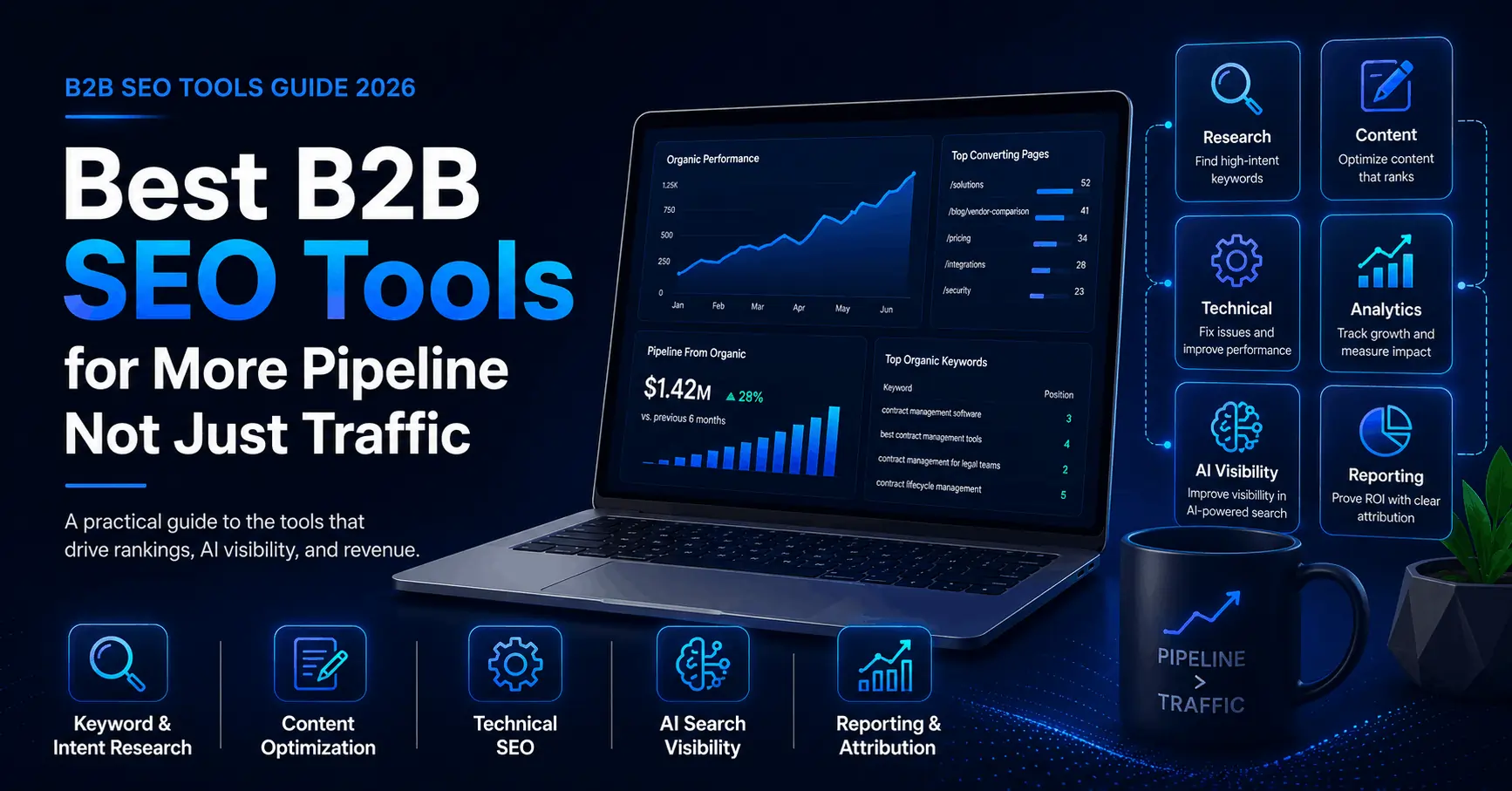
So this guide sorts the market by job, not by feature count. Fifteen tools, six jobs, what each one sees, what it cannot see, what it costs as of July 2026, and which subscription you can cancel this afternoon.
What are B2B SEO Tools?
B2B SEO tools are software platforms that help business-to-business companies improve their search visibility, attract qualified leads, and measure organic performance. They support keyword research, competitor and backlink analysis, technical SEO audits, content optimization, rank tracking, and reporting.
Unlike general SEO software, B2B SEO tools are often used to target high-intent niche keywords, manage complex websites, support longer buyer journeys, and connect organic traffic with leads, conversions, and revenue.
Why B2B breaks most SEO software
Three structural facts about B2B search snap the standard playbook in half.
Volume is a liar. “SOC 2 compliance software for fintech startups” might show 30 monthly searches, or no data at all. “Compliance software” shows thousands and attracts students, job seekers, and competitors. Keyword tools sample clickstream panels where corporate searchers are badly underrepresented, so your best queries get rounded to zero. Sort by volume and the software will steer you, confidently, toward the wrong page.
You are not selling to a searcher. You are selling to a committee. Forrester’s State of Business Buying, 2026 puts the typical decision at 13 internal stakeholders plus nine external influencers, and buying groups roughly double when the purchase involves AI features. The security lead searches your SOC 2 page. Finance searches pricing. The end user searches whether you integrate with the tool they already love. One “ultimate guide” serves none of them.
The shortlist forms before the click. G2 surveyed 1,076 B2B software buyers in March 2026 and found 51% now start research with an AI chatbot more often than with Google, up from 29% a year earlier. Sixty-nine percent chose a different vendor than planned based on what a chatbot told them, and one in three bought from a company they had never heard of. Your rank tracker sees none of this. And it matters, because 6sense’s research found that 95% of the time, the winning vendor was already on the buyer’s day-one shortlist.
Rankings still count. They are simply no longer the whole scoreboard.
The 15 tools, and what each one cannot see
| Tool | The job it does | Its blind spot | Price (July 2026) |
|---|---|---|---|
| Google Search Console | Your real queries, including the zero-volume ones | Competitors. Clicks from AI answers. | Free |
| Bing Webmaster Tools | AI citations and grounding queries | A minority of total search | Free |
| Google Analytics 4 | What visitors do after the click | Which company the visitor works for | Free |
| Microsoft Clarity | Where a page loses people | Why they left | Free |
| Ahrefs | Backlinks, content gaps, competitor pages | Long-tail volume. Pipeline. | $29 to $1,499/mo |
| Semrush | Broad research plus native AI tracking | Same. Seats and add-ons stack fast. | $139.95 to $499.95/mo |
| SE Ranking | The same jobs at roughly half the price | Data depth | Roughly $55 to $110/mo |
| Screaming Frog | Everything technically broken | Which fix is worth money | Free to 500 URLs, then £199/yr |
| Sitebulb | The same crawl, explained to an engineer | Same | Paid, per seat |
| Clearscope | Topical coverage and briefs | Originality | $129 or $399/mo |
| Surfer | Optimization scoring at scale | Same | From roughly $99/mo |
| Profound | The deepest view of AI answers | It measures. It does not fix. | From about $99, enterprise far higher |
| Peec AI | Mid-market prompt tracking | Engine coverage on lower tiers | From about €89/mo |
| Otterly | The cheapest credible AI visibility | Tight prompt and engine limits | From $29/mo |
| Dreamdata | Pipeline and revenue by landing page | Only as good as your CRM | Free tier, paid from roughly $600/mo |
Prices reflect publicly listed rates as of July 2026 and change often. Verify with the vendor before you buy.
Job 1: The free tools you already own and underuse
1. Google Search Console
The only honest record of what Google thinks you are for. Everything else on this list is an estimate.
Do this today. Open Performance, filter queries to average position 8 through 20, sort by impressions. That is your striking distance list, and it is usually full of the specific, low-volume phrases no keyword database would have suggested. Fixing a page that ranks 11th beats writing a new one.
Then apply a regex filter for vs|versus|alternative|pricing|integration plus your competitors’ names. You now have a bottom-funnel content plan pulled from your own data, for free.
New in 2026. Google launched dedicated Search Generative AI performance reports on June 3, 2026, breaking out impressions from AI Overviews and AI Mode. Two catches. The report shows impressions only, with no clicks, no CTR, and no query data, and the rollout is phased, so you may not have it yet. Google also added a toggle to opt out of AI features entirely, which it began honoring on June 17, 2026. For most B2B companies, opting out means volunteering to disappear from the place shortlists get built.
2. Bing Webmaster Tools
Skipped by nearly everyone, which is exactly why ten minutes here pays. Microsoft shipped its AI Performance report in February 2026, four months before Google, and it still shows things Google’s does not: direct citations, and the grounding queries that caused an AI answer to pull from your page.
If you want to know whether assistants are actually reading you, this is the closest thing to a free answer.
3. Google Analytics 4
GA4 will not prove pipeline, but it is the plumbing that carries organic sessions toward the CRM. Configure events for the actions that matter (demo requests, trial starts, pricing views, meeting bookings) and grade landing pages on those, not sessions. A comparison page with 200 visits and four demo requests beats a guide with 9,000 visits and none.
4. Microsoft Clarity
Free heatmaps and session recordings. Use it when a page ranks well and converts badly. Look for repeated patterns across sessions, not one strange recording, and pair it with GA4: GA4 tells you what happened at scale, Clarity shows you how it happened.
Job 2: Research and competitive intelligence (buy one, not two)
You will live in this tool, so pay for one good one. Paying for two is the single most common line of waste in a B2B marketing budget.
5. Ahrefs
Still the best backlink index in the business, and Content Gap remains the fastest route to what competitors rank for that you do not.
- Pricing: Starter $29, Lite $129, Standard $249, Advanced $449, Enterprise $1,499. Annual billing works out to roughly two months free.
- Watch the seats. Extra users run $40 to $100 per month depending on tier. A five-person team on Standard is closer to $489 than $249.
- Watch the gates. There is no free trial, though Ahrefs Webmaster Tools is free on domains you verify.
- Blind spot: long-tail volume. Treat any number under 100 as a rumor.
6. Semrush
Broader than Ahrefs, thinner on links, and the only major suite with AI visibility tracking built into the same login.
- Pricing: Pro $139.95, Guru $249.95, Business $499.95, with 16 to 17% off annual. The newer Semrush One bundles run $199 (Starter), $299 (Pro+), and $549 (Advanced) and fold in AI visibility. On the classic plans, the AI Visibility Toolkit is a $99 per month add-on per domain.
- Watch the total. Seats cost $45 to $100 each, and the Trends add-on is another $289. A three-person Guru team lands near $410 before anything else.
- One procurement note: Adobe completed its $1.9 billion acquisition of Semrush on April 28, 2026. Semrush has told customers nothing changes immediately. If you are signing multi-year, ask your rep for a renewal price cap and a data export clause covering your historical keyword and prompt data, and get both in writing.
7. SE Ranking
The budget-conscious pick. Rank tracking, audits, competitor research, and AI search tracking at roughly half the price of the majors. Less depth, enough coverage.
Ahrefs or Semrush? Choose Ahrefs if links and competitor research drive your strategy. Choose Semrush if you want research, tracking, and AI visibility on one bill. Choose neither if you have not yet built your keyword list from the sources no platform can hand you: sales call transcripts, closed-lost notes, G2 category pages, support tickets, and Search Console.
Then add one column to the sheet: revenue proximity, scored 1 to 5. That column will do more for a B2B program than any built-in opportunity score.
Job 3: Technical crawl (protect the pages that close deals)
B2B sites break in specific ways. The blog sits on HubSpot, the docs on a subdomain, the app behind app., plus 400 programmatic integration pages nobody owns.
8. Screaming Frog SEO Spider
Free to 500 URLs, then £199 per year (about $279) per seat. It checks over 300 issues and remains the best value on this entire list. The paid licence unlocks unlimited crawls, JavaScript rendering, scheduling, and custom extraction.
Crawl in commercial order. Pricing, comparison, integration, security, and docs pages first. The blog can wait. One accidental noindex on a pricing page costs more than a year of tool spend.
While you are in there, open robots.txt and check whether you are blocking GPTBot or ClaudeBot by accident, then wondering why you never get cited.
9. Sitebulb
Screaming Frog tells you what broke. Sitebulb explains it in a report you can hand to an engineer who does not report to you and does not care about SEO. If you lose the fight for dev tickets, that difference is worth paying for. (Confirm current licence tiers before you buy.)
Job 4: Content (the score is a floor, not a target)
10. Clearscope
Essentials $129, Business $399, Enterprise custom. Unlimited users on every tier, which quietly makes it cheaper per head than any per-seat rival once you have five people touching content. Clean grading, a good Google Docs workflow, and it has added prompt tracking for ChatGPT and Gemini. No free trial.
11. Surfer
Cheaper entry, per-seat pricing, real-time editor score writers actually use. Add-ons stack, so price the whole bill.
The caveat neither tool will tell you. A content score measures similarity to whatever already ranks. In B2B, whatever already ranks is often a thin listicle written by someone who has never spoken to your buyer. Term coverage is table stakes.
What earns a citation in an AI answer, and a link from a real publication, is something only you have: your own benchmark data, your actual pricing, a named customer result, an implementation timeline from a sales engineer. Give every money page at least one fact that exists nowhere else on the internet. A page graded A with nothing original in it gets summarized and skipped.
Job 5: AI visibility (the layer most B2B stacks are missing)
This is where shortlists now get built, and blue-link rank tracking is blind to it.
12. Profound
The category leader, and priced like it. Tracks mentions, citations, sentiment, and share of voice across ChatGPT, Perplexity, Gemini, Copilot, and Google’s AI surfaces, and shows which domains the models cite most in your category. That last report is the most actionable thing in the product: it converts link building from guesswork into a list of eight to twelve publications the models already trust. Entry tiers start around $99, but realistic multi-engine deployments run in the hundreds, and enterprise contracts are commonly reported in the thousands. It is now demo-led, so verify.
13. Peec AI
The mid-market challenger. Starter around €89 for 25 prompts, Pro around €199 for 100. Clean, fast, and it turns findings into a prioritized action list rather than a dashboard you admire and ignore. Check which engines are included at your tier, because the cheaper plans cover fewer than the marketing suggests.
14. Otterly
From $29 a month for 15 prompts across four engines. Narrow, but if the choice is between a $29 tool and no visibility data at all, take the $29 tool.
Already paying for a suite? Try the bolt-on first. Semrush’s AI Visibility Toolkit is $99 per month per domain. Ahrefs Brand Radar layers on top of a base plan, so price it fully before assuming it is the cheap option. Half the value here is simply learning whether you have a problem.
How to actually run this
Track prompts, not keywords. Write 30 to 50 questions a real buyer would type:
- “best [category] for [industry or company size]”
- “[your brand] vs [competitor]”
- “alternatives to [category leader]”
- “[category] that integrates with [the tool they already use]”
- “is [your brand] SOC 2 compliant”
Baseline them, then re-measure weekly. Two warnings. First, LLM outputs are non-deterministic, so the same prompt returns different answers on different days. Read trends, never a single reading. Second, measurement does not create the thing being measured. A dashboard telling you competitors appear in 60% of buyer prompts and you appear in 8% is only useful if somebody owns closing that gap.
And the uncomfortable part: G2’s research found that a citation from a review site is the single most confidence-inspiring signal inside an AI answer. Your G2, Capterra, and TrustRadius profiles are now part of your search stack. Fix them before you buy anything else.
Job 6: Attribution (the job that saves your budget)
Your CFO does not care about sessions. This is where SEO programs get cut.
Start free, and do it this week. Add a required “How did you hear about us?” field to your demo form and read it every Friday. Then pass first-touch landing page and last-touch URL into hidden fields on every form, and report closed-won revenue by first-touch URL each quarter. It is crude. It takes an afternoon. It routinely beats six-figure attribution software at catching the dark funnel: the podcast, the Slack group, the ChatGPT answer nobody could track.
15. Dreamdata
Purpose-built B2B revenue attribution. It stitches anonymous sessions to companies, companies to opportunities, and opportunities to closed-won revenue in Salesforce or HubSpot. That is the only view that answers “did organic drive pipeline.” There is a usable free tier, with paid plans commonly quoted from around $600 per month and mid-market contracts landing well above that.
Alternatives. HockeyStack is the enterprise-grade option, quote-based, with third-party procurement data putting entry near $1,399 per month and the median contract around $28,400 a year. Factors.ai has a free plan and paid tiers from roughly $399, and suits LinkedIn-heavy motions.
When it is worth it: somewhere around $5M to $20M ARR, when a single deal justifies the subscription. Below that, your CRM plus a form field is a better use of the money.
Build one report and put it in front of leadership monthly: organic-sourced pipeline by landing page, trailing two quarters. It changes the conversation from “traffic is up 12%” to “these six pages produced $410,000 in pipeline.”
What to buy at your stage
| Stage | The stack | Rough monthly cost |
|---|---|---|
| Solo or early (under $5M ARR) | Search Console, Bing Webmaster Tools, GA4, Clarity, Ahrefs Starter ($29) or SE Ranking, free Screaming Frog, and a “how did you hear about us” field | $0 to $60 |
| Growth (2 to 5 marketers) | One research suite (Ahrefs Standard $249 or Semrush Guru $249.95), a Screaming Frog licence, Clearscope Essentials ($129), one AI tracker (Otterly $29 or Peec from €89), Dreamdata free tier | $450 to $700 |
| Scaling or mid-market | Ahrefs Advanced or Semrush One Advanced, Profound, Clearscope Business, Dreamdata or HockeyStack paid | $2,000+ |
Notice the pattern. At every stage, one research platform.
What to cancel this week
- Your second all-in-one suite. Ahrefs and Semrush overlap by roughly 80%. Keep one until someone’s full-time job is using both.
- Rank tracking on 4,000 keywords. Track the 50 that map to revenue. The rest is noise you pay to generate.
- An AI visibility tool with no owner. If nobody briefs content off the citation gaps, you bought a dashboard, not a channel.
- Seats nobody logs into. Audit at renewal. Fastest money you will ever save.
- Any tool that has not changed a decision in 90 days. That is the only renewal test that matters.
So what is the top SEO tool for B2B?
There is no single best rated SEO tool for B2B, and any list that names one is selling something. There is only the job you are worst at right now.
| Your constraint | Buy this first |
|---|---|
| You do not know what you already rank for | Google Search Console (free) |
| Competitors own your commercial terms | Ahrefs or Semrush. One of them. |
| Pages break and nobody notices | Screaming Frog |
| Writers produce interchangeable content | Clearscope, plus one original fact per page |
| ChatGPT names competitors and not you | Otterly, Peec AI, or the Semrush add-on |
| Your CFO asks what SEO produced | A CRM field, then Dreamdata |
A top rated SEO platform for B2B is not automatically the right fit. Review scores measure ease of use and support. They do not measure whether the database contains your keywords or whether the tool talks to your CRM.
The takeaway
The best B2B SEO tools change what you do on Monday. Everything else is a subscription with a nice interface.
Your buyers build their shortlist before they fill out a form, increasingly inside an AI answer you cannot see, using keywords your research tool insists have no volume. A stack that only measures blue-link rankings will keep reporting green while pipeline stays flat.
So diagnose before you spend, and give it one afternoon:
- Pull your striking distance list from Search Console (positions 8 to 20, sorted by impressions).
- Run 30 buyer prompts through ChatGPT and Perplexity by hand. Write down whether you appear, and who does.
- Ask your last five closed-won accounts how they actually found you.
Those three exercises cost nothing and will tell you exactly which of these B2B SEO tools you need, and which one you were about to waste money on.
Then list every SEO subscription you pay for and write the decision each one changed in the last 90 days. Cancel anything with a blank line next to it. Spend what you saved on the job you are missing, which for most B2B teams in 2026 is AI visibility, attribution, or both.
Frequently asked questions About B2B SEO Tools
What is the top SEO tool for B2B?
If you can only buy one, buy a research platform (Ahrefs Standard or Semrush Guru, both around $250 a month) and surround it with free tools. Know its limits: it will not tell you whether you are in the AI shortlist, and it will not tell you what pipeline you produced.
Is Semrush or Ahrefs the better rated SEO platform for B2B?
Ahrefs for links and competitor research. Semrush for breadth and native AI visibility tracking. Run both briefly on your own keywords, keep the one your team actually opens, cancel the other.
Do I need a separate AI visibility tool?
If your buyers research software, yes, at least a cheap one. Start with the add-on inside the suite you already pay for. Graduate to a dedicated platform when AI-sourced pipeline justifies the line item.
Are zero-volume keywords worth targeting?
Often they are the highest-converting terms you will find. “Zero volume” usually means the tool cannot measure the query, not that nobody searches it. Validate before you commit: if Google autocomplete finishes the phrase and People Also Ask boxes appear, real demand exists.
How much should a B2B SEO stack cost?
A capable growth-stage stack covering all six jobs runs $450 to $700 a month. If you spend more than that and cannot name a decision each tool changed last quarter, you have a subscription problem, not an SEO problem.
Can I run B2B SEO with only free tools?
Early on, yes. Search Console, Bing Webmaster Tools, GA4, Clarity, and free Screaming Frog cover search performance, AI citations, behavior, conversion friction, and basic technical work. The gap is competitor intelligence, which is what a paid suite buys you.
Related Articles:
- How to Choose the Best B2B SEO Agency (Buyer’s Guide)
- Best B2B SEO Services: Vet the Agency, Then Yourself
- B2B SEO Best Practices That Drive Pipeline
- B2B SEO Solutions: Fix the Right Problem First
- B2B SaaS SEO: Rank, Place, or Skip Every Keyword
- B2B SEO Specialist: Hire for Pipeline, Not Traffic
- B2B SEO Consultant: How to Hire One Who Moves Pipeline
- B2B SEO Expert: How to Hire One Who Drives Revenue
- B2B SEO Case Study: 5 Plays That Move Pipeline
- B2B Marketing Agency: How to Choose One (2026 Guide)
- B2B Tech SEO: Your Whole Market Fits on One Sheet
- B2B SEO Statistics 2026: Where the Sources Disagree
- B2B Local SEO: The Playbook Most Marketers Get Wrong
- B2B Ecommerce SEO: The 2026 Pipeline Playbook
Last Updated on 3 months ago by Alipio Umiten IV
