





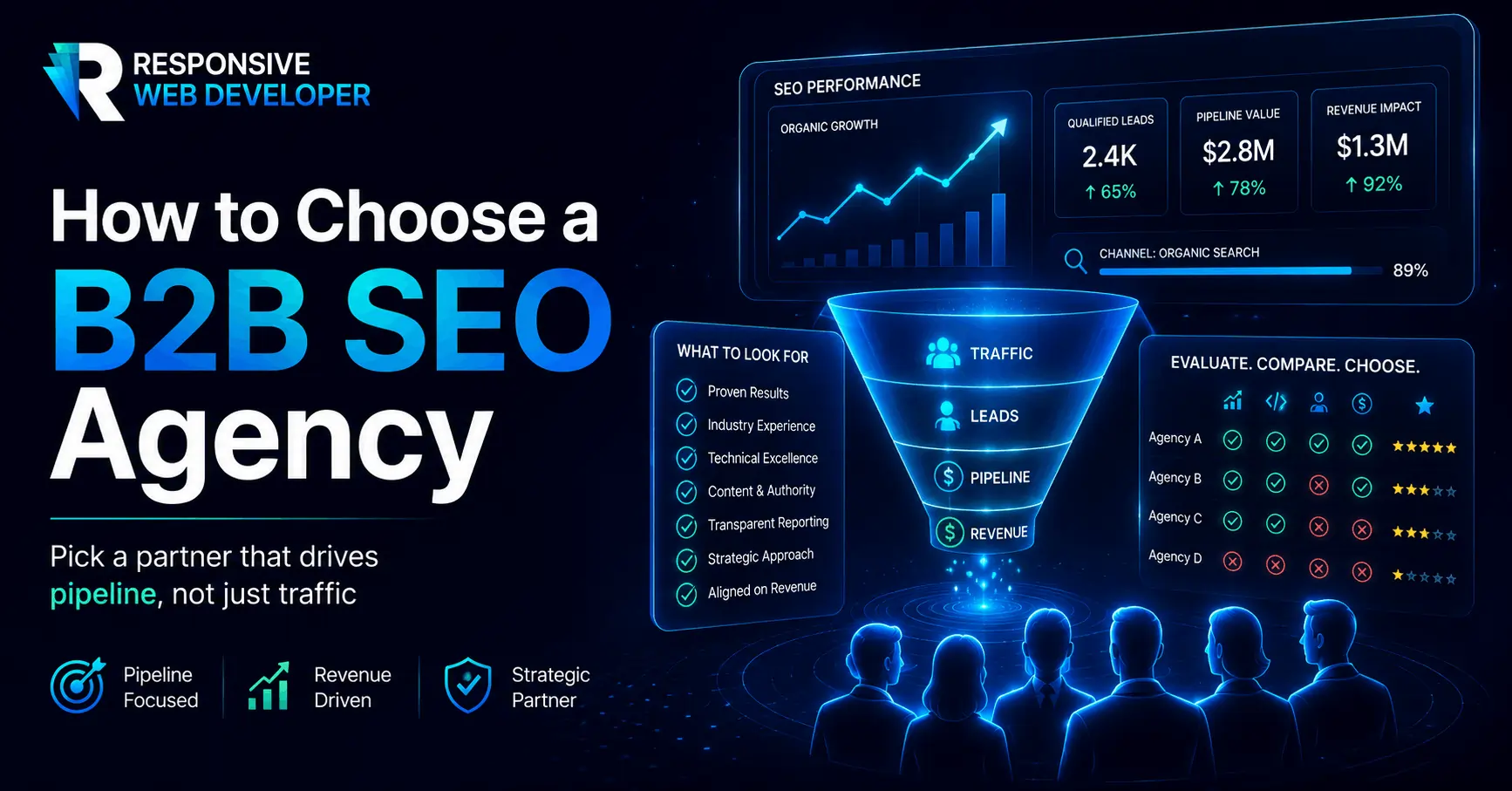
Your organic traffic is climbing. Your pipeline is not. If those two lines have quietly drifted apart, you probably hired an agency that ran a consumer SEO playbook on a company that sells to committees.
That gap is the central risk in hiring a B2B SEO agency. The wrong partner spends six to twelve months growing blog visits that never reach a sales call. The right one ranks you for the small, unglamorous searches your buyers type before they book a demo, and turns organic search into a channel your CFO will defend in a budget meeting.
This is a buyer’s framework for choosing a B2B SEO agency that moves revenue instead of dashboards. You’ll get the services that belong in scope, a way to pressure-test a firm’s track record, the exact questions to ask, the red flags worth walking away from, and honest ranges on cost and timeline.
What is a B2B SEO agency?
A B2B SEO agency helps business-to-business companies get found in search by the specific people who buy, then turns that visibility into leads, demos, and pipeline. That is the short version. The work behind it splits into strategy, technical fixes, content, authority building, and measurement.
The label matters less than the specialization. On paper, a general SEO agency and a B2B SEO firm do the same things. In practice, B2B search behaves so differently that a generalist tuned for e-commerce or local traffic will point you at the wrong goals from the first call.
Four differences decide almost everything about how you evaluate a partner.
Low search volume, high stakes
A consumer brand might chase a keyword with 90,000 monthly searches. In B2B, the term that closes a six-figure contract might draw a few hundred searches a month, and a chunk of those are your own employees and competitors.
That inverts the strategy. Volume becomes a weak signal, and buyer fit becomes the point. A specialist B2B SEO agency builds a keyword map around the problems your ideal customer is trying to solve, then treats a 300-search commercial term as prime real estate because the people typing it have budget and authority. A generalist sees low volume and steers you toward broad top-of-funnel terms that pad traffic and attract almost no buyers.
You’re selling to a committee
B2B purchases rarely come down to one person. A typical deal now involves several stakeholders: an end user, a manager, a finance approver, and often IT or security.
Each of them searches differently. The practitioner googles how to solve a technical problem. The manager compares vendors. The finance lead wants pricing and ROI. Strong B2B SEO maps content to every member of that committee across the funnel, not just the champion who found you first.
Long sales cycles make attribution messy
In consumer search, someone finds a product and buys the same afternoon. In B2B, a prospect might read your article in February and sign in September after a dozen other touches. Any agency promising clean, immediate ROI attribution is either new to B2B or bending the truth about how organic revenue actually gets credited.
The right partner is honest about this. Much of SEO’s impact hides inside anonymous research that later resurfaces as a “direct” or “branded search” visit.
Pipeline is the scoreboard, not traffic
This is the cleanest tell of all. Ask an agency how it measures success. If the answer is sessions, keyword rankings, and domain authority, keep interviewing. Those are inputs. The output you are paying for is qualified pipeline: leads, opportunities, and revenue influenced by organic search.
A firm that lives in B2B talks in that language because its clients’ finance teams demand it. One page ranking for a high-intent commercial term can outperform a viral post that pulls 50,000 readers and zero demos.
The B2B SEO Services That Belong in Scope
When you evaluate B2B SEO services, you are really evaluating four disciplines working together. A firm strong in one and weak in the rest will stall. Use this as a checklist against any proposal you receive.
Technical SEO. The foundation: crawlability, indexation, site speed, structured data, and site architecture. If search engines cannot crawl and render your site cleanly, nothing else compounds. On large B2B sites with thousands of pages, technical debt is often the single biggest thing capping rankings. A one-time audit plus fixes is frequently the fastest early win.
Content strategy mapped to the funnel. Not “more blog posts.” A deliberate content architecture that covers education at the top, comparison and solution content in the middle, and product, pricing, and competitor pages at the bottom. Each piece targets a specific search intent and a specific stage of the buyer’s journey. B2B readers spot thin content instantly, so depth and real expertise matter more here than in any consumer niche.
Link building and digital PR. Earned authority through credible, relevant coverage: original research, expert commentary, partnerships, and guest contributions. Quality beats volume by a wide margin. Ten links from respected industry publications will do more than a thousand from directories, and anyone promising hundreds of links per month is selling spam that can trigger a penalty.
Conversion and measurement. Ranking is worthless if the traffic bounces or never gets tracked. The best B2B SEO agencies optimize the path from search result to conversion, then wire that path to your CRM so you can see which pages and keywords produce pipeline. Without this, you and your agency are both guessing.
Technical, content, and links are table stakes. The real differentiators are defensible link building and honest pipeline tracking. Those separate a genuine B2B SEO company from a firm that publishes articles and hopes.
How to Vet a B2B SEO Agency’s Track Record
Every agency’s site claims it drives results. Your job is to test that claim before you sign anything.
Read case studies for revenue, not traffic
Skim past the “300% increase in organic traffic” headline and look for what happened to the business. Did qualified leads rise? Did pipeline grow? Did the client close deals sourced from organic? A case study that reports only traffic is hiding the metric that matters.
Check whether they rank for their own terms
A B2B SEO agency that cannot rank itself for “B2B SEO agency” or “B2B SEO services” should make you pause. Search the terms they would want to win. If they are buried on page five, ask how they will do for you what they cannot do for themselves.
Look for experience in your corner of B2B
B2B is not one market. SaaS SEO differs from manufacturing SEO, which differs from professional services or fintech. An SEO agency for B2B that has ranked companies like yours already understands your buyer, your sales cycle, and your compliance constraints. Ask directly which clients resemble you and what results they produced. You don’t always need an exact-niche match, but you do need proof they can handle a complex, considered purchase.
If you sell into German-speaking markets, note that buyers there often search for a “B2B SEO Agentur” or “B2B SEO Beratung,” so multilingual and localized capability may belong on your checklist too. Translation alone will not match local search behavior.
Talk to a reference
The strongest signal is a current or former client. Ask the firm to connect you with one, then ask that client the uncomfortable questions. Did they hit their goals? How was communication when results were slow? Would they hire the agency again?
Review their strategy process
Ask how they build a strategy, and be wary of anyone who jumps straight to deliverables. “Four blog posts and ten links a month” is an output, not a plan. A serious process starts with business and customer discovery, a technical audit, keyword and intent research, competitor analysis, and a prioritized roadmap. The order they fix things in tells you whether they think about impact or just fill a content calendar.
Questions to Ask Before You Sign
Bring these to the first call. The shape of the answers reveals more than any deck.
- Can you show B2B results where you moved pipeline, not just traffic? You want a story with qualified leads or revenue attached, ideally in or near your category.
- How do you tie SEO to pipeline and revenue? Look for a described tracking setup that connects organic to your CRM, plus candor about attribution limits.
- How do you research keywords when search volume is small? Strong answers cover intent mapping, customer interviews, and mining sales calls. Weak ones stop at “we find high-volume terms.”
- Who writes the content, and how do they learn our domain? In technical B2B, this one factor often decides whether content ranks and converts. Listen for expert interviews or subject-matter review, not an anonymous content mill.
- What exactly is your link-building method? You want earned digital PR and real outreach, with a clear rejection of paid links and private blog networks.
- Who actually works on my account? Watch for the bait-and-switch where senior talent pitches and juniors deliver. Ask to meet your day-to-day team.
- What does the first 90 days look like, and what happens if results stall by month six? Confident firms describe early technical and foundational work, a realistic timeline, and reasonable exit terms.
Shortlist only the agencies whose answers keep landing on pipeline and revenue. The B2B SEO experts who think in business outcomes stand out fast from the ones who only think in rankings.
Red Flags Worth Walking Away From
Some warning signs should end the conversation on their own.
- Guaranteed number-one rankings. Nobody controls the algorithm. A guarantee signals either dishonesty or inexperience.
- Only vanity metrics. If every metric is traffic, impressions, or domain authority with no line to leads or revenue, accountability is missing by design.
- No relevant B2B examples. A portfolio of e-commerce and local businesses means your long sales cycle will be their experiment.
- Vague link building. Evasiveness about how links are earned usually points to bought links or PBNs that put your domain at risk.
- One-size-fits-all packages. A fixed “Gold Package” of blogs and links ignores what your specific site actually needs.
- No curiosity about your business. If they never ask about your buyers, sales cycle, or pipeline goals, they are about to run a template.
- Long lock-in with no off-ramp. Reasonable notice periods are fine. A twelve-month contract with no performance checkpoint protects the agency, not you.
The through-line is simple. A real specialist is curious about your business and honest about what SEO can and cannot do. A generalist in a B2B costume sells packages and promises.
Agency, Consultant, or In-House?
Hiring an agency is not your only option, and it is not always the right one. Match the model to your stage and your internal capacity.
Hire a B2B SEO agency when you want strategy and execution handled together and need to move faster than hiring allows. You get breadth across technical, content, and links, plus a bench you would otherwise spend a year assembling. You trade some product depth and control for speed.
Hire a B2B SEO consultant when you already have some execution capacity but lack senior direction. B2B SEO consulting is often the most cost-effective way to buy expertise for strategy, audits, or coaching an existing team. The tradeoff is that you supply the hands, so B2B SEO consultants suit companies with writers and developers already in place.
Build in-house when SEO is core to your growth long term and you can attract and keep the talent. An internal team understands your product better than any outsider will, but hiring is slow and one generalist rarely covers technical SEO, content, and links well.
Many B2B companies land on a hybrid: an in-house owner who sets direction and protects institutional knowledge, supported by an agency or consultant for execution and specialized skills. That structure tends to work well for technical products, where insider fluency and outside capacity are both hard to fake.
What a B2B SEO Agency Costs
Pricing is opaque, so let’s make it concrete. Most B2B SEO work runs on one of three models.
Monthly retainer. The most common structure for ongoing programs. You pay a fixed fee for a defined scope, and the range varies widely with ambition and content volume. Retainers suit SEO because results compound over months, not weeks.
Project-based. A fixed fee for a defined deliverable such as a technical audit, a site migration, or a content sprint. Useful when you have a specific problem rather than an ongoing need, and a good way to test a partner before a longer commitment.
Performance-based. Part or all of the fee is tied to outcomes like traffic or leads. It sounds appealing, but scrutinize how “performance” is defined. These deals often push an agency toward whatever metric triggers the bonus rather than toward durable revenue.
One caution holds across every model: in B2B, cheap is usually expensive. A bargain retainer almost always means junior labor and templated content that a technical audience ignores, and you will pay again to redo it. Treat the fee as an investment measured against pipeline generated, not a cost to minimize.
How Long It Takes, and How to Know It’s Working
Set expectations before you start, or you will fire a good agency out of impatience. B2B SEO is a compounding investment, not a switch you flip.
A realistic arc looks roughly like this. The first quarter goes to technical fixes, keyword and content strategy, and early quick wins, with little visible traffic movement. Meaningful ranking gains on competitive terms tend to appear around months four to six. Real, attributable pipeline usually shows up closer to months nine to twelve, and sometimes later for brand-new domains or crowded categories.
Watch leading indicators while you wait, then shift to lagging ones:
- Months 1 to 3: technical issues resolved, indexation improving, and rankings climbing for bottom-of-funnel and comparison terms.
- Months 3 to 6: growth in impressions and clicks from in-market, qualified queries, plus the first leads attributed to organic.
- Months 6 to 12 and beyond: organic-sourced pipeline and closed revenue you can trace back to specific pages.
One habit protects you more than any dashboard: put a dollar figure on organic pipeline every month. When SEO reports in the same currency as the rest of the business, it stops being a mystery line item and becomes a channel leadership will keep funding.
If a firm promises pipeline in 60 days, it either misunderstands B2B or plans to chase easy, low-value traffic to look busy. Patience paired with the right leading indicators is how this channel pays off.
The Bottom Line
The best B2B SEO agency for you is not the one with the slickest deck or the biggest traffic promises. It’s the one that understands your buyers are a committee, your most valuable keywords are quiet, and your only real score is pipeline. The rest optimize for numbers that look good in a report and change nothing on your sales calls.
Vet like a buyer, not a spectator. Study case studies for revenue, ask the seven questions, and walk at the first guaranteed ranking or vanity-metric dashboard. Do that, and you’ll skip the expensive lesson most companies pay for once before they learn to choose properly.
Ready to start? Build a shortlist of three to five agencies with genuine B2B experience, book intro calls this week, and bring this checklist to every one. Ask the pipeline question first. How they answer it will tell you almost everything you need to know.
Frequently Asked Questions About B2B SEO Agency
How much does a B2B SEO agency typically cost?
A B2B SEO agency typically charges between $5,000 and $15,000 per month for an ongoing retainer. Smaller projects may start around $1,500, while complex enterprise programs can exceed $50,000 per month. Pricing depends on your website’s size, competition, goals, content requirements, technical needs, and link-building scope.
What is the Rule of 7 in B2B?
The Rule of 7 suggests that a B2B buyer may need to interact with your brand several times before taking action. These interactions can include reading blog posts, visiting product pages, viewing case studies, attending webinars, or speaking with sales. Seven is not a strict requirement, but the principle highlights the importance of consistent messaging across the buyer journey.
What is the ROI of B2B SEO?
The ROI of B2B SEO varies by industry, sales cycle, contract value, competition, and execution quality. A successful strategy can generate substantial long-term returns because optimized content continues attracting qualified prospects after publication. Companies should measure SEO ROI using organic leads, influenced pipeline, customer acquisition costs, and closed revenue—not traffic or rankings alone.
Related Articles:
- B2B SEO Trends 2026: What Actually Moves Pipeline
- B2B SEO Tools 2026: Real Prices, Real Blind Spots
- B2B Tech SEO: Your Whole Market Fits on One Sheet
- SEO for B2B Marketing: A Portfolio, Not a Calendar
- B2B SEO Statistics 2026: Where the Sources Disagree
- B2B Local SEO: The Playbook Most Marketers Get Wrong
- B2B Ecommerce SEO: The 2026 Pipeline Playbook
- Best SEO Platform for B2B: A 2026 Buyer’s Guide
Last Updated on 3 months ago by Alipio Umiten IV
