





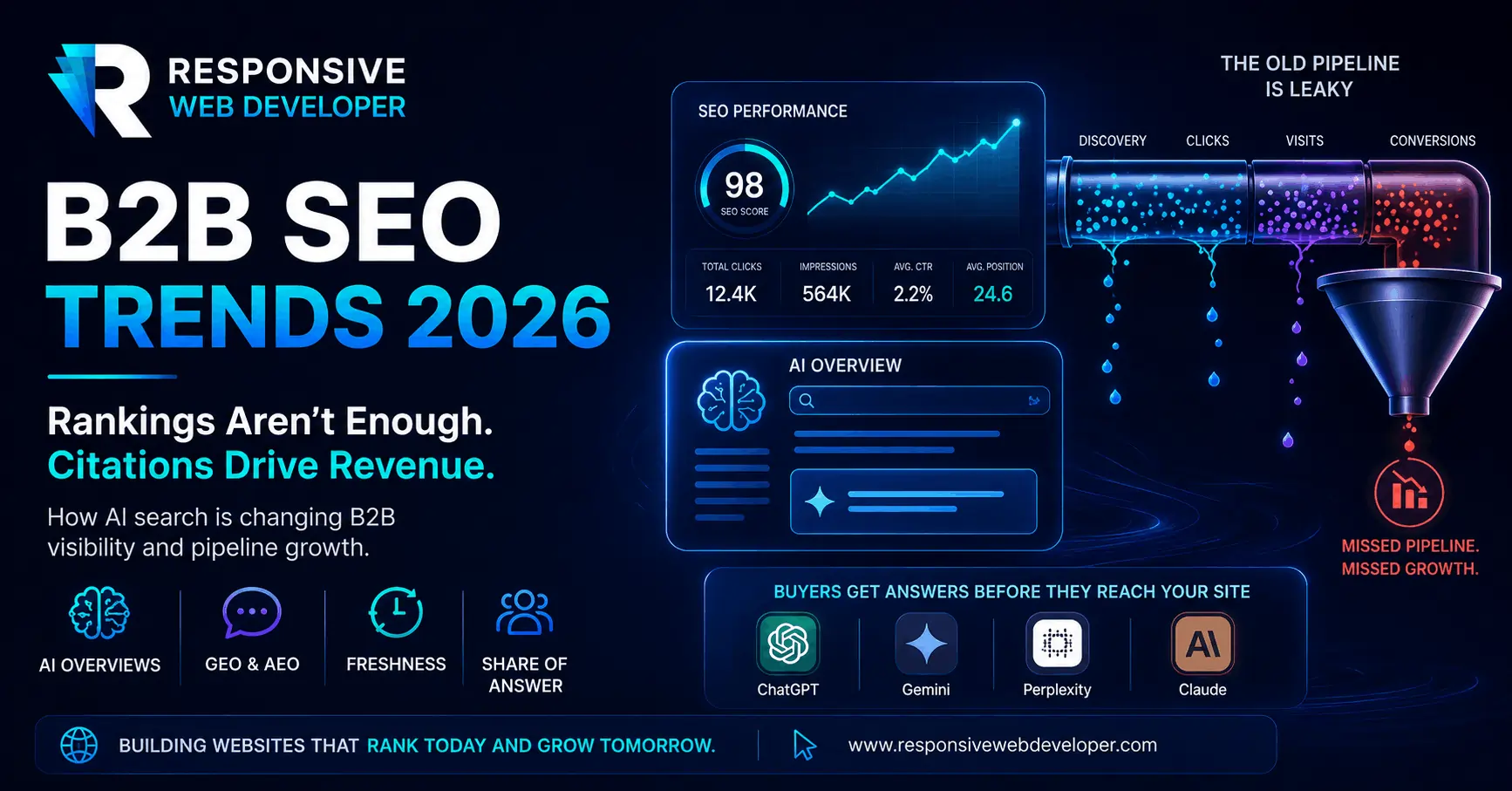
Your rankings look fine. Your pipeline from organic search does not. That gap is the story of B2B SEO in 2026.
For a decade the playbook was simple: rank a page, earn the click, capture the form fill. That machine is breaking. Google now answers a large share of buyer questions before anyone reaches your site, and buyers build shortlists inside ChatGPT and Perplexity before they ever open Google. The most important B2B SEO trends this year all trace back to that one shift.
If you own a number in the forecast, this is not academic. These trends decide which brands land on the shortlist and which quietly drop off it. Below are the changes that matter in 2026, the data behind them, and a prioritized plan you can defend to a CFO.
No trend-chasing. Just the shifts reshaping how buyers find and choose you, and one concrete first move for each.
The one shift behind every 2026 trend
For years, B2B SEO asked a single question: who ranks highest? In 2026 there is a second question that matters just as much: who gets referenced?
AI-generated answers and search-results modules increasingly resolve buyer questions on the spot. So buyers form opinions and build shortlists directly on the results page and inside AI tools, often before they reach your site. That is why your dashboard can look healthy while revenue softens. The ranking holds, but the click and the influence leak away.
The metric that captures this is “share of answer”: how often your brand shows up when an AI or a search feature resolves a buyer’s question in your category. If a synthesized answer names three competitors and defines the category in a rival’s language, you have a pipeline problem disguised as a traffic problem. Every trend below is a consequence of that reframe.
1. AI Overviews turned informational search into a zero-click game
Google’s AI Overviews answer the question inline, and the click that used to follow often does not come. AI Overviews grew from roughly 6 to 7% of searches at the start of 2025 to close to half of all queries by early 2026, according to tracking from BrightEdge and Advanced Web Ranking. In informational verticals like health, education, and research, that figure sits closer to 80%.
The traffic effect is measurable. Ahrefs’ December 2025 study of 300,000 keywords found that when an AI Overview appears, click-through rate for the top organic result falls by about 58%. Pew Research, analyzing nearly 69,000 real searches, found that users clicked an organic result 8% of the time when an AI summary was present, versus 15% without one, and clicked a source cited inside the summary just 1% of the time.
For B2B, top-of-funnel “what is X” content gets hit hardest. That does not make it worthless. It makes it a branding and citation play rather than a traffic play.
What to do:
- Answer the question in the first two sentences of each section, then go deeper for readers who click through.
- Add a tight FAQ block with direct, quotable answers to the specific sub-questions buyers ask.
- Use clear headings and structured data so engines can lift your answer cleanly. Being cited inside an Overview earns roughly 35% more organic clicks than not being cited, per Seer Interactive, so citation is the new position zero.
2. GEO and AEO: optimize to be cited, not just ranked
Generative Engine Optimization (GEO), also called Answer Engine Optimization (AEO), is the practice of structuring content so AI systems like ChatGPT, Gemini, Perplexity, and Claude cite and recommend you inside their answers. Google’s own 2026 guidance frames optimizing for its AI features as still being SEO, so treat GEO as a layer on top of strong fundamentals, not a replacement for them.
The mechanism changes what you optimize. AI answers are assembled with retrieval: the system breaks a query into sub-questions, pulls the most relevant passages, and stitches them into a response. The unit of optimization moves from the page to the passage.
A GEO study presented at KDD 2024 tested optimization tactics across thousands of queries and found that adding relevant statistics, quotations, and citations, plus clearer writing, each raised how often content got surfaced in AI answers, with the strongest single moves lifting visibility by roughly 40%. Semrush’s analysis adds a warning: a question-and-answer format helps citation odds, while promotional language (“the best choice,” “act now”) actively hurts them.
What to do:
- Lead with the answer. Put a 40 to 60 word direct answer under each H2, then expand.
- Raise fact density. Specific, dated, sourced numbers get cited; vague claims get skipped.
- Write standalone paragraphs. AI extracts passages, so a claim that depends on three earlier paragraphs for context gets left out.
- Check crawler access. Confirm your robots.txt and CDN allow GPTBot, PerplexityBot, ClaudeBot, and Google-Extended. Many sites block AI crawlers by accident.
3. What ranks is not what gets cited
This deserves its own section because it upends a decade of habit. AI systems developed their own preferences for which sources to trust, and those preferences skew toward earned media and frequently updated content.
Two patterns from 2026 research stand out. First, freshness is heavily rewarded: one analysis of Perplexity found an 82% citation rate for content updated within 30 days, falling to 37% for older pages, and AI Overview citations skew strongly toward recent content. Second, the overlap between what ranks and what gets cited is smaller than intuition suggests. Analyses from Averi and Whitehat SEO found only about 11% of domains were cited by both ChatGPT and Perplexity for the same query, and Ahrefs found that roughly 67% of the pages ChatGPT cites most often are effectively off-limits to brand SEO: Wikipedia, government and educational sites, app stores, and major news outlets.
What to do: build a refresh cadence, not just a publishing calendar. Add dated “2026 update” sections to cornerstone pages. Chase third-party mentions and original data that other sites reference, because earned corroboration is what AI engines lean on most.
4. Bottom-of-funnel content is where the pipeline lives
B2B teams over-invested in top-funnel keywords for years because they had the volume. Now more teams care about revenue, and that is pushing competition toward decision-stage queries: best [category] software, [competitor] alternatives, [tool A] vs [tool B], [category] pricing, and [solution] for [industry].
These terms carry stronger intent, and the AI data backs the shift. Siege Media found that case studies and pricing pages are among the best content types for driving traffic in the AI era, while thin top-funnel guides saw the steepest declines. This is also where product-led SEO earns its keep: templates, calculators, integration pages, and comparison hubs that your product naturally supports.
The trap is turning these into thin sales copy. Buyers spot that instantly.
What to do: create honest comparison and decision-support pages. A strong comparison page names who each option is best for, the real tradeoffs, pricing model differences, and implementation effort, even when the answer is not always “choose us.” Say plainly, “Choose Product A for fast setup and a small team; choose Product B for advanced permissions and deeper reporting.” That clarity converts better than forced persuasion, and it gives sales better conversations.
5. Depth and original expertise beat content volume
Generative AI flooded the web with competent, generic content that all reads the same. That is a problem and an opening. When anyone can generate an 800-word explainer in seconds, the differentiator becomes what a model cannot invent: first-hand experience, practitioner insight, and original data.
The cautionary tale is well known in the industry. HubSpot, long the model for content-led growth, reportedly lost a large share of its organic traffic (estimates run from 70 to 80%) after algorithm updates penalized a sprawling library of off-topic pages. Breadth without authority became a liability.
Topical authority is the flip side of the same coin. Search engines and AI systems both reward demonstrated depth: an interconnected cluster of content that covers a subject from every angle beats scattered posts chasing single keywords. A cybersecurity company should not publish one post on “cloud security.” It should build a cluster around risk assessment, compliance by industry, vendor evaluation, implementation, and ROI, with each page strengthening the next.
What to do:
- Lead with first-party data: product usage patterns, customer results, proprietary benchmarks.
- Put named authors with real credentials on your content, and show your sources and dates.
- Publish fewer, better assets. Replace one generic post with one original study, teardown, or genuine point of view.
6. Search is everywhere, especially Reddit and LinkedIn
B2B buyers research across ChatGPT, YouTube, LinkedIn, Reddit, industry forums, and podcasts, and AI systems pull from all of them when they build answers. Visibility now means showing up where the conversation happens, not just on your own domain.
Reddit deserves special attention: it consistently ranks among the most-cited sources across the major AI engines, and because Perplexity uses real-time retrieval, a genuinely helpful Reddit answer can surface in AI citations within days. For B2B specifically, LinkedIn and subject-matter-expert voices carry unusual weight. The practical move for 2026 is to treat your executives’ and experts‘ feeds as primary channels, not side projects.
What to do: turn each major asset into a pack of posts, clips, and documents your leaders and teammates actually share, and show up in the specific subreddits, communities, and YouTube searches where your category gets debated. Skip astroturfing; fake reviews and sockpuppet accounts are easy to detect, and the trust collapse when you are caught costs far more than any short-term lift.
7. Agentic search is coming for the shortlist
The step past AI answers is AI action. Agentic search means AI agents that research, compare, and increasingly transact on a buyer’s behalf. Gartner projects that by 2028, 90% of B2B buying will be intermediated by AI agents, routing more than $15 trillion of spend through agent-driven workflows. Gartner’s March 2026 survey also found that 67% of B2B buyers now prefer a representative-free experience.
When an agent assembles a vendor shortlist, the brands with clean, machine-readable evidence make the cut. If your pricing logic, specifications, certifications, and differentiators are buried in PDFs or images, an agent can filter you out before a human buyer ever sees the list.
What to do: make your core facts explicit and structured in text an agent can parse. Give the exact questions buyers ask their own clear pages (“Do you offer SOC 2 compliance?”, “What is your minimum contract?”). Legibility to a machine is becoming a visibility requirement.
8. Measure pipeline and share of answer, not sessions
If discovery now happens before the click, session counts mislead. Rankings can hold steady on your dashboard while your real influence on buyers declines. The teams pulling ahead tie SEO to pipeline in the CRM and watch a broader scoreboard.
Here is the encouraging part: AI-referred traffic tends to convert far better than classic organic, because the buyer has already absorbed the synthesis and arrives ready to verify one option rather than evaluate ten. Seer Interactive’s analysis of a B2B client measured ChatGPT referrals converting at 15.9% and Perplexity at 10.5%, against 1.76% for Google organic. Ahrefs found that 0.5% of its AI-referred visitors drove 12.1% of signups. Fewer visits, much higher intent.
Track instead:
- Share of answer: how often AI tools mention or recommend you in your category.
- AI Overview and citation appearances for your priority terms.
- Branded search volume, a strong proxy for the demand your content creates. Branded queries with an AI Overview see roughly an 18% CTR lift, per Amsive, while generic terms fall.
- Influenced pipeline and close rate, not just traffic.
How to prioritize these B2B SEO trends
You do not need to chase all of these at once. Start with the bottleneck closest to revenue.
- Traffic is dropping. Audit pages affected by AI Overviews and refresh your best ones with answer-first intros, sourced stats, and stronger proof.
- Rankings are stable but leads are weak. Shift effort to bottom-of-funnel and comparison pages, product-led assets, and clearer conversion paths.
- Your category is crowded. Add original research, expert commentary, and customer proof that competitors cannot copy.
- AI tools do not mention your brand. Test your buyer prompts in ChatGPT, Perplexity, and Google’s AI features, then close the gaps with depth, clarity, and third-party mentions.
- Leadership questions SEO value. Report share of answer, AI referral conversion, and influenced pipeline instead of sessions.
A practical 90-day B2B SEO action plan
Days 1 to 30: audit and baseline. Run your 20 most important buyer questions through ChatGPT, Perplexity, and Google’s AI Overviews, and record where you appear and where a competitor owns the narrative. Confirm AI crawlers are not blocked. Set your new scorecard: rankings, plus AI citation share, plus influenced pipeline.
Days 31 to 60: fix your best pages. Rewrite the top 10 pages by impressions with answer-first intros and question-shaped headers. Add dated, sourced statistics and FAQ and Article schema. Improve internal links from education to evaluation, and add a next step that matches each page’s buyer stage.
Days 61 to 90: build authority and distribute. Publish one piece of original research designed to be cited. Turn it into a LinkedIn and expert-led distribution pack, seed it in the communities your buyers trust, and start a refresh cadence for cornerstone content.
The takeaway
The core B2B SEO trend of 2026 is not any single tactic. It is a reframe. You are no longer competing only to rank. You are competing to be the answer, and the shortlist is often set before the click. Rankings still count and fundamentals still win, but the brands that show up inside AI answers, back their content with real expertise, and measure influence instead of traffic will own the consideration set.
Start with the audit. This week, pull up the 10 questions your best buyers ask, run them through the AI tools those buyers already use, and note every place a competitor gets named and you do not. That single list will tell you more about your real B2B search position than any ranking report, and it is your roadmap for the next quarter.
Related Articles:
- How to Choose the Best B2B SEO Agency (Buyer’s Guide)
- Best B2B SEO Services: Vet the Agency, Then Yourself
- B2B SEO Best Practices: A 2026 Pipeline Playbook
- B2B SEO Solutions: Fix the Right Problem First
- B2B SaaS SEO: Rank, Place, or Skip Every Keyword
- B2B SEO Strategy: A Coverage Grid That Builds Pipeline
- B2B SEO Specialist: Hire for Pipeline, Not Traffic
- B2B SEO Consultant: How to Hire One Who Moves Pipeline
- SEO for B2B Companies: Diagnose Before You Cut It
- B2B Marketing Agency: How to Choose One (2026 Guide)
- B2B Tech SEO: Your Whole Market Fits on One Sheet
- SEO for B2B Marketing: A Portfolio, Not a Calendar
- B2B Local SEO: The Playbook Most Marketers Get Wrong
- B2B Enterprise SEO: The 3 Ceilings That Cap Growth
- B2B SEO Keywords: How to Choose Ones That Convert
- B2B Ecommerce SEO: The 2026 Pipeline Playbook
- Best SEO Platform for B2B: A 2026 Buyer’s Guide
Last Updated on 3 months ago by Alipio Umiten IV
