





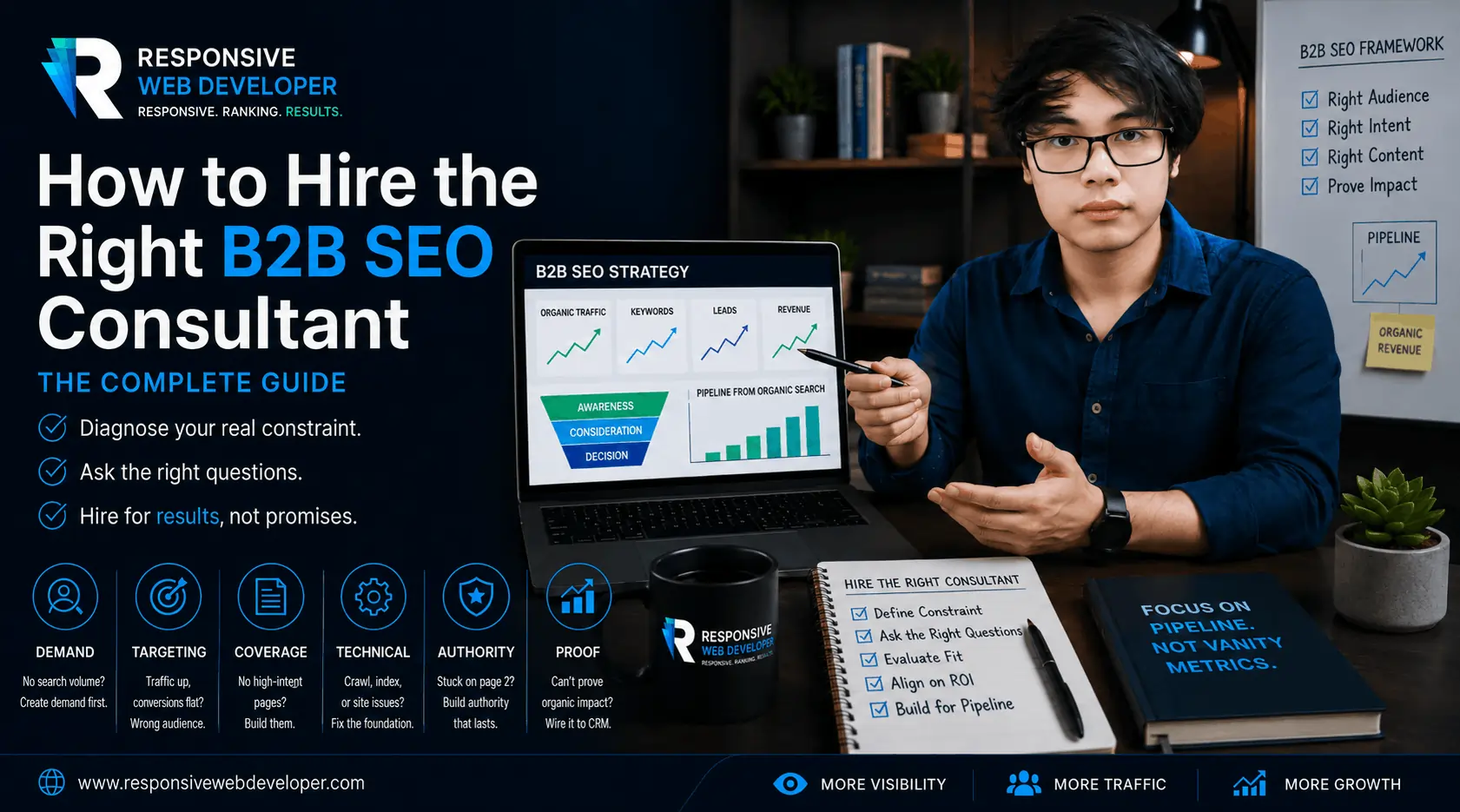
You can hire an excellent B2B SEO consultant and still waste a year.
Not because they were lazy or dishonest. Because “our SEO isn’t working” describes at least six different problems, and those problems do not share a fix. Hire a technical specialist when your real constraint is that nobody searches for what you sell, and twelve months later you will own a beautifully crawlable website with no pipeline attached to it.
So this guide runs the diagnosis before the shopping. You get the six constraints, the kind of help each one needs, what B2B SEO consultants charge, the eight questions that expose a generalist inside twenty minutes, and the contract terms that make a bad fit visible in month two instead of month twelve.
It is a hiring guide, not a pitch.
What Is a B2B SEO Consultant?
A B2B SEO consultant is a specialist who helps companies that sell to other businesses turn organic search into qualified leads, sales opportunities, and revenue.
Unlike general SEO providers who may focus primarily on rankings and website traffic, a B2B SEO consultant aligns search strategy with the company’s sales process. They account for longer buying cycles, complex products, high-value contracts, and purchasing decisions involving multiple stakeholders.
Their work typically includes technical SEO, buyer-intent keyword research, competitor analysis, content strategy, website architecture, internal linking, authority building, and organic lead attribution. They may also create or optimize high-intent pages such as comparison, pricing, integration, industry, use-case, and alternative pages.
The goal is not simply to attract more visitors. It is to attract the right decision-makers, answer the questions that influence a purchase, and demonstrate how organic search contributes to pipeline and revenue.
In simple terms, a B2B SEO consultant answers the question: Which searches are being made by companies most likely to buy, and what content will help them choose us?
Start here: name your constraint
Most companies walk into consultant calls holding a symptom (“traffic is up, pipeline is flat”) and let the vendor name the disease. That is backwards, and it is how you end up buying whatever that vendor happens to sell.
There are six reasons B2B organic search fails to produce pipeline. Find yours before you take a single call.
1. Demand. Nobody is searching for what you sell. You invented the category, or the words your buyers would use do not exist yet. Symptom: every keyword worth having does 20 searches a month and half of those are your own team. Fix: not SEO. Demand creation, through outbound, events, community, and paid. Hiring an SEO consultant here is the most expensive mistake on this list.
2. Targeting. You have traffic. It is the wrong traffic. Symptom: sessions climbing, demo requests flat, sales calling the leads unqualified. You rank for “what is [category]” and own nothing a buyer types in the two weeks before booking a call. Fix: a strategist who maps keywords to revenue and is willing to delete pages.
3. Coverage. The right buyers are searching. You have no page to catch them. Symptom: competitors hold every “[competitor] alternatives,” “best [category] for [industry],” integration, and pricing query. Yours do not exist. Fix: someone who builds bottom-of-funnel pages, plus the capacity to actually ship them.
4. Technical. The pages exist and Google cannot see them. Symptom: a migration dropped organic 40% overnight, your product pages render in JavaScript and never get indexed, your docs subdomain is cannibalizing your solution pages. Fix: a technical SEO who can hold a real conversation with your engineers.
5. Authority. Everything is right and you still sit at position 14. Symptom: strong pages, thin link profile, and you keep losing to weaker content on stronger domains. Fix: original research, digital PR, linkable assets. Slow, expensive, and the only thing that works.
6. Proof. It may already be working. Nobody can demonstrate it, so it is about to get cut. Symptom: last-click attribution hands every closed deal to “Direct,” and the CFO wants the line item gone. Fix: someone who wires organic into your CRM before they touch a keyword.
| Constraint | Symptom | Who to hire |
|---|---|---|
| Demand | No meaningful search volume exists for your category | Nobody. Create demand first. |
| Targeting | Traffic up, demos flat, sales says the leads are junk | A keyword-to-revenue strategist |
| Coverage | Competitors own every high-intent query; you have no page | A BOFU page builder plus execution capacity |
| Technical | Migration drop, indexation gaps, JavaScript rendering | A technical SEO who can brief engineers |
| Authority | Good pages, stuck on page two | Digital PR and original research |
| Proof | It may be working; last-click says otherwise | Someone who wires organic into the CRM |
One more, and it is not an SEO problem at all: if the right buyers land on your high-intent pages and do not convert, you have a messaging and CRO problem. More organic traffic will only make the leak louder.
Most companies have two constraints. Rank them and hire for the one on top. A consultant who is excellent at #4 and mediocre at #2 will cheerfully take your money to solve #4.
What a B2B SEO consultant actually does
Strip away the deliverables theater and the job is this: turn search demand into a small number of pages a buying committee will actually read, then prove in the CRM that it worked.
Five moves get you there.
- Map keywords to revenue, not volume. Every target term gets a buyer, a stage, and an estimate of deals per year. Terms that do not pay get cut, however flattering the volume chart looks.
- Subtract before adding. Consolidate the thin posts, kill the pages nobody reads, merge the templates cannibalizing each other. A consultant who only ever adds work is optimizing for retainer length.
- Ship the pages nobody volunteers to write. Comparison, alternatives, pricing, integrations, “for [role],” and industry use cases. They rank faster than thought leadership because competition for them is thinner, and they convert because the person reading them is already shopping.
- Earn citations, not links. Original data, expert commentary, partner and integration listings, digital PR. Not a package priced per link on sites your buyers have never opened.
- Report in pipeline. Sessions are a diagnostic. Sourced and influenced pipeline is the result.
Notice how much of that requires your sales team. Roughly a third of the real work happens inside call recordings, lost-deal notes, and an hour a month with two AEs. A B2B SEO consultant who never asks for that access is planning to guess.
Why the generalist playbook breaks in B2B
Sell running shoes and 100,000 visitors beat 10,000 every time. Sell revenue-cycle software to hospital CFOs and those two lines come apart completely. Most SEO advice was written by people who have never watched that happen.
Volume and revenue are decoupled. A term doing 30 searches a month can outperform one doing 30,000, because those 30 people run procurement at companies that sign six-figure contracts.
Run the model on your own numbers. Take a bottom-of-funnel term at 70 searches a month. Rank first, capture roughly a third of the clicks, and you get about 23 visits. Convert 4% to a demo and that is one demo a month. At a 25% close rate and a $45,000 ACV, that single page is worth around $135,000 a year. Now run the same math on a 20,000-volume “what is [category]” article whose readers are students, job seekers, and your competitors’ interns. Substitute your own inputs. The point is the model, not my numbers.
You are not selling to a person. You are selling to a committee, and every member searches differently. The end user searches for features. The IT director searches SOC 2, SSO, and integrations. The CFO searches pricing and payback. One ultimate guide serves none of them.
Long cycles wreck naive attribution. A buyer reads your comparison page in March, forwards it to her VP in May, and books a demo in September through branded search. Last-click hands the credit to Direct. Your consultant looks useless on the one dashboard leadership actually opens.
Your sales team is the best keyword tool you own. The objections that stall deals in legal review are search queries waiting to be written down. No software has that list. Your AEs do.
Consultant, agency, in-house, or fractional?
The right answer follows from your constraint, not from your budget.
| Option | Buy this when your constraint is | What you actually get | How it fails |
|---|---|---|---|
| Independent consultant | Targeting, Technical, or Proof, and you already have hands to execute | One senior brain, direct access, someone willing to say no | Brilliant diagnosis, nothing shipped |
| Agency | Coverage or Authority, and you have no internal production capacity | A pod of specialists and real throughput | The senior who sold you disappears; your strategy quietly goes to a junior |
| In-house hire | Organic is a permanent core channel and you need someone in Slack fighting for dev time | Context, ownership, compounding institutional knowledge | You hire a technician when you needed a strategist, then wait three to six months for ramp |
| Fractional head of SEO | You want one accountable owner but cannot justify the salary yet | A seat in the marketing leadership meeting and a number they own | Still needs execution capacity underneath them |
For most B2B companies under roughly 200 employees, the winning setup is a hybrid: a consultant for judgment, a freelance writer with real domain knowledge for output, and two days a month of developer time. That trio costs less than most agency retainers and it is unambiguous about who is accountable for what.
Already have an agency? A consultant can still earn their fee by auditing that agency and holding it to a pipeline number instead of a traffic number. Some of the highest-return consulting work is exactly that.
What B2B SEO consultants cost
Five pricing models, and the model matters more than the number.
| Engagement | What it buys | Best when your constraint is | Typical range |
|---|---|---|---|
| Paid diagnostic sprint (2 to 4 weeks) | Audit, keyword-to-revenue map, prioritized roadmap | You cannot name your constraint yet | $5,000–$10,000 fixed fee. SEO consultancies’ most common project price is $5,001–$10,000, with an average of about $8,686. |
| Hourly or day rate | Second opinions, unblocking an in-house team, training | Technical or Proof | $150–$250 per hour, or $1,200–$2,000 per day. The broader consultant market centers around $100–$150 per hour, with SEO consultancies averaging about $171 per hour; senior B2B specialists tend to price above the market midpoint. |
| Retainer, strategy only | Direction, briefs, reviews, prioritization | Targeting or Coverage, when you have writers and a dev | $2,500–$5,000 per month. This is the most common monthly-retainer bracket reported specifically for SEO consultancies. |
| Retainer, strategy plus execution | The above, plus pages, links, and dev support | Coverage or Authority, when you have nobody to build | $5,000–$15,000 per month. Current specialist B2B SaaS benchmarks place full-service engagements in this range; public agency packages commonly start around $3,000–$6,000 before heavier content, authority, and development scope is added. |
| Fractional head of SEO | An owner with a number and a seat at the table | Any of them, when organic is core to the plan | $6,000–$15,000 per month. Fractional marketing-leadership retainers commonly run from roughly $5,000 to $15,000 per month, while more embedded or executive-level mandates can reach $20,000. |
Three things move the price: how senior the person doing the daily work actually is (as opposed to the person on the sales call), whether execution is bundled in, and how broken your site already is.
Run the break-even on the first call. Multiply your ACV by your close rate on qualified opportunities. That is what one opportunity is worth to you. Divide the annual cost of the engagement by that figure and you have the number of opportunities organic must produce to pay for itself. A $6,000 monthly retainer costs $72,000 a year; at a $12,000 opportunity value, it breaks even at six. Now you are negotiating against a number instead of a feeling.
Make the candidate do that arithmetic with you. The ones who change the subject to domain authority are selling deliverables.
And cheap gets expensive here. The $1,500-a-month retainer promising eight blog posts is not a bargain. Work out what a writer can be paid to produce eight posts inside that budget and you will know precisely what you are buying. A wasted year of publishing costs more than a good consultant does, because your competitors spent that year building the authority you now have to outrank, and you will pay someone else to consolidate and delete the mess.
Vet by their questions, not their answers
Every candidate has rehearsed answers. Almost none have rehearsed questions. Watch what they want to know.
Green flags: what a strong candidate asks you, unprompted
- What is your average contract value, and your close rate on qualified opportunities?
- Who signs, and who can kill the deal?
- What are your top three lost-deal reasons?
- Can I have 60 minutes with two AEs and access to call recordings?
- Who publishes a page here, and how long does it take from brief to live?
- What have you already tried, and why did you stop?
Time it. If twenty minutes pass and nobody has asked what a customer is worth to you, they cannot value a keyword. They are going to open a tool and sort by volume.
Then ask these eight
- Which of our pages would you delete first, and why? Tests whether they can subtract. A consultant who only adds has never been accountable for a result.
- Our best-fit keyword gets 30 searches a month. What is it worth? Strong: “Depends entirely on who those 30 people are and what a customer is worth to you,” followed by questions about your economics. Weak: they steer you toward higher-volume terms and start talking about brand awareness.
- Show me a B2B engagement where traffic went down and it was still a win. Strong: they have one and can explain it (junk traffic cut, authority concentrated on money pages). Weak: visible confusion.
- Our SMEs will not give you time. What then? Strong: they tell you the truth first (the content will be generic and it will lose), then hand you a system: 25-minute recorded interviews they run themselves, transcripts, drafts back in 48 hours, one standing calendar hold nobody is allowed to cancel. Weak: “no problem, our writers research thoroughly.” Generalists let you off the hook here. That is exactly why their content sounds like everyone else’s.
- How will you tie organic to pipeline in our CRM, and what will that model miss? Strong: named fields, UTM discipline, a self-reported attribution question on the demo form, both first-touch and last-touch views, and candor about the gaps. Honesty about attribution is a hiring signal, not a weakness.
- What have you changed in the last twelve months because of AI search? Strong: specific, testable changes and a method for tracking citations. Weak: “SEO is dead,” or “we’ll add schema.”
- Who does the work, what percentage is you personally, and will that go in the contract? Get the answer in writing. “Our team” is not an answer.
- Under what conditions would you tell us not to hire you? The sharpest question in the set. A consultant who cannot describe the circumstances in which their own service is a bad idea has never run the analysis.
Score all three candidates against the same eight. The gaps show up fast.
Red flags
- Guaranteed rankings, or a guaranteed number of leads by a date. Disqualifying on its own. Nobody controls Google’s ranking systems.
- A keyword list before a sales call. They are selling a template.
- “X blog posts per month” as the headline deliverable. You are buying volume, not outcomes.
- Links priced per link, with no discussion of where they come from. You are buying a future penalty.
- A “custom audit” that is a crawler export with a logo on it.
- They want to own your Search Console, analytics, CMS, or hosting. You own the accounts. Day one. No exceptions.
- Case studies with percentages and no absolute numbers. “+400% traffic” from a base of 100 visits is 400 visits.
- Domain authority presented as a goal. It is a third-party score, not a business outcome.
- Every reference client is still a client. Ask for one who left, and why.
- A week into discovery, they still cannot say anything specific about what your product does.
The AI search half of the job
Your buyers are exactly the people building vendor shortlists inside an AI assistant. They describe their use case, get five names back, and start evaluating from there. Miss that answer and you never enter the deal at all.
The mechanics differ from ranking, and this is where weak candidates expose themselves.
AI answers get assembled from sources you do not own: review platforms, roundup posts, community threads, trade publications. They also favor pages that state things plainly and quotably. So the work looks like this:
- Getting you onto the third-party lists and review profiles the models actually retrieve from
- Publishing original data other people cite, because citations are the currency
- Making your own pages extractable: direct answers near the top, clean definitions, consistent naming of your product and category, structured markup where it earns its keep
- Tracking which assistants name you, for which prompts, and how that shifts over time
The content losing the most ground is the top-of-funnel explainer. “What is [category]” was already the wrong target in B2B. AI search just made choosing it more expensive.
The content gaining ground: comparison tables with real numbers, published pricing, documented methodology, customer results with figures attached. Which is to say, the same pages a good B2B SEO consultant was already pushing you to build, because they are the pages that convert.
One caution. Nobody can guarantee a citation in an AI answer, and a candidate selling “GEO” as a service line without naming a mechanism is selling a label. Ask how they would measure it. If there is no method, there is nothing underneath.
What the first 90 days should produce
Days 1 to 30. Diagnosis, not keywords. They ask for your last 20 closed-won and closed-lost deals, sales call recordings, the objection list, Search Console, analytics, and CRM access. Technical audit ranked by revenue impact rather than by severity score. A keyword-to-revenue map built from those calls. Baseline metrics agreed in writing.
Days 31 to 60. Plumbing and the first pages. Technical blockers cleared or ticketed with named owners. Cannibalization cleaned up. Internal links pointed at the pages you want ranked. The first bottom-of-funnel pages live. Tracking verified end to end, including a “How did you hear about us?” field on the demo form.
Days 61 to 90. A machine that runs. Comparison and alternatives pages shipping at a cadence you can sustain without heroics. An SME interview process running. Early position gains on low-competition, high-intent terms. A report that opens with demos and influenced pipeline instead of a sessions chart.
Do not expect revenue at day 90. Expect proof that the machine runs.
Say this to your CEO on day one, not in a QBR next spring: if the sales cycle runs nine months, a win in month five shows up as closed revenue somewhere around month fourteen.
The hard test: if day 60 arrives with no baseline, no roadmap, and no page live, that is not a slow start. That is a bad engagement.
Structure the deal so failure shows up early
Five terms. Insist on all five.
- Buy the diagnostic before the retainer. A two to four week audit and strategy sprint at a fixed fee. It is the cheapest way to test someone’s judgment, their working style, and whether their recommendations survive contact with your engineering team. A consultant who will only sell a twelve-month contract has told you what they optimize for.
- You own every account. Search Console, analytics, CMS, the keyword research file, the CRM dashboards. In your name, from day one.
- Name an internal owner. Someone whose actual job is unblocking the consultant. Without one, you are paying senior rates for a stranger to chase your dev team in Slack.
- One standing meeting with sales. Thirty minutes a month, consultant in the room. This is where the real keyword strategy comes from, and it is the first thing to get cancelled if nobody protects it.
- Write the kill switch. Pick the leading indicators, pick the review date (month six works), and write both down before you sign. If the indicators are not there, you part cleanly and nobody is surprised.
When you should not hire a B2B SEO consultant
The section most pages on this keyword leave out.
- Nobody searches for your category. Search captures demand. It does not create it.
- You need pipeline this quarter. Wrong instrument. Run paid, run outbound, work your existing customers.
- Your TAM is 200 named accounts. Named-account outbound beats organic at that size. Search pays off when a meaningful number of strangers are already looking for what you sell.
- You cannot publish a page without an engineering sprint. Fix that, or the retainer buys you a place in a queue.
- Nobody internally owns content. A consultant hands you a strategy, not a department. Somebody on your side has to receive it.
- You are pre-product-market-fit. Positioning will change twice before anything ranks, and everything you publish becomes debt.
Two or more of these true? Spend the money elsewhere and come back in two quarters. A good B2B SEO consultant will tell you that on the first call, which is one more reason to ask question eight.
The metrics that tell you it is working
Leading (weeks 2 to 12). Indexation of money pages. Impressions and average position on the 20 to 30 keywords tied to revenue, not “total keywords.” Technical errors closed. Pages shipped against the roadmap. Citations in AI answers for your buying prompts.
Middle (one to two quarters). Non-brand organic demo requests. Assisted opportunities. Branded search volume, which is badly underrated: in B2B, rising branded search is often the earliest honest signal that your content is landing with real buyers, because people read, remember, and come back by name.
Lagging (two to four quarters). Organic-sourced and organic-influenced pipeline. Closed-won by first-touch landing page. Cost per qualified opportunity.
Two guardrails. Always split brand from non-brand organic, because brand search rises whenever marketing spends money anywhere, and combined reporting lets a weak engagement hide inside your paid and events budget. And add an open “How did you hear about us?” field to your demo form today, whether or not you hire anyone. Self-reported attribution is messy, unscientific, and closer to the truth than your dashboard.
If the monthly report leads with sessions and keyword counts, ask for a different report.
The takeaway
The tools are commodities. Anyone can pull a keyword list. What is rare is someone who looks at a term doing 30 searches a month, tells you it is the most valuable page on your website, and then proves it in your CRM nine months later.
Before your next call, do two things.
Name your constraint from the six above, in one sentence. Then pull your last 20 closed-won deals and write down the exact words those buyers used to describe their problem before they found you. Ask sales. They know.
Bring both to the call and hand them over. Any B2B SEO consultant worth the retainer will build the strategy from that page. Anyone who sets it aside and opens a keyword tool has just answered every question you had.
Frequently Asked Questions About B2B SEO Consultant
What does a B2B SEO consultant do?
They diagnose why organic is not producing pipeline, map search demand to your ICP and sales stages, prioritize the technical and content work, build the pages a buying committee reads before it buys, and wire organic into your CRM so the channel survives budget season. Some execute the work themselves. The good ones make sure someone credible does.
How much does a B2B SEO consultant cost?
Pricing runs from hourly advisory through fixed-price projects, monthly retainers, and fractional leadership. The biggest single variable is whether execution is bundled in or handled by your team. Compare scope and expected business value, never the sticker price alone.
Should I hire a consultant or an agency?
Hire a consultant for judgment and prioritization when you already have execution capacity. Hire an agency when you need production at volume and have an internal owner to direct it. Plenty of B2B teams run both, deliberately. Either way, confirm who does the daily work before you sign.
How long does B2B SEO take to work?
Technical fixes and bottom-of-funnel pages can move within 60 to 90 days. Compounding growth usually shows in months six to twelve, and closed revenue lands roughly one sales cycle after that. Anyone promising closed deals in 30 days is selling something other than SEO.
Do I still need SEO if my buyers research in ChatGPT?
More than before, and the job is wider now. AI assistants build answers from search results, review sites, and third-party content. The work is being the source those systems trust, not only holding a blue link.
Can a B2B SEO consultant guarantee rankings?
No, and the ones who guarantee them are the ones to avoid. Nobody controls Google’s ranking systems. A credible consultant guarantees a process, a set of deliverables, and a measurement model. Never a position.
What is the difference between B2B and B2C SEO?
Volume versus intent. B2C wins on reach and speed. B2B wins on a small number of high-intent pages that speak to a buying committee across a long cycle, backed by expertise a competitor cannot copy out of another blog post.
Related Articles:
- B2B SEO Best Practices That Drive Pipeline
- B2B SEO Solutions: Fix the Right Problem First
- B2B SaaS SEO: Rank, Place, or Skip Every Keyword
- B2B SEO Strategy: A Coverage Grid That Builds Pipeline
- B2B SEO Trends 2026: What Actually Moves Pipeline
- B2B Tech SEO: Your Whole Market Fits on One Sheet
- SEO for B2B Marketing: A Portfolio, Not a Calendar
- B2B SEO Statistics 2026: Where the Sources Disagree
- B2B Local SEO: The Playbook Most Marketers Get Wrong
- B2B Enterprise SEO: The 3 Ceilings That Cap Growth
- B2B SEO Keywords: How to Choose Ones That Convert
- B2B Ecommerce SEO: The 2026 Pipeline Playbook
Last Updated on 1 month ago by Alipio Umiten IV
