




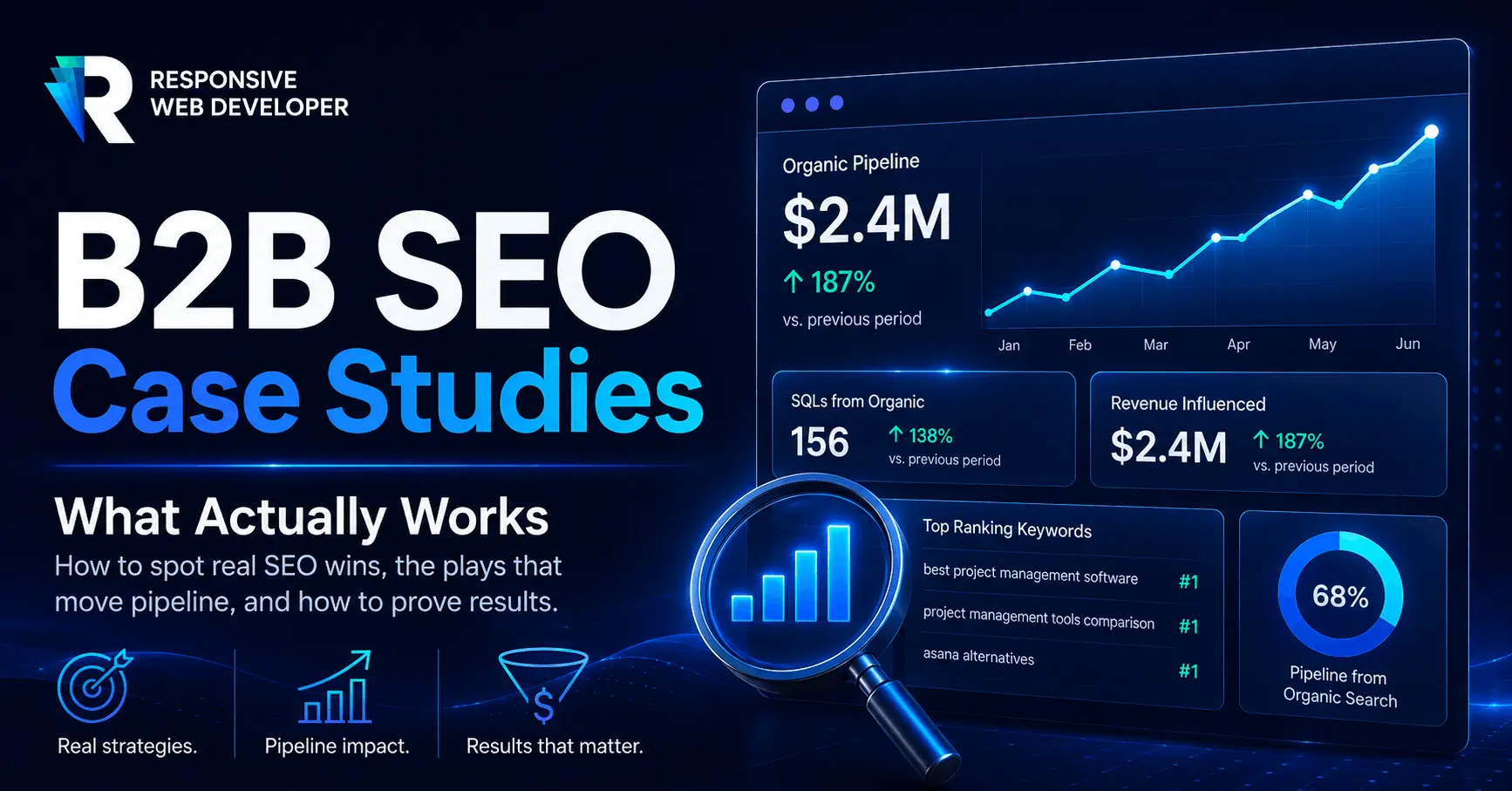
Most B2B SEO case studies are built to impress, not to inform.
You have seen the format. A traffic chart shooting up and to the right, a client logo, a quote about explosive growth, and almost nothing about whether that traffic turned into a single sales conversation.
That vagueness is a real problem when you are the one deciding whether SEO is worth it, or defending the budget to a CFO who treats organic search as a coin flip. You need the mechanics behind a B2B SEO case study, not the highlight reel.
This post gives you three things: how to tell a credible case study from marketing theater, the five plays that show up again and again when SEO moves pipeline instead of just moving a chart, and a template for documenting your own results so they hold up.
What a Real B2B SEO Case Study Contains
A real case study connects a specific action to a business outcome. A weak one shows you the outcome, a bigger traffic number, and asks you to assume the action caused it.
The difference lives in the metrics. Traffic, impressions, and keyword counts grow easily and inflate easily. They tell you almost nothing about whether SEO earned money.
A credible B2B SEO case study includes:
- A clear baseline: traffic, rankings, and pipeline before the work started.
- The specific goal or problem, like ranking on page three for the category’s highest-intent term.
- The exact tactics used, not a vague claim about creating great content.
- Business results: organic-sourced pipeline, demos booked, sign-ups, or revenue influenced.
- A timeframe, so you know whether this took three months or three years.
- Honest context about what else was running, such as paid campaigns or a funding round.
If a case study skips the business results and the timeframe, read it as an ad, not evidence.
The metrics that matter more than traffic
Rank these above sessions every time:
- Organic-sourced pipeline and revenue influenced
- Marketing-qualified and sales-qualified leads from organic
- Rankings for commercial-intent keywords, the terms buyers search near a purchase
- Conversion rate from organic visitor to lead
- Share of voice for your core category terms
Traffic still counts, but only as an input. A page that pulls and converts no one loses to a page that pulls a fraction of that and books demos every week.
Why B2B SEO Case Studies Look Nothing Like B2C
B2C SEO chases volume. An e-commerce store or a recipe blog can win with hundreds of thousands of visitors, because a small conversion rate on a huge number still pays the bills.
B2B runs in reverse. Your buyers are few, your deals are large, and the keywords that matter often draw searches a month rather than a million. Ranking first for a term with 200 monthly searches can beat ranking first for one with 200,000, when those 200 people carry budget and buying authority.
Two more differences change what a good case study looks like.
The buying committee. In B2B, the person who finds your page is rarely the person who signs the contract. They are one voice on a committee of five to ten people, so your content has to help a champion sell internally, not just win a click.
The sales cycle. A deal can take to close, so SEO work that created a lead in the spring might not show as revenue until the next fiscal year. Strong case studies account for that lag. Weak ones pretend rankings and revenue arrive in the same week.
5 B2B SEO Plays That Move Pipeline
Strip the logos off the strongest B2B and SaaS case studies and the same handful of moves keep repeating. None are secret. The advantage lives in the execution.
1. Win the bottom of the funnel first
The highest-intent searches your buyers run are commercial: “best [category] software,” “[competitor] alternatives,” “[Tool A] vs [Tool B],” and “ pricing.” The searcher has already decided they need a solution and is choosing between options.
These pages convert far above blog-post average because they catch people at the moment of comparison. A SaaS company that builds 15 to 30 comparison and alternative pages can see a conversion rate several times higher than its informational content.
How to copy it: list every competitor and every core use case you serve, then build one honest, specific page for each. Buyers can smell a puff piece, so name real tradeoffs and tell readers who each option fits best.
2. Build topical authority with clusters
Google rewards depth. Instead of one thin post per keyword, the winning approach builds a pillar page on a core topic and surrounds it with a cluster of supporting articles, all interlinked. HubSpot popularized this model, and B2B sites use it to outrank larger domains on the topics they choose to own.
Covering a subject thoroughly signals expertise and lifts every page in the cluster, not just the pillar.
How to copy it: pick a topic you can plausibly own, not one dominated by billion-dollar incumbents. Map ten to twenty subtopics, publish the pillar, then fill in the cluster over the following months.
3. Scale with programmatic SEO, where the data supports it
When your product sits on structured data, such as integrations, templates, job titles, or locations, a single well-built template can generate hundreds or thousands of targeted pages. Zapier’s integration pages and Wise’s currency-conversion pages are the textbook examples: each page matches a precise long-tail query that would be uneconomical to write by hand.
This play captures a wide set of specific, low-competition searches that each convert a little, and the volume adds up. It only works when every page carries real value. Thin, near-duplicate pages get ignored or penalized, so quality control is the whole game.
How to copy it: find a repeatable pattern in how your buyers search, confirm you have quality data to fill the template, and make each page useful on its own.
4. Make your content product-led
The strongest B2B content teaches a reader to solve a real problem that your product also solves. Think tutorials, templates, and free tools where signing up is the obvious next step. Ahrefs ranks with free tools, HubSpot with its Website Grader, and each hands the visitor a working taste of the paid product.
Product-led content pulls in the exact people who might buy and earns you the right to mention the product in context, so traffic and sign-ups climb together instead of separately. A single free tool can become the top organic entry point for a whole company.
How to copy it: find a small, painful task your product handles, and give away a lightweight version that solves it. Make it fast, useful, and clearly connected to what you sell.
5. Earn links with original data
For competitive money terms, content alone rarely wins. The case studies that break through pair strong pages with deliberate link acquisition, and the most durable links come from being worth citing. Original research, benchmark reports, and industry surveys attract editorial links that other companies want to reference.
A “State of [Industry]” report published each year becomes an asset that earns links, mentions, and rankings on repeat, lifting the authority of every page on the domain.
How to copy it: survey your market or analyze data you already hold, package the findings clearly, and pitch them to writers covering your space. One strong study can earn links for years.
How to Pressure-Test Any B2B SEO Case Study
Before you trust a case study or model your strategy on it, run it through six questions:
- Whose traffic? Did the new visitors match the ideal customer, or just inflate the total?
- What is the business result? Are there leads, pipeline, or revenue, or does the story stop at traffic?
- What was the baseline? Growth of 300 percent from 50 visitors is 200 visitors.
- How long did it take? A result with no timeline hides whether it is repeatable or a fluke.
- What else was running? Paid ads, a funding round, and a product launch in the same quarter can steal the credit.
- Is it specific enough to copy? A case study that will not name the keywords, pages, or tactics is marketing, not a case study.
Survive all six and it is worth learning from. Dodge half of them and the headline number deserves suspicion.
How Long B2B SEO Really Takes
Longer than anyone selling it wants to admit. Most B2B programs take 6 to 12 months to show meaningful ranking and pipeline movement, and competitive categories take longer.
There is a nuance that works in B2B’s favor, though. Because search volumes are low, you can capture high-intent, low-competition terms faster than a B2C site would, sometimes within the first few months. The competitive head terms take longer. A realistic case study shows both: early wins on the long tail, then slower progress on the money keywords.
The payoff is durability. Paid traffic stops the moment you stop paying. A page that ranks keeps generating qualified leads for years at close to zero marginal cost, and blended cost per lead tends to fall as content compounds.
Anyone promising page-one rankings for competitive B2B terms in 30 days is describing a sales pitch, not a case study.
How to Write Your Own B2B SaaS SEO Case Study
Once your SEO starts working, document it. A strong case study wins trust with prospects, justifies budget to leadership, and sharpens your own thinking. It also holds up better than the vague wins everyone else publishes, because specificity is what makes it credible.
Use this structure:
- The starting point. State the baseline in numbers: traffic, rankings, and pipeline before you began.
- The constraint. Name what made it hard, whether a small budget, a brand-new domain, or a crowded category. Constraints make the result believable.
- The strategy. Explain the one or two bets you made and why, tied directly to buyer intent.
- The execution. Show the work: page counts, keyword targets, link tactics. Give a peer enough detail to follow it.
- The results. Lead with pipeline or revenue, then support it with traffic and rankings, and include the timeframe.
- The attribution. Explain how you know SEO caused the result and what else was in play. Admitting a paid campaign ran alongside makes the whole case study more believable, not less.
Write down the awkward, precise figures instead of rounding them into slogans. In a B2B SaaS SEO case study, you can often trace an organic visitor to a trial to a paid conversion inside your own analytics, which makes that full-funnel path the most persuasive thing you can show.
The Takeaway
A good B2B SEO case study is proof of a repeatable system, not a screenshot of a traffic spike. Read case studies for the tactics and the business results, ignore the vanity metrics, and copy the patterns that fit your market. The five plays above show up in nearly every real win, which is exactly why they are worth stealing.
Your move: pick the last case study that impressed you and run it through the six questions. If it cannot tell you what the SEO earned and how long it took, you have your answer. Then choose one of the five plays, map it to three buying-intent keywords your competitors are ignoring, and ship the first page this month. Measure whether it drives pipeline, and let that result decide what you scale next.
Related Articles:
- How to Choose the Best B2B SEO Agency (Buyer’s Guide)
- Best B2B SEO Services: Vet the Agency, Then Yourself
- B2B SEO Best Practices That Drive Pipeline
- B2B SEO Solutions: Fix the Right Problem First
- B2B SEO Trends 2026: What Actually Moves Pipeline
- B2B SEO Specialist: Hire for Pipeline, Not Traffic
- B2B SEO Consultant: How to Hire One Who Moves Pipeline
- B2B SEO Expert: How to Hire One Who Drives Revenue
- B2B SEO Audit: Fix What’s Costing You Pipeline
- SEO for B2B Companies: Diagnose Before You Cut It
- B2B Marketing Agency: How to Choose One (2026 Guide)
- B2B Tech SEO: Your Whole Market Fits on One Sheet
- B2B SEO Statistics 2026: Where the Sources Disagree
- B2B Local SEO: The Playbook Most Marketers Get Wrong
- B2B Enterprise SEO: The 3 Ceilings That Cap Growth
- B2B Ecommerce SEO: The 2026 Pipeline Playbook
- Best SEO Platform for B2B: A 2026 Buyer’s Guide