





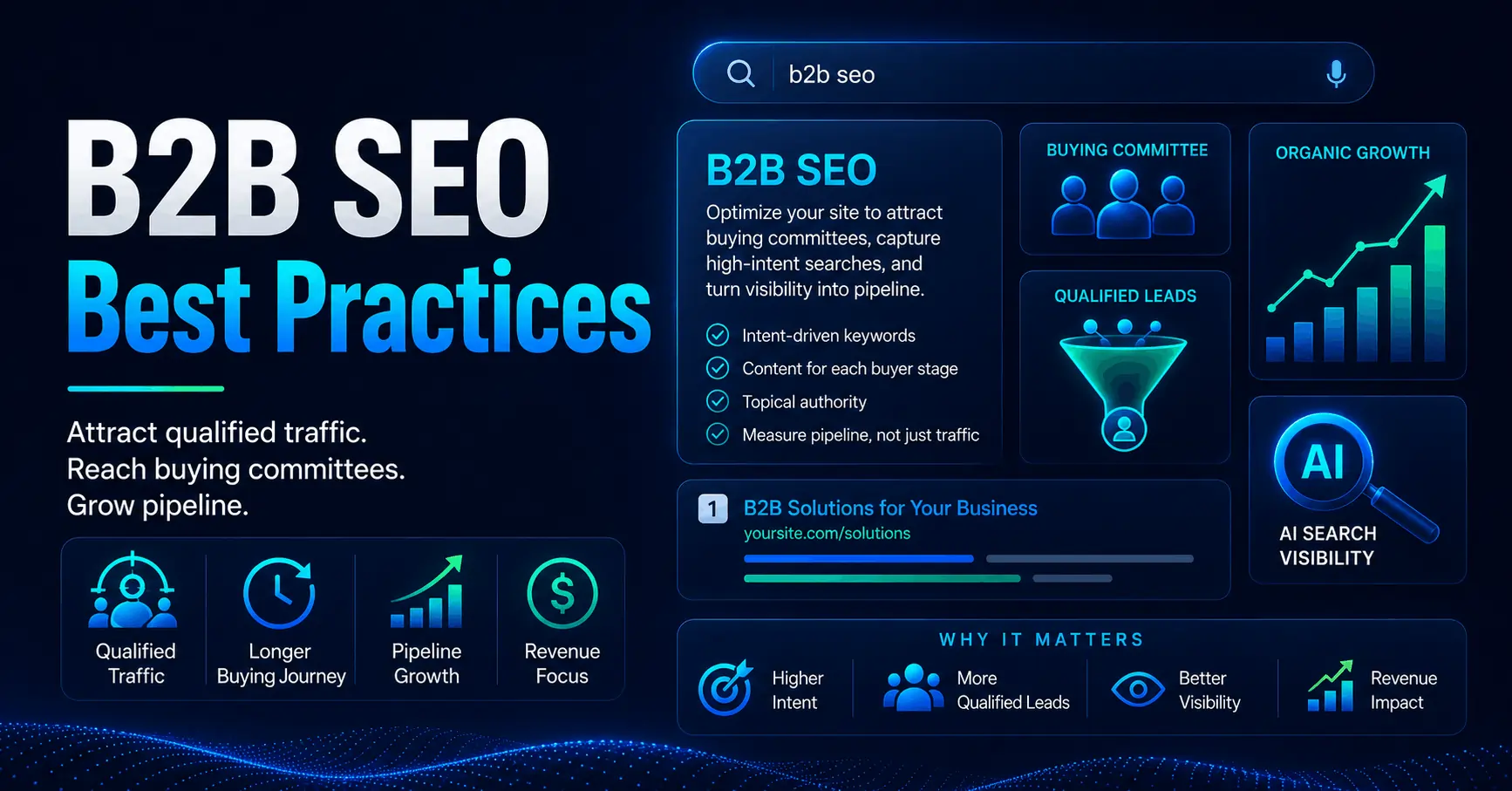
Your rankings are climbing. Your traffic chart looks great. And your head of sales still can’t name a single deal that started with organic search.
That gap is the core failure of most B2B SEO programs. Teams optimize for traffic when the real prize is pipeline, and the two rarely line up. A blog post can rank on page one, pull in thousands of visitors, and send zero qualified leads to sales.
These B2B SEO best practices fix that. Instead of chasing the biggest keywords, you target the ones your buyers type right before they buy. You build content a full buying committee trusts. And you measure results in pipeline, not pageviews.
Nine tactics, each one you can start this quarter.
What Makes B2B SEO Different
The mechanics of ranking are the same as B2C. The strategy is not, and three realities should reshape everything you do.
Search volume is low, but value is high. A term like “enterprise contract management software” might get a rounding error of monthly searches next to a consumer keyword. Yet the few people typing it are often ready to buy, and each account can be worth five or six figures. Volume is the wrong filter for B2B keywords.
The buyer is a committee, not a person. A single purchase pulls in stakeholders who share no job title and search for completely different things. Your content has to satisfy the champion who found you, the finance lead who signs off, and the technical evaluator who vets the fit.
The sales cycle is long. Someone may read your comparison page in January and buy in July. That gap breaks last-click attribution and tempts teams to undervalue SEO. Plan for it rather than fight it.
The through-line: stop optimizing for traffic and start optimizing for qualified demand. Every tactic below serves that shift.
1. Start With Buyer Intent, Not Search Volume
Most keyword tools sort by volume, so most SEO strategies chase the biggest numbers. In B2B, that is backwards.
“Project management software” carries huge volume and huge competition, and most people searching it will never buy an enterprise tool. “Asana vs. Monday for agencies” gets a fraction of the volume, but the person typing it has a shortlist, a budget, and a deadline.
Rank your target keywords by commercial intent first, volume second. The high-intent patterns worth owning:
- Comparison terms: “[competitor] vs. [competitor],” “[category] comparison”
- Alternative terms: “[competitor] alternatives,” “alternatives to [tool]”
- Solution terms: “best [category] software for [industry or use case]”
- Problem terms: the exact phrases buyers use to describe the pain you solve
- Pricing and implementation terms: “[category] pricing,” “how to implement [category]”
Here is a quick exercise. For each keyword, estimate the average deal size of a customer who would search it, then multiply by a rough conversion rate. You will often find a 90-searches-a-month term beats a 9,000-searches-a-month one on expected revenue.
This is the most important of all B2B SEO tips: a page that ranks for a small, boring, high-intent keyword and converts 8% of visitors beats a page that ranks for a giant keyword and converts 0.1%.
2. Map Content to the Whole Buying Committee
B2B purchases are not made by one person, so content built for one persona leaves the deal to stall in a meeting you never see.
Each role Googles something different. The practitioner searches how-to queries. The manager searches “best [tool] for [team].” The economic buyer searches “[category] ROI” or pricing. IT and security search “[category] SOC 2” or “[category] integrations.” One deal, four very different searches.
Audit your content library against every role in the committee, then fill the gaps:
| Stakeholder | What they search | Content that serves them |
|---|---|---|
| End user / practitioner | How-to and task queries | Tutorials, guides, templates |
| Manager / champion | “Best” and comparison queries | Comparison pages, case studies |
| Economic buyer | ROI and pricing queries | ROI calculators, pricing pages |
| IT / security | Integration and compliance queries | Docs, security pages, integration guides |
Where you find a missing asset, such as no security page for the technical evaluator, that gap is both a ranking opportunity and a deal accelerant. When you cover the full committee, you show up at every step of a months-long evaluation instead of just the first one.
3. Build Your Bottom-of-Funnel Pages First
Top-of-funnel blog posts get the traffic and the applause. Bottom-of-funnel pages get the revenue. Most B2B sites are wildly overweight on the first and underbuilt on the second.
Flip the order. Publish the pages that capture buyers who are already comparing options, because they convert far above blog-post averages:
- Comparison pages (“[you] vs. [competitor]”) capture active evaluation. Be fair and specific; buyers trust an honest scorecard more than a rigged one.
- Alternatives pages (“best [competitor] alternatives”) catch people already unhappy with a rival.
- Use-case and solution pages (“ for [industry or role]”) match your offer to a buyer’s exact context and rank for long-tail terms.
- Integration pages, one per tool you connect to, quietly capture a long tail of “[tool] + [your product]” searches.
These pages feel unglamorous to write, and they tend to convert several times better than an awareness article. If you only have budget for five new pages this quarter, make them bottom-of-funnel. Once they earn pipeline, reinvest that credibility upward into awareness content.
4. Organize Content Into Topic Clusters
Publishing one-off articles on scattered keywords rarely builds authority. Google reads each page in relation to the rest of your site, and a pile of disconnected posts signals a dabbler.
Use the pillar-and-cluster model. One comprehensive pillar page covers a broad topic. A set of cluster pages each covers a narrower subtopic in detail. Every cluster page links up to the pillar, and the pillar links down to each cluster. A payroll company might build a pillar on “payroll compliance” surrounded by clusters on state tax rules, contractor classification, and pay-run deadlines.
Clusters also solve a quiet SEO problem: internal linking. When content is organized by topic, relevant internal links become obvious, and link equity flows to the pages you most want to rank. Two habits keep this working:
- Point descriptive anchor text at your money pages. “Enterprise payroll compliance software” tells search engines more than “learn more.”
- When you publish a new page, go back and add links to it from relevant older posts, so it gets discovered faster.
Build clusters around your ideal customer profile, not raw keyword categories. Segment solution pages and case studies by vertical so the CFO in manufacturing and the CFO in healthcare each find proof written for them.
5. Lead With Real Expertise and Original Data
Generic content is easy to publish and easy to ignore. B2B buyers can tell when an article was written by someone who has never worked with the problem, and Google’s helpful-content guidance rewards depth and first-hand experience over recycled definitions.
Show your work. Attribute articles to named authors with real credentials, quote practitioners who have actually done the thing, and replace vague advice with specifics. Compare these two lines:
Weak: “Choose software that integrates with your tools.”
Strong: “Before choosing a customer success platform, confirm it syncs account health scores, renewal dates, product usage, and support tickets with your CRM. If those fields do not sync, your CSMs will still prep renewal calls in spreadsheets.”
The strongest asset you can build is original data your competitors cannot copy: a survey of a few hundred practitioners, an honest look at anonymized product data, or a benchmark from your own customers. Original research earns links and citations that recycled stats never will. Package the findings as a report, pull out the most quotable numbers, and pitch them to writers who cover your space.
A practical source of all of this is your own team. A single 30-minute interview with a sales rep or implementation specialist can improve a landing page, a comparison guide, and a nurture email at once.
6. Match Format and CTA to Search Intent
A ranking page has to satisfy the format the searcher expects and offer the next step that fits their stage.
Before writing, study what already ranks. If the top results for “B2B SEO checklist” are scannable lists, publish a better list, not a 3,000-word essay. If the results are comparison tables, build a sharper table. Meet the intent, then add something the current results lack: a decision framework, original data, or a downloadable template.
Then match the call to action to where the buyer sits. The most common mistake is forcing “Book a demo” onto a reader who is three months from buying.
- Awareness content: soft CTAs. Download a checklist, read a related guide, try a calculator, subscribe.
- Consideration content: evaluation CTAs. Compare plans, view use cases, read a case study.
- Decision content: direct CTAs. Book a demo, request pricing, start a trial, talk to sales.
Place CTAs where they help rather than interrupt. After a section on calculating implementation cost, offer a cost worksheet. After a comparison table, offer a vendor evaluation template. A useful CTA feels like the obvious next move.
7. Fix the Technical Foundation Before Scaling
You can write the best content in your category and still lose if search engines struggle to crawl, render, or trust your site. Technical SEO will not win the deal, but skipping it quietly loses the ranking before you get to compete.
For most B2B teams, a handful of checks cover the risk:
- Crawlability and indexing. Confirm your important pages are actually indexed and that robots.txt, noindex tags, or gated-content setups are not blocking anything they shouldn’t.
- Site architecture. Keep key pages within a few clicks of the homepage and group related content logically.
- Core Web Vitals. Aim for Largest Contentful Paint under 2.5 seconds, Interaction to Next Paint under 200 milliseconds, and Cumulative Layout Shift under 0.1. Test your key landing pages monthly, not just the homepage.
- Structured data. Use Organization schema on the homepage, Article schema on posts, and FAQ schema on guides, and only mark up content that is actually visible on the page.
Technical issues tend to surface during redesigns, migrations, and CMS changes, so run a review before and after any major site change. One warning for teams eyeing programmatic SEO: generating thousands of near-identical location or feature pages can backfire under Google’s quality systems. Scale only when each page offers genuinely distinct value.
8. Optimize for AI Answers, Not Just Blue Links
Your buyers no longer stop at ten blue links. They ask ChatGPT for a vendor shortlist, read Google’s AI Overview above the organic results, and query Perplexity for comparisons, often without clicking anyone’s site. Getting cited in those answers is becoming as valuable as ranking.
This work, sometimes called answer engine optimization (AEO) or generative engine optimization (GEO), runs alongside classic SEO rather than replacing it. Strong fundamentals feed it. The added moves are specific:
- Answer the question directly in the first sentence after each heading, so a model can lift a clean response instead of digging through paragraph nine.
- Keep answer blocks self-contained, roughly 40 to 60 words, and define key terms cleanly.
- Use descriptive headings phrased the way buyers actually ask questions, plus FAQ schema engines can parse.
- Back claims with third-party validation, because AI systems favor sources they can corroborate off your own site. Keep your facts, pricing, and product details consistent everywhere they appear.
You will not control exactly how a model quotes you. You can make your page the easiest, most trustworthy thing to quote, and buyers who arrive from an AI recommendation often show up already shortlisted.
9. Measure Pipeline, Not Rankings
This is the tactic that decides whether everything else gets funded. Report rankings and traffic, and SEO looks like a cost center. Report pipeline, and it looks like growth.
The catch is that organic search usually influences a B2B deal long before it produces a form fill, so last-click reporting misses most of its value. Connect Google Search Console, your analytics platform, and your CRM, then track the fuller story:
- Influenced and sourced pipeline, not just sessions: which deals touched an organic page on the way in?
- Assisted conversions and multi-session paths, since a blog post read in month one often sets up a demo booked in month six.
- Return visits from target accounts and conversion rate by page and keyword intent.
- Revenue attributed to organic across the full, multi-touch journey.
Use multi-touch attribution and self-reported “how did you hear about us” data together, rather than trusting last click alone. Then change what leads your quarterly review: open with pipeline contribution, not a screenshot of rankings. That framing is what keeps SEO funded, because it speaks the language leadership cares about.
Where to Start
Every tactic here points the same direction. B2B SEO works when it serves the real buyer and the real deal, not the vanity metrics that look good on a slide. Target intent over volume, write for the whole buying committee, own the bottom of the funnel, prepare for AI answers, and measure the pipeline you influence.
You do not need to run all nine at once, and you should not try. Sequence the work by speed to pipeline.
Do one thing this week: pull your top ten organic pages and ask a blunt question of each. Is this mapped to real buyer intent and connected to pipeline, or is it just collecting traffic? Every “just traffic” answer is your next project.
Then build one bottom-of-funnel comparison page against your toughest competitor, publish it, and track the opportunities it touches over the next quarter. That single page, measured properly, is how a B2B SEO program earns the right to grow.
Related Articles:
- How to Choose the Best B2B SEO Agency (Buyer’s Guide)
- Best B2B SEO Services: Vet the Agency, Then Yourself
- B2B SEO Trends 2026: What Actually Moves Pipeline
- B2B SEO Specialist: Hire for Pipeline, Not Traffic
- B2B SaaS SEO: Rank, Place, or Skip Every Keyword
- B2B SEO Consultant: How to Hire One Who Moves Pipeline
- B2B SEO Expert: How to Hire One Who Drives Revenue
- B2B SEO Audit: Fix What’s Costing You Pipeline
- SEO for B2B Companies: Diagnose Before You Cut It
- B2B Marketing Agency: How to Choose One (2026 Guide)
- B2B Tech SEO: Your Whole Market Fits on One Sheet
- SEO for B2B Marketing: A Portfolio, Not a Calendar
- B2B SEO Statistics 2026: Where the Sources Disagree
- B2B Local SEO: The Playbook Most Marketers Get Wrong
- B2B Ecommerce SEO: The 2026 Pipeline Playbook
Last Updated on 3 months ago by Alipio Umiten IV
