





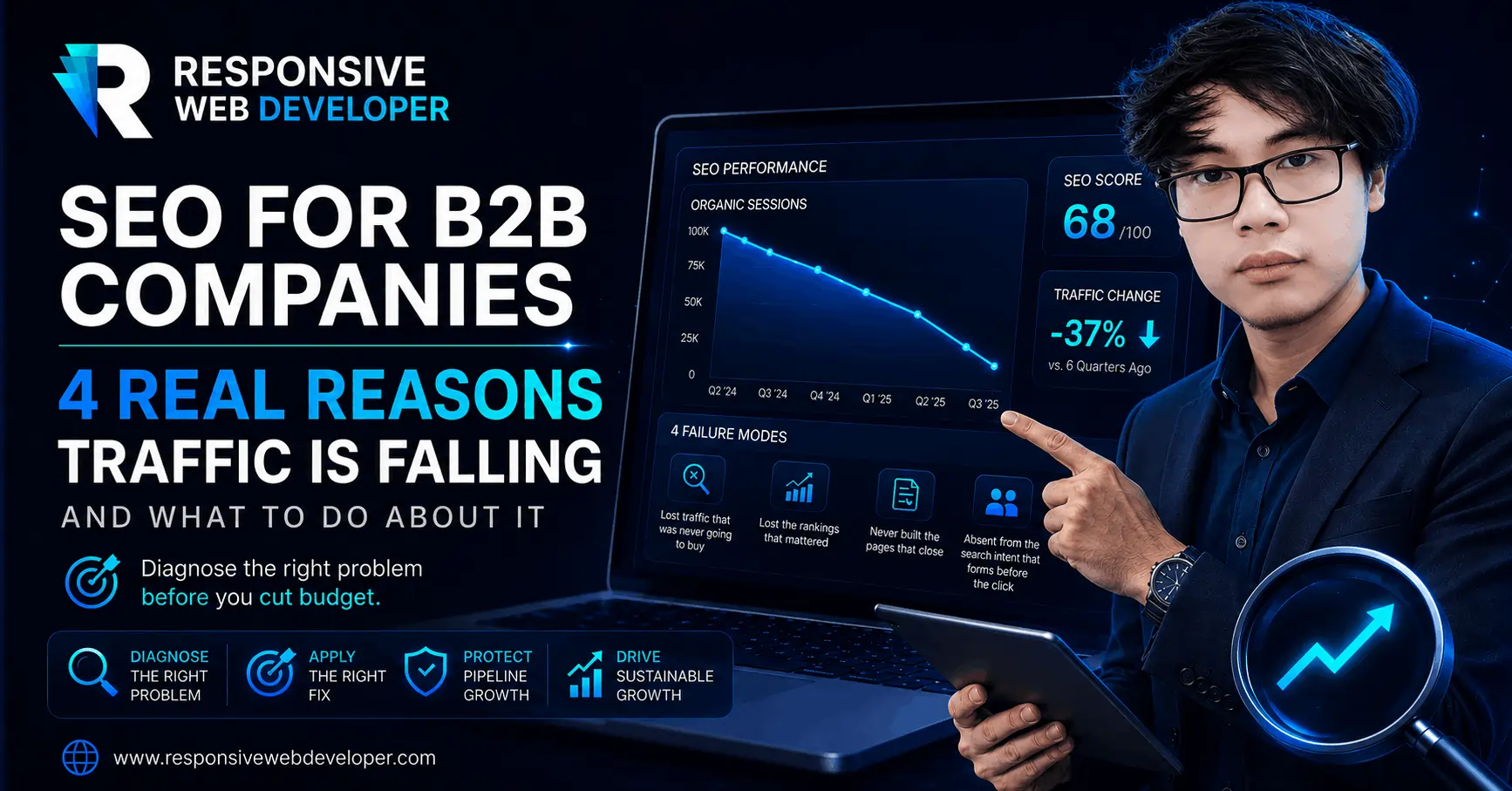
Someone at your company is about to make an expensive decision based on a single chart.
The chart shows organic sessions falling for six straight quarters. The decision it triggers is a budget cut. What nobody checks first is which part of the program actually broke, because SEO for B2B companies now fails in four distinct ways, and three of them produce an identical-looking traffic line.
Cutting the retainer solves exactly one of them. The other three get quietly worse, and the bill arrives about nine months later, when your name stops appearing on buyer shortlists and nobody connects the two events.
So here is the diagnostic first. Four failure modes, the test that identifies each one, and the fix that matches. Then what changed structurally, which metrics survive a CFO conversation, and how to hire help without buying a content quota.
Is SEO dead for B2B software companies?
No. But B2B software sits in one of the hardest-hit categories on the internet, and the aggregate numbers hide that completely.
Graphite’s analysis with Similarweb, covering the top 40,000 US sites, found organic search traffic down 2.5% year over year, reported by Search Engine Land in January 2026. A real decline. Not an extinction event.
Your category is a different story. BrightEdge tracked AI Overview coverage from February 2025 to February 2026 and found B2B technology queries triggering them 82% of the time, up from 36% a year earlier. E-commerce and real estate sit under 6%. Google protects the queries attached to Shopping and ad revenue. Nobody is protecting yours.
So when B2B teams report traffic declines in the 10% to 40% range, they are neither imagining it nor uniquely incompetent.
Here is the fact that reframes the whole panic. Published estimates put informational queries at somewhere between 88% and over 99% of what triggers an AI Overview. The absorption is concentrated almost entirely on definitional and explanatory search. Comparison, alternatives, pricing, and integration queries still send clicks.
Which means “is SEO dead for B2B software companies” is really a question about your page mix. Answer that before you answer anything else.
Four ways SEO for B2B companies actually fails
Most advice on this subject prescribes before it diagnoses. Run these four tests in order and stop at the one that matches your data.
Failure 1: You lost traffic that was never going to buy
Symptom. Blog sessions collapsed. Comparison, pricing, and integration pages held steady. Pipeline is roughly flat.
The test. Segment 24 months of sessions and conversions by page type. Compare the conversion rate of informational blog sessions against commercial pages.
Most teams running this for the first time find a blog converting near zero and comparison pages converting at many multiples of it. If that is your shape, you did not lose revenue. You lost a number that was standing in for revenue and never really earned the job.
The fix is a reporting change, not an SEO change. Replace organic sessions with organic-influenced pipeline on the marketing dashboard, before someone replaces your budget with something else.
Failure 2: You lost the rankings that mattered
Symptom. Impressions and clicks are falling on your commercial pages.
The test. Open Search Console, pull 16 months, and plot impressions against clicks page by page.
- Impressions flat or rising while clicks fall: AI answers are absorbing the query. Publishing more posts will not fix this.
- Impressions and clicks both falling: you lost rankings. Different problem entirely.
- Both falling on a page that used to convert: fix this before anything else on your list.
This is the failure mode nobody wants to find and everybody should hope for, because it responds to ordinary competitive SEO work. Content refresh, internal links, technical cleanup, and beating whoever passed you.
Failure 3: You never built the pages that close
Symptom. Traffic looks fine. Pipeline is thin. Your sales team never sends prospects a link from your own site.
The test. Count your comparison pages against your competitor list. Count integration pages against the top tools in your customers’ stack. Count segment pages against your actual ICP list.
A ratio of 300 blog posts to four comparison pages is common enough to be a genre. It means every buyer who reached the evaluation stage found their answer on somebody else’s website.
The fix is 15 to 25 pages. One per direct competitor, one per incumbent you displace, one per meaningful integration, one per priority segment, and a pricing page with real pricing logic on it. This is the highest-return content most B2B teams have never finished.
Failure 4: You are absent from the shortlist that forms before the click
Symptom. Everything on-site looks healthy and pipeline still shrinks. Sales starts reporting deals where the buyer evaluated three vendors and you were not one of them.
The test. Build a prompt log. Write 30 to 50 prompts a real buyer would type. Run them across ChatGPT, Gemini, Perplexity, and Google’s AI Mode. Record which vendors get named, which URLs get cited, and how you are described on the occasions you appear.
This failure mode produces no on-site symptom at all, which is exactly why it goes undiagnosed for quarters. Your analytics cannot show you a conversation that happened somewhere else and ended without you in it.
The fix lives off your domain, which is why it lands awkwardly in most org charts. More on that below.
The diagnostic table
| If you see this | Run this test | What it means | What fixes it |
|---|---|---|---|
| Blog traffic down, pipeline flat | Conversion rate by page type, 24 months | Nothing broke except your metric | Change the report |
| Impressions and clicks both down on commercial pages | Search Console, 16 months, impressions vs. clicks | You lost rankings | Ordinary competitive SEO |
| Traffic fine, pipeline thin | Count commercial pages vs. competitors, integrations, segments | Architecture gap | Build 15 to 25 commercial pages |
| Everything looks fine, deals vanish early | 50-prompt log across four AI engines | You are off the shortlist | Off-site consensus work |
Note that these have four different owners, four different timelines, and four different costs. Cutting the content budget addresses none of them well.
How AI changes SEO for B2B companies
Three structural shifts, in order of how much they should change your plan.
Ranking first no longer buys you the citation
For years, ranking and getting quoted were nearly the same job. That link has weakened badly.
Ahrefs re-ran its citation overlap analysis across 863,000 keyword SERPs and 4 million AI Overview URLs and found 37.9% of cited URLs appearing in the first ten result blocks, down from roughly 76% in its July 2025 study. BrightEdge, using a different method, puts the overlap closer to 17%.
Two honest caveats. Ahrefs improved its citation parsing between studies, so the two datasets are not a clean like-for-like comparison. And BrightEdge notes that B2B tech actually sits above the average, in the low twenties for top-ten overlap. The exact figure is contested. The direction is not.
The mechanism is query fan-out. Google decomposes one question into many sub-queries and pulls sources that perform across the cluster, a behavior that intensified after Gemini 3 became the default model for AI Overviews globally in late January 2026. Ranking first for one keyword now buys you one ticket in a much larger draw.
The shortlist gets assembled where you have no visibility
Forrester’s State of Business Buying, 2026, published in January and based on responses from nearly 18,000 global business buyers, found 94% used AI during their most recent purchase, up from 89% a year earlier. Twice as many named generative AI or conversational search their most meaningful information source as named any other option, ahead of vendor websites, product experts, and sales reps. More specifically: 55% compared vendors inside AI tools, 54% researched products there, and 47% built an internal business case, all before contacting a vendor.
G2’s Answer Economy report, based on a March 2026 survey of 1,076 B2B software buyers, sharpens it. 51% now start research in an AI chatbot more often than in a search engine, up from 29% eleven months earlier. Chatbots rank as the number one influence on shortlists at 54%, ahead of review sites at 43% and vendor websites at 36%. And 69% chose a different vendor than they originally planned based on chatbot guidance, with one in three buying from a company they had never heard of before running the prompt.
Now set that against 6sense’s long-running finding that 95% of the time, the winning vendor was already on the buyer’s Day One shortlist. Forrester also puts the typical buying decision at 13 internal stakeholders and nine external influencers.
Read those together and the implication is blunt. A 22-person buying network assembles its Day One list inside a system that never touches your site, your forms, or your pixels, and the vendor on that list usually wins. If the model does not name you, there is no click to lose and no loss to see.
Consensus lives on domains you do not own
Models build recommendations from corroboration, which is why so much of this work sits outside your CMS.
G2’s research found review site citations to be the single strongest signal making buyers trust a chatbot’s recommendation, and 85% of buyers said they think more highly of a vendor an AI names in a recommendation. G2’s acquisition of Capterra, Software Advice, and GetApp from Gartner, announced in January 2026, concentrates even more of that citation surface under one roof.
Format matters too. Ahrefs found YouTube to be the most-cited domain in AI Overviews, accounting for roughly 6% of all citations in its dataset, and more than 18% of citations that came from pages ranking nowhere in the top 100. Clean transcripts do real work here.
The practical version: your prompt log tells you which sources the engines actually pull for your category. Go earn placement in those specific sources, in the order they appeared. That log is your new rank tracker.
One page-level change worth making everywhere
Retrieval systems lift passages, not pages. Answer each heading directly in the first 40 to 60 words underneath it, then add the nuance. Use real numbers instead of “significantly.” Name products, standards, and companies rather than saying “leading platforms.”
Vague marketing prose has become expensive in a specific way: a model cannot quote a sentence that does not say anything.
How does SEO impact lead generation for B2B companies?
Directly, less than agencies claim. Indirectly, far more than your attribution model can see.
Three mechanisms do the work.
Capture. Bottom-of-funnel pages catch buyers already building a shortlist. Lowest volume in the program, highest conversion rate by a wide margin.
Validation. Buyers finish most of their evaluation before contacting anyone. Someone who first heard about you on LinkedIn still searches your name, your reviews, and your competitors before booking. Your organic footprint is the due diligence layer. It does not create the lead. It decides whether the lead survives.
Enablement. The comparison page your SEO team wrote is the page an AE pastes into a stalled thread when a prospect asks how you stack up. That page produces revenue nobody will ever credit to organic.
Why the numbers look wrong
A buyer asks an AI assistant for a shortlist, gets four names, reads two comparison pages, fills in no forms, and closes the tab. Two weeks later they search your brand and book a demo. Last-touch records branded organic or direct. Then someone defunds the content that put you on the list.
The traceable slice of this shows up clearly, though. Opollo’s 2026 benchmark, built from GA4 and CRM data across 312 B2B technology firms and counting only qualified enquiries, put AI referral conversion at 14.2% against 2.8% for Google organic. Ahrefs reported internally that 0.5% of its visitors arriving from AI search drove 12.1% of total signups.
Two caveats that most posts skip. Volume is tiny, roughly 1% of total traffic on most B2B sites. And the conversion premium is a selection effect, not magic: those visitors finished their research before clicking. That is the entire point. The click now arrives after the comparison instead of before it.
Meanwhile only about 14% of marketers track AI search as a separate channel at all.
Five metrics that survive a budget meeting
- Citation share of voice. Across a fixed set of 50 buyer prompts, how often does each engine name you versus competitors? Re-run monthly.
- Branded search volume. The most reliable public signal that upper-funnel work is landing. Rising branded impressions while non-branded traffic falls is a healthy pattern, not a contradiction.
- Bottom-funnel page conversion rate, tracked separately from blog traffic.
- Self-reported attribution. Add “How did you hear about us?” as a free-text field on demo forms. Not a dropdown, which only returns the answers you wrote. A text box returns “ChatGPT recommended you.”
- Organic-influenced pipeline in currency, at the opportunity stage rather than the lead stage.
One more worth setting up now: Google launched dedicated Search Generative AI performance reports in Search Console on June 3, 2026, isolating impressions from AI Overviews and AI Mode. Read the fine print before building a dashboard on it. The report shows impressions only, with no clicks, CTR, or query data, it holds no history before May 18, 2026, and the rollout began with a subset of UK-based site owners. The same release added a control letting you block your content from AI features, which Google began honoring on June 17, 2026, and which Google says will not affect standard rankings.
The importance of SEO for B2B, in the language finance uses
Four arguments a traffic chart never made for you.
It compounds while the alternatives decay. Paid stops the day the card stops. A comparison page shipped in March keeps closing deals in November, and its cost per opportunity improves with age.
It covers a committee, not a buyer. Thirteen internal stakeholders search thirteen different things. The champion searches for the best tool in their industry. Finance searches pricing. Security searches your SOC 2 and SSO documentation. The skeptic searches your name plus “problems.” Most B2B sites have one decent page for the first search and nothing for the rest.
It defends the category. If a competitor ranks for “[your brand] alternatives” and you do not, you are funding their pipeline from your marketing budget. That page takes a day to write.
It keeps you in the corpus. Every AI answer is assembled from indexed material. Companies that stop publishing do not merely lose rankings. They exit the source pool that models draw from, and they exit it silently.
What to do in the first 90 days
Days 1 to 30: measure. Build and run the 50-prompt baseline. Add the free-text attribution field. Segment AI referral sources in GA4. Export every URL with 12 months of sessions, conversions, and referring domains.
Days 31 to 60: build the capture layer. Ship the comparison, alternatives, pricing, and integration pages. Prune hard: anything with under 50 sessions, zero conversions, and zero backlinks over 12 months is a redirect or a delete. Expect to remove 30% to 60% of a mature B2B blog. Then rewrite your top 20 surviving pages to answer their headings in the first 60 words.
Keep a handful of category glossary pages even if their traffic is gone. They do entity work now, associating your brand with the category. Just stop measuring them by sessions and stop producing more of them.
Days 61 to 90: earn consensus. Launch a review-generation push with customer success. Pitch inclusion in the three roundups your prompt log surfaced. Publish one original data asset built from your own numbers, since aggregated benchmarks from your customer base are the one thing a model cannot synthesize from your competitors’ pages.
Re-run the prompt log on day 90. That comparison is your real before-and-after.
How to choose the best SEO company for B2B
Skip the ranked lists. Every “best SEO company for B2B” roundup is either an agency ranking itself or an affiliate page. The useful question is whether a firm can do the two jobs that now exist: win commercial rankings and earn citations inside AI answers, while proving both against your CRM.
Six questions, and listen for how fast the answer comes.
- Show me your AI citation share of voice for a current client, before and after. Most agencies cannot produce this, and that alone is diagnostic.
- Which of our existing pages would you delete, and why?
- What percentage of the content you would produce for us is bottom of funnel? Under 50% means they are still selling a traffic program.
- Which of our competitors do AI engines currently recommend over us? A good agency will have run the prompts before the call.
- Who writes the content, and what is your process for extracting expertise from our team?
- What does month three look like if this is failing?
Green flags. They ask about ACV, sales cycle, and buying committee makeup before they mention keywords. They report on pipeline. They have opinions about your comparison pages within the first month. They can name the review sites and communities your buyers use without being told. They tell you what to delete.
Red flags. Guaranteed rankings. Deliverables priced in blog posts per month. No subject-matter-expert interview process, which in B2B produces content written by someone who has never used the product, because it was. Reporting that stops at sessions and domain authority. A deck full of e-commerce case studies. AI visibility sold as an upsell rather than as part of one organic program.
On build versus buy. Below roughly $20K ACV with a self-serve motion, an agency or fractional lead can carry most of it. Above that, keep strategy and SME access in-house and buy execution capacity. Nobody outside your company can interview your customers as well as you can. Whatever you spend, start with a paid audit or a defined 90-day pilot rather than a twelve-month retainer.
The takeaway
Stop reading your traffic chart as a health chart.
SEO for B2B companies did not die. It got narrower and more valuable at the same time, and the measurement never caught up. Fewer people will land on your site. A much higher share of the ones who do will be committee members carrying a budget, a shortlist, and a deadline.
Do two things this week. Pull the impressions-versus-clicks comparison in Search Console to find out which decline you are actually dealing with. Then write ten buyer prompts, run them through three AI assistants, and log who gets named.
Both take under an hour. Together they will tell you more about your search position than your next quarterly report will.
Frequently Asked Questions About SEO for B2B Companies
Is SEO dead for B2B software companies in 2025 or 2026?
No. Informational traffic is declining permanently as AI answers absorb definitional queries, but commercial-intent pages still earn clicks and still convert. The channel narrowed. It did not close.
How long does B2B SEO take to produce pipeline?
Bottom-funnel pages targeting existing demand can convert within weeks of indexing, because the demand already exists. Building authority for competitive terms takes considerably longer. Budget for twelve months regardless.
What is the difference between SEO and GEO or AEO?
Generative Engine Optimization and Answer Engine Optimization describe earning citations inside AI answers rather than ranked links. Most of the underlying work is good SEO. The genuinely new parts are citation tracking, third-party source presence, and structuring content for passage-level extraction.
Should B2B companies still publish blog posts?
Fewer of them, with a different job. Blog content should support commercial pages, publish original data, and demonstrate expertise a model cannot synthesize elsewhere. Generic explainers no longer clear their production cost.
Does AI-generated content hurt B2B SEO?
The origin matters less than the result. Content adding nothing beyond what already ranks performs badly whether a human or a model wrote it. Original research and practitioner insight perform well for the same reason.
Related Articles:
- Best B2B SEO Services: Vet the Agency, Then Yourself
- B2B SEO Best Practices That Drive Pipeline
- B2B SEO Solutions: Fix the Right Problem First
- B2B SaaS SEO: Rank, Place, or Skip Every Keyword
- B2B SEO Strategy: A Coverage Grid That Builds Pipeline
- B2B SEO Trends 2026: What Actually Moves Pipeline
- B2B SEO Specialist: Hire for Pipeline, Not Traffic
- B2B SEO Consultant: How to Hire One Who Moves Pipeline
- B2B SEO Expert: How to Hire One Who Drives Revenue
- B2B Tech SEO: Your Whole Market Fits on One Sheet
- SEO for B2B Marketing: A Portfolio, Not a Calendar
- B2B SEO Statistics 2026: Where the Sources Disagree
- B2B Local SEO: The Playbook Most Marketers Get Wrong
- B2B Enterprise SEO: The 3 Ceilings That Cap Growth
- B2B SEO Keywords: How to Choose Ones That Convert
- B2B Ecommerce SEO: The 2026 Pipeline Playbook
Last Updated on 2 months ago by Alipio Umiten IV
