





You can hire the best B2B SEO services on the market and still get nothing back.
That happens more often than agencies admit, and it rarely has anything to do with the algorithm. The engagement dies because nobody on your side could free up four hours a month from a solutions engineer. Or because the demo form has no source field. Or because legal quietly stripped the opinion out of every draft until the content read like a brochure and no buyer forwarded a single page of it.
Meanwhile you are signing off on a six-figure annual line item, in a channel whose payoff lands two quarters after your reporting cycle closes. You need to be right the first time.
So this guide gives you both halves of the decision. How to vet an agency: the questions, the pricing, the phrases that mean the opposite of what they sound like. And how to vet yourself: the six checks to run before you take another sales call, and the kill criteria to write down while everyone is still optimistic.
What Are B2B SEO Services?
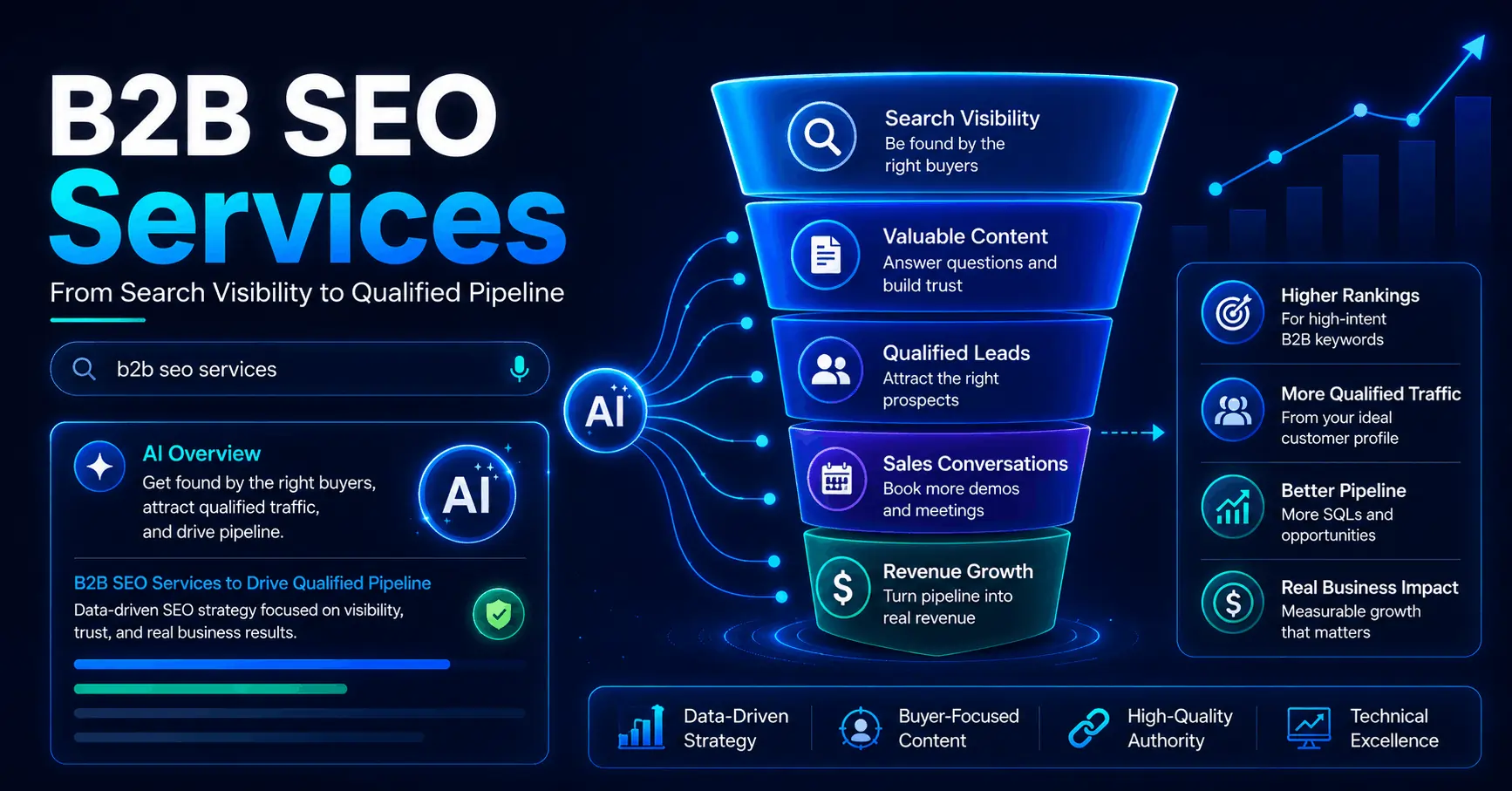
B2B SEO services help business-to-business companies improve their search visibility, attract qualified decision-makers, and generate sales opportunities through organic search. Unlike traditional SEO, B2B SEO focuses on high-intent, niche keywords, complex buying journeys, multiple stakeholders, and longer sales cycles. It typically includes technical optimization, expert content creation, authority building, and lead-to-revenue tracking to drive Sales Qualified Leads—not just website traffic.
Why B2B SEO engagements actually fail
Three structural facts about B2B search break the standard playbook. Every decent guide lists them. Almost none tell you what each one demands from your side of the table, which is where the failures start.
The volume is tiny and the value is enormous
Your best commercial keyword might do 70 searches a month. That is not a research failure. That is B2B. A term with 70 searches and a $40,000 average contract value beats a term with 70,000 searches and an audience of students, job seekers, and your competitors’ interns.
What it demands from you: your average contract value, your demo-to-close rate, and your site’s visitor-to-demo rate. Without those three numbers, an agency cannot rank keywords by revenue per click. It can only rank them by volume, which is the exact mistake you hired it to avoid.
You rank for a committee, not a person
The engineer searches for the integration. The security reviewer searches your name plus SOC 2. Finance searches your name plus a competitor’s plus “pricing.” The champion searches for the use case, in the words they will use to defend the purchase to their boss.
Miss the security page and you do not lose a ranking. You lose the deal in week fourteen, and nobody files that loss under SEO.
What it demands from you: access to recorded sales calls, not summaries of them. Your positioning doc and your buyers’ actual language are two different documents, and only the recordings hold the difference.
The sales cycle outlives the reporting cycle
Someone reads your comparison page in March, disappears, comes back through a branded search in August, and books a demo. Last-touch attribution files that under Direct. Organic gets no credit, the budget gets cut, and pipeline dies eighteen months later for reasons nobody connects.
What it demands from you: a CRM with a source field somebody maintains, plus a free-text “how did you first hear about us?” question on the demo form. That field costs an afternoon and outperforms most attribution software. If it is not live before the retainer starts, you have already decided not to measure this.
Half the scorecard: vetting the agency
Eight questions, and what a real answer sounds like
| Ask this | Strong answer | Red flag |
|---|---|---|
| Which keyword on our list would you delete, and what would we lose by deleting it? | Names a specific high-volume term, explains who it attracts, concedes the tradeoff | Keeps everything, because everything is billable |
| Show me a client where traffic dropped and revenue grew. | A pruning or consolidation story with numbers attached | Confusion, then a traffic chart |
| Who writes the content, and how many hours a month do you need from our experts? | A number, a named interview process, a cadence | “Our in-house writing team handles it” |
| Open last quarter’s link placements in front of me. | Actual URLs, on screen, right now | “We have relationships with sites in your niche” |
| It is month five and nothing has moved. What are your first three moves? | A rehearsed diagnostic sequence, because this happens to everyone | A promise that it will not happen |
| What do you need from us, and what breaks if we do not deliver it? | SME hours, dev time, CMS access, sales feedback, all named | “Nothing, we handle everything” |
| How do you baseline our visibility in AI answers? | Named tools, a current baseline, a plan for when we are absent | “That is not really a thing yet” |
| When did you last tell a prospect not to hire you? | An immediate example and a reason | Never. Nobody has ever been a bad fit |
Score each answer out of three. Twenty-four is the ceiling. Below sixteen, you are looking at a content vendor with a nicer deck.
The decoder ring
Sales calls run on phrases that sound like answers. Here is the translation.
| What they say | What it usually means |
|---|---|
| “We’re data-driven.” | Everyone is. Ask which data, from which system, and who reads it. |
| “We’ll know after discovery.” (asked which pages they would build) | They have not looked at your competitors’ rankings, which takes about twenty minutes. |
| “We have relationships with sites in your niche.” | They buy links. You inherit the cleanup. |
| “Our in-house writing team handles it.” | Nobody is going to interview your solutions engineer. |
| “We’ll get you onto page one.” | They will rank you for your own brand name and call it a win. |
| “SEO takes twelve months.” (with no interim milestones) | They want twelve months of invoices before the first checkpoint. |
| “We’ll handle everything.” | They plan to publish without you, and it will read that way. |
Red flags that should end the call
- Guaranteed rankings, or a guaranteed number of leads
- A proposal priced in deliverable counts (posts, links, hours) instead of outcomes
- No technical audit before the proposal
- No questions about your ACV, close rate, or sales cycle on the first call
- A twelve-month lock-in with no performance checkpoint at ninety days
- Content priced per word
- A sample report that opens with rankings and Domain Authority
- Case studies made entirely of traffic charts
- The people pitching you are not the people who will run the account
The half nobody publishes: vetting yourself
Now the uncomfortable part. Run these six checks before you take another sales call. Every one is visible today, and none can be fixed by hiring a better agency.
1. One named owner on your payroll. Not a committee, not “marketing.” A person whose name goes on the outcome and who can approve a draft without three rounds of review. If you cannot name that person in five seconds, the engagement will drift and the agency will take the blame for the drift.
2. SME hours you can actually put on a calendar. Two to four hours a month from someone who does the job for a living: a solutions engineer, your best AE, a customer success lead. This is the tax on real B2B content, and there is no way to pay it in cash instead. Book the recurring slot before you sign, not after.
3. A CRM source field somebody maintains. Covered above, and worth repeating. It is the difference between a program you can defend in a board meeting and one you can only describe.
4. Dev capacity, in hours, with a name attached. The technical audit will produce a ticket queue: rendering fixes, canonicals, internal links, page templates. If engineering’s backlog runs fourteen weeks deep and SEO tickets go to the bottom, the audit is a PDF. Ask your CTO for the hours before you commit, not after the findings land.
5. Permission to have an opinion. Test this before you sign. Take one draft with a real point of view, something a competitor would object to, and push it through your actual approval process. If it comes back beige, you will publish beige for twelve months. Beige does not get linked to, cited by an AI assistant, or forwarded by a sales rep to a live deal.
6. Twelve months of runway for the line item. Not “we’ll see how Q1 goes.” SEO compounds. It does not rescue. If a soft quarter kills the retainer in month five, you paid for the setup and collected none of the return.
Score both columns
| Requirement | Their side | Your side |
|---|---|---|
| Understands the buying committee | Can name your six searchers | Will hand over recorded sales calls |
| Prioritizes by revenue, not volume | Shows you the model | Has supplied ACV and close rate |
| Content built on real expertise | Interviews your team | Has booked the SME hours |
| Technical work gets shipped | Writes dev-ready tickets | Has committed dev hours |
| Organic is traceable to pipeline | Wires it into the CRM | Maintains the source field |
| The work has a point of view | Writes it | Will approve it |
Score each row out of five, both columns. If the agency scores 26 and you score 12, the engagement will fail, and the post-mortem will name the wrong culprit.
What B2B SEO services cost
Ranges move year to year and by market. Anchor these against a current benchmark before you budget:
| Engagement type | Typical monthly | Best for |
|---|---|---|
| Independent consultant (strategy only) | $2,000 to $6,000 | You have writers and developers and need someone to aim them |
| Boutique B2B specialist agency | $6,000 to $15,000 | Strategy plus execution in one focused market |
| Full-service or enterprise agency | $15,000 to $50,000+ | Multiple products, regions, or languages |
| One-off technical audit | $5,000 to $25,000 (project) | A migration, a replatform, or a diagnosis |
The only calculation that matters
Take the retainer, multiply by twelve, and work backwards.
Say a $10,000 monthly retainer, so $120,000 a year. Your average contract value is $45,000 and you close 25% of demos. Break-even sits at roughly 2.7 closed deals, which means about eleven demo requests from non-brand organic search across the entire year.
Eleven. Roughly one a month.
Write that number on the first page of the contract and stop comparing hourly rates. And if your CFO will be in the room, run the same math against gross profit rather than revenue. The required deal count goes up, and it is better to discover that now than in the QBR.
Two rules hold at every tier.
Cheap SEO is the most expensive kind. A bargain retainer buys a template audit and outsourced posts. Cleaning that up costs more than doing it properly would have.
Expensive does not mean specialized. Large agencies charge enterprise rates and often run the same ecommerce playbook they use for everyone else. The premium worth paying is for people who understand long cycles, buying committees, and revenue attribution. The rest is overhead.
The timeline, and what you owe at each stage
| Window | What they ship | What you owe |
|---|---|---|
| Month 1 | Technical audit, keyword-to-pipeline map, CRM and analytics plumbing, fast indexation fixes | ACV and close rate, CRM access, dev hours, recorded sales calls |
| Months 2 to 3 | Bottom-funnel pages go live: comparisons, alternatives, integrations, use cases | SME interviews on the calendar, drafts approved inside a week |
| Months 4 to 6 | Mid-tail commercial terms climb. First demos traceable to non-brand organic | Lead-quality feedback from sales, delivered honestly |
| Months 6 to 12 | Clusters mature, links compound, cost per opportunity drops below paid | Original data. Somebody has to pull it and somebody has to approve it |
| Month 12 onward | The asset pays rent. Pages from month three keep producing pipeline | Nothing new. That is the point |
The leading indicator to watch in the first quarter is not traffic. It is how many commercial-intent pages now sit in the top ten, and whether any of them started a conversation.
Anyone promising results in sixty days is either lying or planning to rank you for your own brand name.
Kill criteria: the clause nobody writes
Agree, in writing, before you sign, on what failure looks like. Do it while both sides are optimistic and honest, because neither of you will be either in month seven.
Day 90. Technical fixes shipped and verified. Tracking live in the CRM. Keyword-to-pipeline map agreed. First bottom-funnel pages published and indexed. Not rankings. Rankings at ninety days are noise.
Day 180. Money keywords appearing in the top twenty. Non-brand impressions climbing. At least one demo traceable to a non-brand organic landing page.
Day 270. Pipeline you can attach account names to. If they cannot hand you company names, they cannot prove anything.
Then write the consequence: a diagnostic sprint, a scope reset, or an exit with thirty days’ notice and full ownership of everything produced.
Then write your half. If you missed your SME hours, skipped the dev tickets, or sat on drafts for three weeks, you do not get to invoke the clause. That is what makes it a contract instead of a threat.
Getting cited when your buyer asks an AI first
Your buyers now build vendor shortlists inside AI assistants before they ever reach your website. They ask for the best tools in the category, get five names, and start the evaluation from there. If you are not one of the five, you were never in the deal.
Nobody has fully solved this, and anyone selling guaranteed AI Overview placement is guessing with confidence. What credible providers actually do:
- Publish things worth quoting. Original benchmarks, survey data, anonymized product data. Models cite what exists nowhere else.
- Make claims extractable. Clear definitions, the answer in the first sentence, comparison tables, structured lists. Four hundred words of wind-up gets skipped.
- Build third-party corroboration. G2, Capterra, Reddit threads, podcasts, analyst mentions. Your own website is one vote among many.
- Fix entity consistency. Same product name, same category description, same claims everywhere you appear.
- Measure it. Segment AI referrals in analytics, watch branded search volume, and read the self-reported attribution field.
Your side of the table: original data means somebody runs a query against your product database and gets the results cleared for publication. If that will take four months and a legal review, say so on the first call and pick a different authority strategy.
Ask any provider: “How do you baseline our AI visibility, and what do you do when we are absent from the answer?” If the reply centers on keywords, their playbook stopped updating in 2022.
Agency, consultant, or in-house?
- Freelance consultant. Right when you already have writers and engineers and need a senior person to aim them. Cheapest option, and it fails immediately if you have no execution capacity.
- Specialist B2B agency. Right when you need strategy, content, technical work, and links without hiring four people. The common fit between roughly $5M and $50M in revenue.
- In-house team. Best long-term economics, slowest to start. It works only if you can hire someone who understands the product well enough to argue with your sales team.
- Hybrid. One in-house owner holding the strategy, agency or freelance execution underneath. Most companies land here once organic becomes a real channel.
The failure mode is hiring an agency to compensate for having nobody internally accountable. That is the one thing no agency can sell you.
What “top rated SEO for B2B” is actually worth
Directory badges and award lists build a shortlist. They do not make a decision. An agency can become the top rated SEO for B2B on a review site by servicing two hundred small accounts competently, or simply by chasing reviews harder than anyone else. Neither fact tells you whether it can move a $250,000 enterprise deal through a nine-month cycle and a legal review.
Better signals, in order:
- Case study forensics. Take the client named in the case study, pull their organic curve in Ahrefs or Semrush, and check whether the shape matches the story. Four minutes of work eliminates half your shortlist.
- Revenue inside the case study. “Traffic up 340%” is a number the agency chose. “$2.1M in sourced pipeline over fourteen months” is a number the client cared about.
- A reference from a client who left. Ask for one. How an agency describes a relationship that ended tells you how it will describe yours.
- Reverse-engineering. Search your own bottom-funnel terms: “[competitor] alternatives,” “[category] software for [your industry].” Whoever’s clients own those results is doing the work that matters. Find out who they hired.
The takeaway
The best B2B SEO services can only convert the inputs you hand them. An excellent agency with no SME access, no dev hours, and no source field in the CRM produces exactly what a mediocre one would: pages, rankings, and a quarterly deck full of green arrows that nobody in the pipeline meeting recognizes.
So score both columns. Ask the eight questions, run the decoder ring, then run the six checks on yourself. Write the kill criteria while everyone still likes each other.
Before your next sales call, write down three things: your average contract value, your demo-to-close rate, and the name of the person on your payroll who will own the outcome.
If the third one is blank, cancel the call. You are not ready to buy yet, and no agency on any list is going to fix that for you.
Frequently Asked Questions About B2B SEO Services
How much do B2B SEO services cost?
Most serious programs run between roughly $6,000 and $40,000 a month depending on scope, with consultants below that range and enterprise pods above it. Judge the number against your average contract value, never against another agency’s quote.
How long does B2B SEO take to work?
Leading indicators around month three, first traceable demos between months four and six, and pipeline you can defend in a board meeting somewhere past month nine. New domains and crowded categories stretch every window.
What makes an agency the top rated SEO for B2B?
Not the badge. A more useful definition: it can hand you a named list of accounts that organic search sourced, its average client tenure is measured in years, and it will let you call a reference you choose rather than one it prepped.
Should we hire an agency or build in-house?
Agencies win on speed, breadth, and pattern recognition across dozens of accounts. In-house wins on product depth and long-term cost. Most companies end up hybrid: one internal owner, external execution.
Is B2B SEO still worth it now that buyers use AI assistants?
Yes, though the target moved. Definitional content that an assistant can summarize will keep losing clicks. Comparison pages, pricing, integrations, and proprietary data still earn clicks, and they are exactly what assistants cite.
Can we skip the subject matter expert time?
No. You can pay more, hire a better agency, and extend the contract. None of it substitutes for two to four hours a month from someone who does the job. That is the tax, and refusing to pay it is the single most common reason these engagements fail.
Related Articles:
- B2B SEO Best Practices That Drive Pipeline
- B2B SEO Solutions: Fix the Right Problem First
- B2B SaaS SEO: Rank, Place, or Skip Every Keyword
- B2B SEO Trends 2026: What Actually Moves Pipeline
- B2B SEO Specialist: Hire for Pipeline, Not Traffic
- B2B SEO Consultant: How to Hire One Who Moves Pipeline
- SEO for B2B Companies: Diagnose Before You Cut It
- B2B Tech SEO: Your Whole Market Fits on One Sheet
- SEO for B2B Marketing: A Portfolio, Not a Calendar
- B2B SEO Statistics 2026: Where the Sources Disagree
- B2B Local SEO: The Playbook Most Marketers Get Wrong
- B2B SEO Keywords: How to Choose Ones That Convert
- Best SEO Platform for B2B: A 2026 Buyer’s Guide
Last Updated on 3 weeks ago by Alipio Umiten IV