





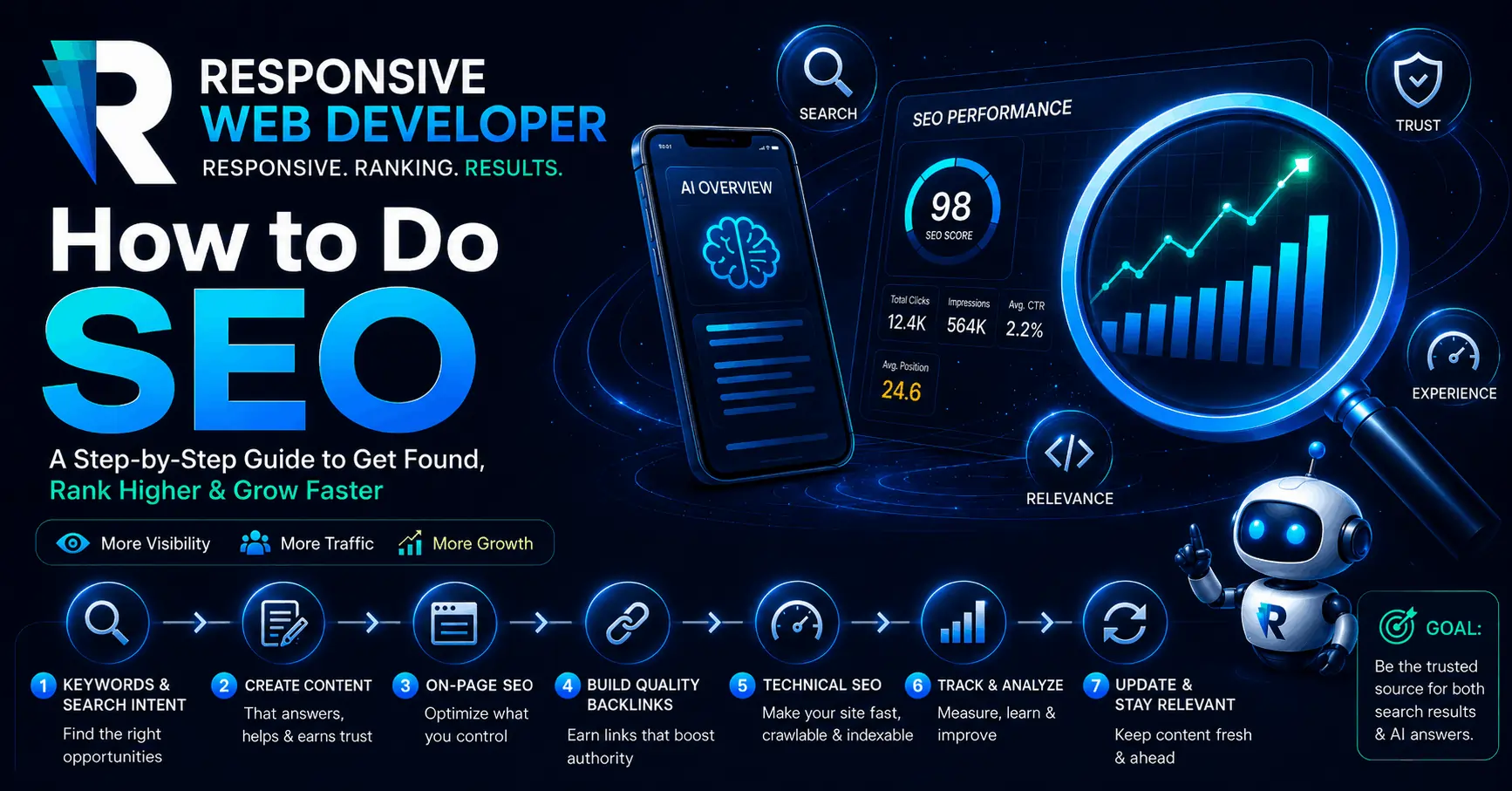
How to do SEO starts with following the right steps in the right order, not chasing every SEO tactic you come across.
Beginners often jump between backlinks, meta tags, site speed, content clusters, and schema markup because everything sounds important. That approach creates confusion, wastes time, and makes SEO feel harder than it needs to be.
A better approach follows a simple process. Find the keywords your audience actually searches for. Understand what they want when they search. Create a page that answers their needs better than competing results. Build authority so Google has a reason to trust your site. Then track your performance, learn from the data, and improve what already works.
In this guide, you will learn how to do SEO in five practical steps with real examples you can apply to your own website. By the end, you will have a clear SEO process you can start using this week instead of spending another month jumping between random tactics.
What SEO Actually Is (and What It Is Not)
SEO means making your pages show up when people search for what you offer. That is the whole idea. Everything else is mechanics.
Google ranks pages by weighing two big questions. First, relevance: does this page answer the query? Second, authority: do other trustworthy sites vouch for it? Nearly every SEO task you will ever do feeds one of those two questions. Keyword research and content improve relevance. Backlinks and reputation build authority.
SEO is not about tricking an algorithm with loophole tactics like buying links or stuffing keywords into white text. The five steps below are the durable version. They worked ten years ago, and they will keep working because they line up with what Google wants: satisfied searchers.
Step 1: Find Out What People Actually Search For
This is keyword research, and it is where most beginners skip ahead and pay for it later. Writing a brilliant page about a topic nobody searches gets you zero visitors.
The goal is simple: collect the exact phrases your future customers type into Google, then pick the ones you can realistically win.
How to build your first keyword list
Say you run a plumbing company in Austin. Here is how the first pass looks:
- Start with seed terms. Write down the obvious ones: “plumber Austin,” “water heater repair,” “drain cleaning.”
- Expand with free clues. Type each seed into Google and watch autocomplete. Scroll to the “People also ask” box. You will find phrases like “water heater repair cost Austin” and “why is my water heater leaking from the bottom.” These are real queries from real people.
- Check volume and difficulty. Plug your list into a keyword tool. Google Keyword Planner is free with a Google Ads account. Ahrefs and Semrush cost money but show you exactly how hard each term is to rank for.
- Prioritize the specific stuff first. “Plumber Austin” is brutally competitive. “Tankless water heater installation Austin” gets fewer searches, but the people typing it know what they want, and a new site has a real shot at page one.
That last point trips people up. Beginners chase the biggest numbers. Smart beginners chase the phrases where they can actually compete, then work upward as their site earns authority. Ten visitors who want a tankless install quote beat a thousand impressions you never rank for.
Choose keywords you can actually win
The same logic works for online stores. Say you sell homemade hot sauce. “Hot sauce” is a war you will lose for years. But “ghost pepper hot sauce gift set” or “small batch habanero sauce” are winnable, and the people searching them have their wallets out.
One more filter before you commit to a keyword: sanity-check it against your business. A query only matters if the searcher could plausibly become your customer. “Water heater repair cost” brings the plumber buyers. “Water heater parts diagram” brings DIYers who will never call. Both get searched. Only one pays.
Step 2: Match the Search Intent
Every query has a job behind it. Search intent is that job, and Google is ruthless about rewarding pages that do it.
Four types cover almost everything:
- Informational: the searcher wants to learn. “Why is my water heater leaking.”
- Commercial investigation: they are comparing options. “Best tankless water heaters.”
- Transactional: they are ready to act. “Water heater installation quote Austin.”
- Navigational: they want a specific site. “Austin Water login.”
You do not have to guess which type a query is. Google it and look at what already ranks. If the first page for “water heater repair cost” is nine cost guides and one calculator, Google has told you the answer: write a cost guide. If you publish a sales page for that query instead, you will lose no matter how good it is.
This is the cheapest competitive intelligence you will ever get. The top ten results tell you the format, the depth, and the angle Google wants. Give it that, then make yours better.
The hot sauce store runs the same play. “Best hot sauce for wings” returns listicles, so the store pitches its sauces to the people writing those listicles and publishes its own wing-sauce ranking. “Buy ghost pepper sauce” returns product pages, so that is what it builds. Same store, two different page types, because the queries carry two different intents.
Step 3: Build a Page That Deserves to Rank
On-page SEO is where you turn a keyword and an intent match into an actual page. Four elements do most of the work.
Write a title tag that earns the click
The title tag is the blue link in search results. It is the strongest on-page ranking signal you control directly, and it doubles as your ad copy.
Weak: “Home | Austin Plumbing Pros LLC”
Strong: “Water Heater Repair in Austin, TX | Same-Day Service”
Keep it under about 60 characters so it does not get cut off, put the keyword near the front, and give the searcher a reason to pick you.
Write a meta description that closes the sale
The meta description is the gray text under the title. It does not directly affect rankings, but a good one lifts your click-through rate, and clicks are the whole point.
Example: “We repair and replace water heaters across Austin. Upfront pricing, licensed techs, same-day appointments. Call for a free estimate.”
Specific beats clever every time.
Answer the query completely
This is where content quality lives. Google’s quality rater guidelines use a framework called E-E-A-T: experience, expertise, authoritativeness, and trust. Translated into plain English, Google wants pages written by people who clearly know the subject, on sites that feel credible.
For the Austin plumber, that means real prices instead of “call for pricing,” photos of actual jobs, a named author with credentials, and specifics only a working plumber would know, like which water heater brands hold up in Austin’s hard water. Any writer can produce generic filler. Experience is the thing competitors and AI tools struggle to fake, so pour it on.
Structure helps too. Use clear H2 and H3 headings, keep paragraphs short, and answer the main question in the first screen of the page. Searchers skim. If they bounce back to Google in five seconds, rankings follow them down.
Add internal links
Internal links connect your pages to each other. They help Google find your content, spread authority from your stronger pages to your weaker ones, and keep visitors moving through your site.
The plumber’s water heater repair page should link to the cost guide and the installation page using descriptive anchor text like “water heater installation in Austin,” not “click here.” It takes minutes and compounds over time.
Step 4: Earn Trust and Cover the Technical Basics
You can nail everything above and still rank nowhere if Google does not trust your site. Two buckets matter here: backlinks and basic technical health.
Backlinks, without the sleaze
A backlink is another website linking to yours. Google uses links as one signal of a page’s authority and relevance, and strong backlink profiles are closely associated with higher rankings. In Backlinko’s analysis of 11.8 million Google search results, the #1 result had an average of 3.8 times more backlinks than pages ranking in positions #2 through #10.
Beginners do not need hundreds of links. They need a few real ones:
- Local directories and your chamber of commerce, if you run a local business.
- Suppliers, partners, and manufacturers who list where their products are sold or serviced.
- Local press and blogs, earned by doing something worth covering.
- Genuinely useful resources, like an original cost survey, that other sites reference on their own.
Never buy links from marketplaces or spam networks. It violates Google’s guidelines, and the penalty costs more than the links were ever worth.
Technical SEO, the beginner minimum
Technical SEO sounds intimidating, but the beginner checklist is short:
- Your site works well on a phone.
- It loads over HTTPS.
- Pages load in a few seconds. Test yours with Google’s PageSpeed Insights.
- Google can actually find your pages. Create a free Google Search Console account, submit your sitemap, and check that your key pages show as indexed.
If those four are true, you have covered most of what technical SEO demands at this stage. Fancy optimizations can wait until you have traffic worth optimizing.
Step 5: Measure, Learn, and Iterate
Doing SEO without measurement is guessing with extra steps. Google Search Console is your dashboard, and it is free.
The Performance report shows the queries your site appears for, how many people saw you (impressions), and how many clicked. Check it every couple of weeks and look for two things.
First, pages sitting in positions 8 through 20. They are close. A better title tag, a stronger intro, or a few added sections often pushes them onto page one, where the clicks live. Second, queries with lots of impressions and a low click-through rate. That is a title tag problem, not a rankings problem, and it is the cheapest traffic you will ever win.
Then iterate. Update the page, watch what happens over the next few weeks, and repeat. SEO is a loop, not a launch.
The Tools You Actually Need
You can learn SEO basics and execute all five steps with three free tools:
- Google Search Console: crawling, indexing, queries, impressions, clicks. Non-negotiable.
- Google Keyword Planner: search volume straight from Google, free with an Ads account you never have to fund.
- Google PageSpeed Insights: tells you if your pages load slowly and what to fix.
Paid tools like Ahrefs and Semrush add real value once you are publishing regularly: precise difficulty scores, competitor keyword gaps, backlink tracking. But they are accelerators, not prerequisites. Plenty of sites reach thousands of monthly visitors on free tools alone. Spend your first months building pages, not building a software budget.
Common Beginner Mistakes to Skip
A short list of the traps that waste the most time:
- Targeting one keyword per site instead of one per page. Each page earns its own rankings. Your homepage cannot rank for everything, so spread keywords across dedicated pages.
- Publishing and abandoning. Pages decay. Competitors update, prices change, links rot. Revisit your important pages every few months.
- Writing for the algorithm instead of the searcher. If a sentence exists only to hold a keyword, delete it. Google’s helpful content systems are built to spot exactly that.
- Quitting at month two. The timeline below explains why this is the most expensive mistake on the list.
Your Next Move
Learning how to do SEO comes down to five steps in order: find real queries, match their intent, build pages that deserve to rank, earn trust signals, and measure so you can improve. The people who win at SEO are not the ones with secret tactics. They are the ones who run this loop consistently while everyone else chases hacks.
So start small, but start today. Set up Google Search Console this afternoon. Pick one keyword you can realistically win, check its intent, and build the page this week. One page, done right, teaches you more than another month of reading ever will.
Frequently Asked Questions About How to Do SEO
How can I do SEO on my own?
You can do SEO on your own by learning the fundamentals and improving your website step by step. Start with keyword research, understand search intent, optimize your titles, headings, content, images, and internal links, then improve site speed and mobile usability. Use tools such as Google Search Console and Google Analytics to monitor performance. Focus on creating genuinely useful content for your audience instead of simply adding keywords.
Can a beginner do SEO?
Yes, a beginner can do SEO. You can learn core tasks such as keyword research, on-page SEO, content optimization, internal linking, and basic technical SEO without advanced technical knowledge. Start with the fundamentals, apply what you learn to real pages, track your results, and build your skills over time. More advanced areas, such as technical SEO and link building, can be learned later.
Can ChatGPT do SEO?
ChatGPT can help with SEO, but it cannot replace a complete SEO strategy or an experienced SEO professional. It is useful for generating keyword ideas, creating content outlines, clustering topics, improving headings, writing meta descriptions, brainstorming internal links, and analyzing content. However, you should still verify keyword data, facts, search intent, competitor information, and content quality before publishing.
Can I do local SEO myself?
Yes, you can do local SEO yourself. Start by optimizing your Google Business Profile, choosing accurate business categories, keeping your name, address, and phone number consistent online, collecting genuine customer reviews, and adding relevant local keywords to your website. You should also create useful location-specific pages or content when appropriate. Consistent optimization can significantly improve your visibility in local search results.
Can I do SEO without a website?
Yes, you can do some SEO without having your own website. You can optimize your Google Business Profile, YouTube videos, social media profiles, marketplace listings, and business directory pages so they can appear in search results. However, having your own website gives you much more control over your content, branding, customer experience, analytics, and long-term organic search growth.
What are common SEO mistakes?
Common SEO mistakes include keyword stuffing, publishing thin or duplicate content, targeting keywords without understanding search intent, ignoring mobile optimization, having a slow website, using weak title tags, neglecting internal links, and failing to fix technical SEO problems. Another common mistake is creating content primarily for search engines instead of providing a useful and satisfying experience for readers.
What will replace SEO?
SEO is unlikely to be replaced completely. Instead, it is evolving as AI-powered search, answer engines, voice search, and other discovery platforms become more important. Businesses will still need to create useful, trustworthy, well-structured content that search engines and AI systems can understand. The future of SEO is likely to involve optimizing for both traditional search results and AI-driven discovery.
Can I do SEO by myself?
Yes, you can do SEO by yourself. Small business owners, bloggers, and beginners can manage tasks such as keyword research, content creation, on-page optimization, internal linking, local SEO, and basic technical improvements. The biggest requirements are time, consistency, and a willingness to learn. You may need professional help later if your website becomes more complex or your market is highly competitive.
Can I do my own SEO for my business?
Yes, you can do your own SEO for your business. Begin by researching the terms your potential customers use, optimizing your main service or product pages, publishing helpful content, improving your local presence, and tracking your organic search performance. Doing SEO yourself can reduce costs, but it requires consistent effort. As your business grows, hiring an SEO professional may make sense if your time is better spent on other priorities.
How long does SEO usually take?
SEO typically takes several months to produce noticeable results. Some improvements can appear sooner, especially after fixing technical issues or optimizing existing content, but meaningful growth often takes longer. The timeline depends on your competition, website authority, content quality, backlink profile, technical health, and how consistently you work on SEO. For most businesses, SEO should be treated as a long-term investment rather than a quick fix.
Related Articles:
-
- SEO Pricing: How Much Does SEO Cost in 2026? (Real Data)
- B2B SEO Services: The 2026 Buyer’s Guide
- Why SEO Is Important in 2026: 7 Data-Backed Reasons
- How to Do SEO in 2026: A 7-Step Plan for Beginners
- How to Learn SEO in 2026: A 30-Day Beginner Plan
- Is SEO Dead? 2026 Data Says No, But Clicks Are Dying
- How to Work in SEO: 7-Step Career Guide (2026)
Last Updated on 9 hours ago by Alipio Umiten IV