





EEAT does not come with a score, a dashboard, a Search Console toggle, or a number Google hands your site. Still, it influences which pages climb and which ones disappear.
Search for “what is EEAT,” and you will probably find more confusion than clarity. Some advice treats Google EEAT like a magic ranking dial you can turn up. Other advice dismisses it because Google does not call it a direct ranking factor. Both views miss the point.
This guide explains what EEAT means, why Google uses it, which pillar matters most right now, and the specific EEAT SEO improvements you can make on a single page this week. No filler. No myths.
What Is EEAT?
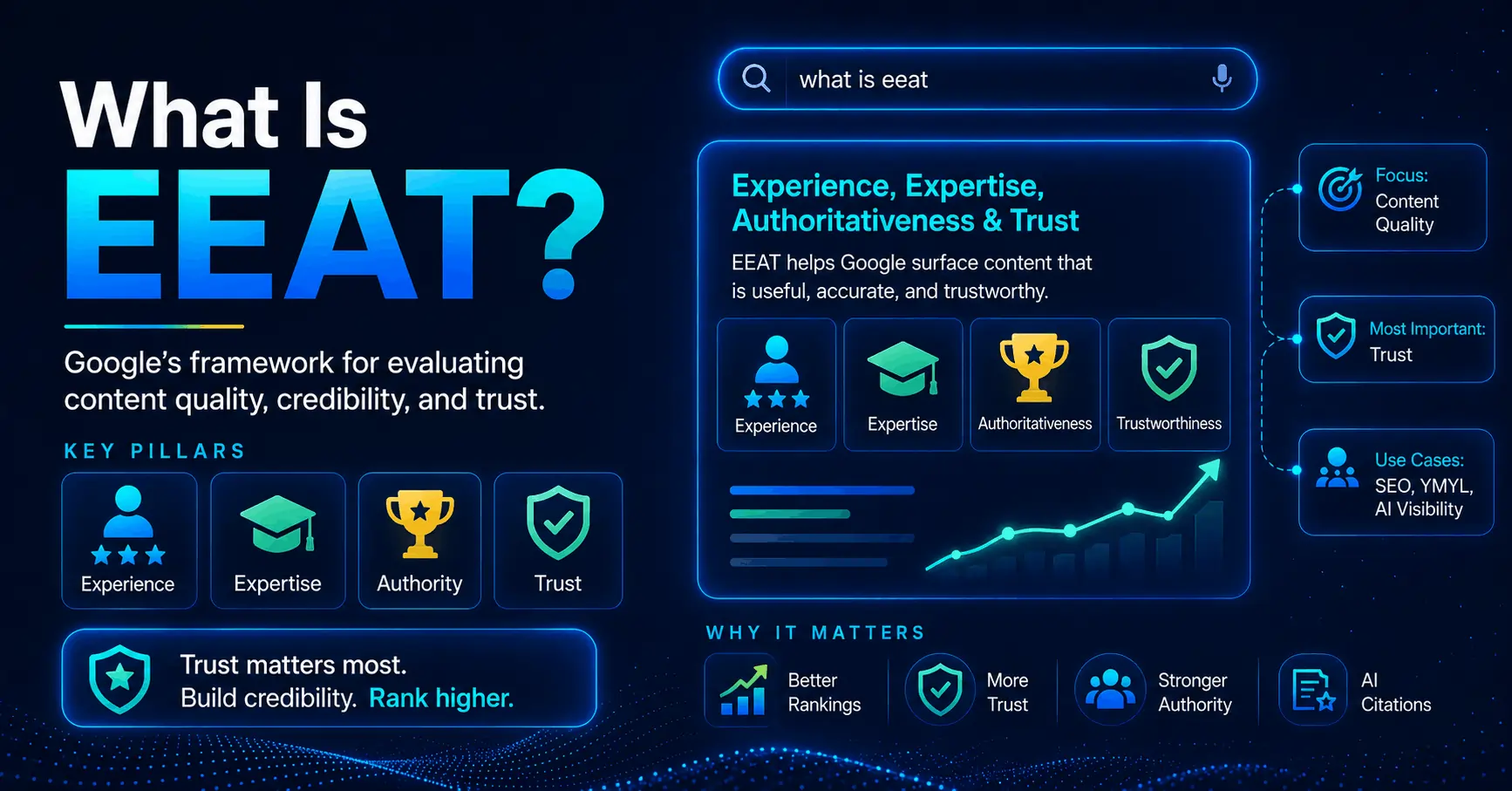
EEAT stands for Experience, Expertise, Authoritativeness, and Trustworthiness. You will see it written both ways, as E-E-A-T and as EEAT. It is the framework Google’s human quality raters use to judge whether a page is genuinely helpful and worth showing.
Each letter answers a different question about whoever made the page.
- Experience asks whether the creator has firsthand, lived involvement. Did this person actually use the product, visit the place, or do the procedure?
- Expertise asks whether the creator has the knowledge or skill the topic demands. A board-certified doctor writing about diabetes clears a higher bar than a generalist.
- Authoritativeness asks whether the creator and the site are recognized as a go-to source. Think citations, mentions, and reputation across the wider web, not claims you make about yourself.
- Trustworthiness asks whether the page is accurate, honest, safe, and transparent about who stands behind it.
Here is a useful way to hold it in your head. Experience and Expertise describe what the author brings to the page. Authoritativeness describes how the rest of the web regards them. Trust ties everything together, and Google singles it out as the most important of the four. A page can look expert and authoritative and still fail if readers cannot trust it.
From E-A-T to E-E-A-T: Why Google Added “Experience”
The framework started as E-A-T, with three letters: Expertise, Authoritativeness, Trust. The concept had lived in Google’s rater guidelines for years, but the August 2018 core update, nicknamed “Medic” by the SEO community, is when it stormed into mainstream attention by hammering health and finance sites with thin sourcing and no named authors.
In December 2022, Google added the second E, for Experience.
That was a deliberate signal, not a wording tweak. Plenty of searches are answered better by someone who has done the thing than by someone who only studied it. A traveler wants notes from a person who actually slept in that hotel. A buyer wants the take of someone who owned the gadget for six months.
The timing was strategic too. Experience is the one pillar synthetic content struggles to fake. A model can assemble facts at scale, but it cannot stand on the trail or return the defective product. That single fact shapes the whole 2026 playbook, as you will see below.
The Biggest Myth: EEAT Is Not a Ranking Factor
Read this twice, because most EEAT advice gets it wrong: there is no EEAT score inside Google’s algorithm. No engineer turns a dial labeled “authority” for your domain.
EEAT lives in Google’s Search Quality Rater Guidelines, a 182-page document in its current September 2025 version. Google uses roughly 16,000 contracted raters worldwide, often hired through firms like Appen and Telus, to assess sample search results against those guidelines. Their scores never move your individual ranking.
Google has been blunt about this in its own documentation. Raters have no control over how pages rank, and their data is not fed directly into the ranking systems. Google compares them to feedback cards a restaurant collects from diners. The cards do not change tonight’s menu by themselves, but over time they tell the kitchen whether the food is landing.
So how does EEAT connect to rankings at all? Through training, not a direct lever. Rater judgments help Google evaluate and refine its algorithms, which then try to approximate that sense of quality at scale using signals they can actually measure: link patterns, content depth, author reputation, and factual accuracy.
The practical takeaway changes how you work. You cannot optimize for EEAT the way you edit a title tag. You build the observable signals that demonstrate it, and you stop chasing a number that does not exist.
Trust Is the Pillar That Matters Most in 2026
If you fix one thing, fix Trust. Google’s guidelines call it the most important member of the EEAT family, and recent core updates have backed that up hard.
The March 2026 core update, which ran from March 27 to April 8, was among the most volatile in recent memory. SE Ranking measured roughly 79.5% of top-three results changing position during the March update window, up from 66.8% after the December 2025 update, with about one in four top-10 pages falling out of the top 100 entirely.
The pattern underneath the chaos is the clarifying part. Independent analyses from SE Ranking, Sistrix, and others described a source-quality reordering. Google tilted visibility toward primary sources, official institutions, government domains, established brands, and specialist publishers, and away from aggregators, directories, comparison hubs, and thin user-generated content. In plain terms, Google grew more willing to rank the site that was the natural endpoint for a query instead of the middleman standing between the user and the answer.
The lesson is uncomfortable but useful. Trust at the source level, meaning who you are and who vouches for you, can outweigh raw expertise listed on the page. Being the most knowledgeable voice is not the same as being the most trusted one.
What does Trust look like in practice?
- Accurate claims backed by sources you actually link to.
- Clear disclosure of who wrote and reviewed the content, with real bios.
- An honest About page, working contact details, and visible ownership.
- For commercial pages, secure checkout, clear pricing, and transparent policies.
- A clean reputation off-site, since Google weighs what other people say about you.
YMYL: Where the EEAT Bar Gets Strict
Not every page faces the same standard. Google applies its toughest quality bar to YMYL content, short for “Your Money or Your Life.”
YMYL covers topics that can affect a person’s health, financial stability, safety, or wellbeing. In the September 2025 guideline update, Google renamed the old “YMYL Society” category to “YMYL Government, Civics & Society,” spelling out elections, voting information, and trust in public institutions. Medical advice, investment guidance, legal questions, and major life decisions all sit squarely in this bucket.
The reasoning is straightforward. A mediocre article about houseplants wastes a few minutes. A mediocre article about drug interactions can hurt someone. So Google demands far stronger EEAT on YMYL pages, and the gap shows up fast.
If you publish in a YMYL niche, treat every signal as mandatory rather than optional. Name a qualified author, show credentials, cite primary sources, and review the content on a real schedule so it never goes stale. To be clear, EEAT applies to every query. The difference on YMYL topics is the size of the consequences when the content is wrong, and the bar rises with that risk.
EEAT and AI Content: The 2026 Reality
Plenty of people assume Google penalizes AI-written content on sight. It does not. The stance is more nuanced, and more demanding.
Google judges content by quality and usefulness, not by whether a human or a machine typed it. In its January 2025 guideline update, Google formally defined generative AI for the first time and made clear that mass-produced, low-value pages earn the lowest possible rating. That same update named three spam categories aimed at scaled tactics: scaled content abuse, expired domain abuse, and site reputation abuse. The guidelines now even call out “filler,” the generic padding that inflates word count before a reader reaches anything useful.
This is where EEAT and AI collide in a productive way. A model cannot manufacture genuine experience, and it cannot be a named, accountable author. Those are exactly the pillars Google leans on hardest.
There is a second reason 2026 raises the stakes: AI Overviews. Google’s AI-generated answers now appear on a large and growing share of searches. Estimates vary widely by methodology, device, and query type, from roughly 15% of queries in some Semrush samples to nearly half in BrightEdge tracking, with health and informational queries running far higher. These summaries cite their sources, and earning a citation is some of the most valuable visibility left in search. Seer Interactive found that brands cited in AI Overviews earn around 35% higher organic click-through rates than uncited brands on the same queries.
Here is the convergence worth internalizing. The pages that get cited by AI tend to be clear, accurate, expert-led, and close to the original source, which is the same profile that wins blue-link rankings. Optimizing for EEAT and optimizing for AI citation are turning into the same job.
So use AI as a drafting and research assistant if it helps, then add what it cannot:
- Inject firsthand experience the model could never have, like your own tests, screenshots, and results.
- Fact-check every claim and cite real sources.
- Put a named, credentialed human on the byline and have a person review it.
- Disclose meaningful use of automation where it matters to the reader.
Run that way, AI saves you time. Used as a shortcut to flood the web with thin pages, it is a fast path to invisibility.
How to Demonstrate EEAT on a Page
Google offers a simple lens for self-assessment: evaluate your content through “Who, How, and Why.” Who created it, how was it produced (including any use of AI), and why does it exist? Pages built to help people pass that test. Pages built only to rank tend to fail it.
Translate that into action across the four pillars.
Show Experience
Add the proof only a real practitioner could supply: original photos and screenshots, a step-by-step account of what you actually did, specific results with real numbers, and honest notes about what went wrong. Generic stock imagery signals the opposite. “This tool is easy to use” is filler. “Setup took 14 minutes, but the reporting dashboard needed another hour because the default labels were too broad” reads as real.
Prove Expertise
Put a real, named author on every meaningful page, never an “Admin” byline. Link the byline to a detailed bio that lists relevant credentials and other published work. Where the topic is sensitive, name the expert who reviewed the piece. Depth helps too, since thorough, well-structured content reads as expert while thin coverage of a dense topic reads as filler.
Build Authoritativeness
Authority is earned off your own site, so chase relevance over volume. A single citation from a respected industry publication beats dozens of links from unrelated blogs. Pursue genuine mentions, guest contributions, original research others want to reference, and honest reviews on platforms Google reads. One signal worth knowing: an SE Ranking study of 129,000 domains found referring domains to be the strongest predictor of whether a source gets cited in ChatGPT’s answers.
Earn Trust
Serve the site over HTTPS, publish a clear About page and real contact details, cite primary sources, and keep content current. Add a “last reviewed” date only when you have made a real update, not a cosmetic one. Disclose affiliate links, sponsorships, and any conflicts honestly, because transparency builds trust rather than eroding it.
Your EEAT Self-Audit Checklist
Run any important page through this before you publish or update it:
- Named author with a real, detailed bio and relevant credentials.
- Reviewer credit where accuracy matters, especially on YMYL topics.
- Firsthand experience shown through original images, data, or process notes.
- Cited claims that link to credible primary sources.
- Current information, with a genuine review date and refreshed stats.
- Clear site trust signals: working About and contact pages, secure connection, transparent policies.
- Off-site reputation worth having, built through quality mentions and links.
- A real reason to exist that passes the “Who, How, Why” test.
- Intent match, so the format fits what searchers actually want for that query.
- No filler, with every section earning its place.
Each “no” is a signal you can repair. Start with the page already ranking in positions two through ten, since that is where small Trust and Experience gains tend to move the needle fastest.
The Takeaway
EEAT is not a switch you flip or a score you chase. It is the quality standard Google’s raters use to train the systems that decide what ranks, and the closest public description we have of what “good” looks like. In 2026, Trust sits at the center, firsthand Experience is the edge synthetic content cannot copy, and the strictest standards apply wherever your content touches someone’s health, money, or safety.
Here is your move. Pick your single most important page today. Run it through the checklist above, find the weakest pillar, and fix that one first. Then do the next page. That steady, unglamorous work, not a magic score, is what compounds into rankings that survive the next update.
Frequently Asked Questions About E-E-A-T
Below are quick answers to the most common questions about E-E-A-T.
What does E-E-A-T mean?
E-E-A-T stands for Experience, Expertise, Authoritativeness, and Trustworthiness. It is a quality framework used in Google’s Search Quality Rater Guidelines to help evaluate whether online content is helpful, reliable, and created by a credible source.
What is the E-E-A-T standard?
The E-E-A-T standard is Google’s way of assessing content quality. It looks at whether content shows firsthand experience, relevant expertise, recognized authority, and strong trust signals. E-E-A-T is not a direct ranking factor, but it reflects the type of content Google aims to reward in search results.
Where is E-E-A-T commonly used?
E-E-A-T is commonly used in SEO, content marketing, and website quality evaluation. It is especially important for YMYL topics, which stands for “Your Money or Your Life.” These include health, finance, legal, safety, and major life decision topics where inaccurate information could seriously affect readers.
What is the difference between E-A-T and E-E-A-T?
The main difference is Experience. E-A-T originally stood for Expertise, Authoritativeness, and Trustworthiness. Google later added another “E” for Experience to highlight the value of firsthand knowledge, such as personal use, product testing, professional practice, or lived involvement with the topic.
Is E-E-A-T a word?
E-E-A-T is not a regular word; it is an acronym. It stands for Experience, Expertise, Authoritativeness, and Trustworthiness. You may also see it written as EEAT without hyphens, but both refer to the same content quality concept.
Last Updated on 2 months ago by Alipio Umiten IV
