





Most SEO job postings ask for two years of experience. Yet almost every SEO I know, including me, started with zero.
I have spent ten+ years ranking pages. The pattern never changes. Certificates rarely get people hired. Proof does.
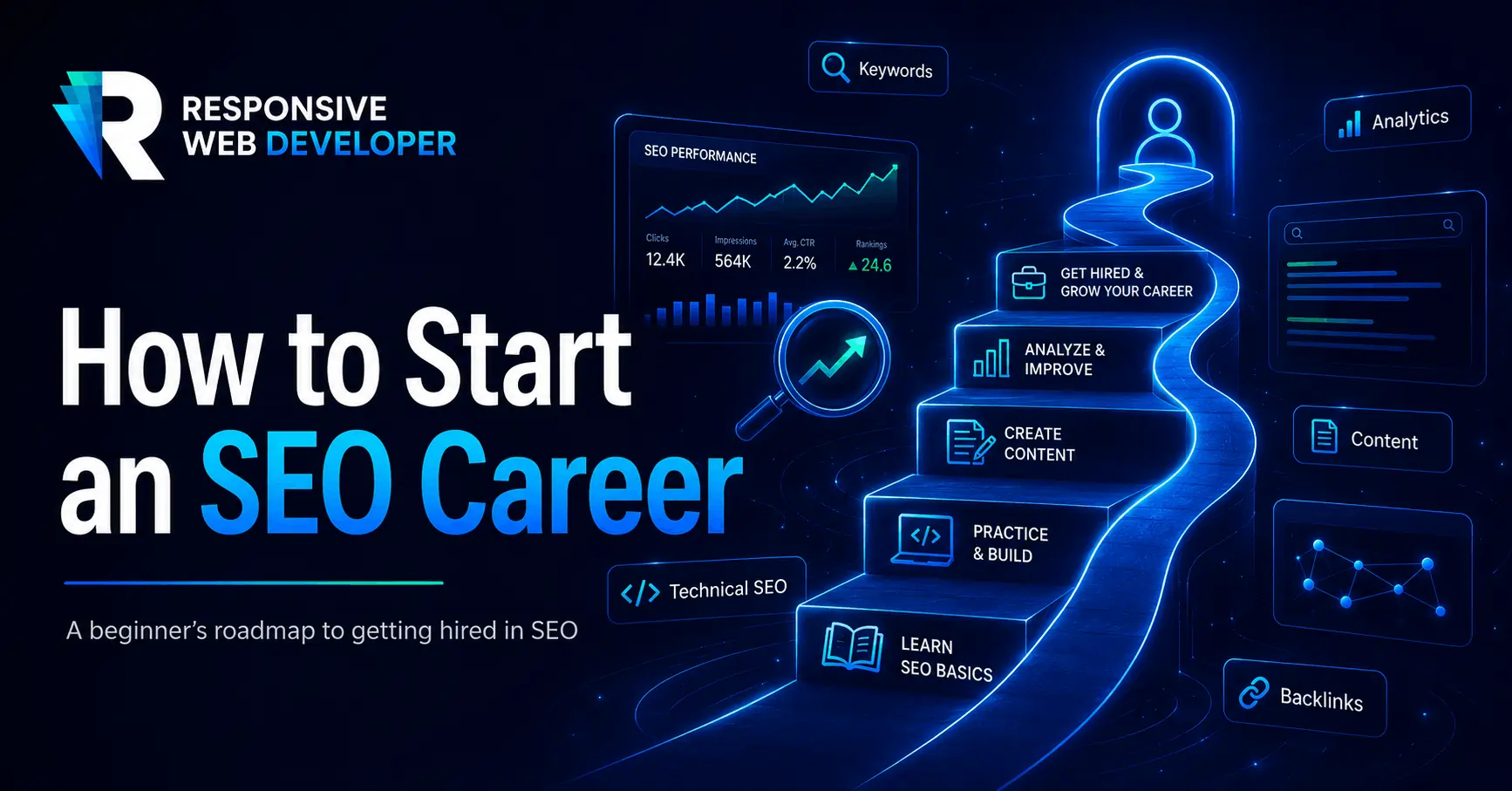
This guide shows you exactly how to work in SEO without a marketing degree. You will get the skills to learn, the portfolio method that wins interviews, real 2026 salary numbers, and a 7-step plan you can start tonight.
Quick answer: To work in SEO, you need proof, not a degree. Learn the fundamentals through free resources like Google Search Central. Build one test website and rank it for low-competition keywords. Track results in Google Search Console, land one real client project, then apply for junior SEO and content roles. Most focused beginners get hired within 6 to 12 months.
What Does an SEO Actually Do All Day?
SEO work splits into three pillars. Content SEO covers keyword research, writing briefs, and optimizing pages. Technical SEO covers crawling, indexing, and site speed. Off-page SEO covers earning links and mentions.
In my experience, most juniors start as generalists. Early SEO work usually means content briefs, on-page fixes, Search Console reporting, keyword research, simple technical checks, and client or team communication. Nobody hands you full strategy in year one. You earn it by proving you can make pages easier to find, understand, and improve.
Know the job titles before you search. SEO Specialist, SEO Analyst, SEO Coordinator, Content Strategist, and Technical SEO Analyst all describe entry paths. In the UK, “SEO Executive” is the standard junior title.
You also pick an environment. Agencies expose you to many clients fast, so you learn quickest there. In-house roles go deeper on one brand. Freelancing pays the most per hour but is brutal without a track record. Start at an agency if you can.
How to Work in SEO: 7 Steps From Zero to Hired
Step 1: Learn the fundamentals free (weeks 1 to 4)
Do not buy a course on day one. Google publishes its own rulebook for free.
Start with the Google Search Central SEO Starter Guide and the “How Search Works” documentation. Then watch the free Semrush Academy and Ahrefs beginner courses on YouTube.
One hour a day for four weeks covers roughly 80% of the theory a junior role requires. Take notes in your own words. Those notes become your interview answers later.
Step 2: Get hands-on with 4 free tools
Beginners overrate tools. You only need four to be dangerous:
- Google Search Console. Free. This is where real rankings live.
- Google Analytics 4. Free. Traffic and conversion data.
- One keyword tool. Ahrefs Webmaster Tools and the Semrush free tier both work.
- Screaming Frog. The free version crawls 500 URLs, which is plenty for learning technical SEO.
Here is the interview secret. When I screen candidates, I ask one tool question: “Show me a Search Console report you have actually used.” Most applicants cannot. The ones who can almost always advance.
Step 3: Build a test site and rank it (the portfolio method)
This is the step most career guides mention in one vague sentence. It deserves numbers, because it is the single highest-leverage move you can make.
Here is the exact 30-day spec I give beginners:
- Buy a domain for about $10. Use WordPress or any simple builder.
- Pick a narrow niche you genuinely know. A hobby beats a “profitable” niche you faked interest in.
- Find 10 to 15 keywords with a Keyword Difficulty score under 10.
- Publish 8 to 12 genuinely helpful pages in 30 days.
- Verify the site in Search Console, submit your sitemap, and screenshot the impressions graph every two weeks.
Why does this matter so much? Because a live project separates you from the certificate pile. Plenty of beginners can say they watched SEO lessons. Far fewer can show a real site, Search Console impressions, indexed pages, and changes they made based on data.
One ranked page beats five certificates. Write that down.
Step 4: Get one real result for a real business
A test site proves skill. A client result proves you can work with stakes.
Offer a local business, a nonprofit, or a friend’s shop a free 10-point SEO audit. Do not pitch vague “SEO services.” Pitch three specific fixes: “Your title tags are duplicated, your Google Business Profile is incomplete, and your service pages have no internal links. I will fix all three free.”
Then measure for 60 to 90 days and screenshot the before and after. You now own a case study with a real business name attached. That is worth more than any bootcamp credential.
Step 5: Pick a lane
Generalists get hired. Specialists get paid. After 3 to 6 months, lean into one of these:
- Content SEO. The easiest entry point with the most junior openings.
- Local SEO. The fastest visible wins, and ideal if you want freelance clients early.
- Technical SEO. Fewer candidates, higher pay. Webflow’s 2026 salary guide pegs the technical SEO premium at $10,000 to $20,000 above generalist pay at the same level.
- Digital PR and link building. Best fit if you enjoy outreach and writing.
You do not need to master all four. You need to be clearly useful in one.
Step 6: Package your proof
Build a one-page portfolio. Not a resume. A results page.
Use the Problem, Action, Result format for each project. Include two Search Console screenshots. Keep the whole page readable in under two minutes, because recruiters skim.
Weak line: “Completed SEO certification.” Strong line: “Grew a new site from 0 to 1,400 monthly impressions in 90 days. Here is the graph.”
Step 7: Apply like an SEO
Search these exact titles: SEO Coordinator, SEO Analyst, Junior SEO Specialist, Content Specialist, and Marketing Assistant. Agencies post the most junior roles, so filter for them first.
Apply when you meet about 60% of the listed requirements. Entry-level postings describe a wish list, not a checklist.
Then personalize. Add one sentence naming something you would test on their actual site. Mention a title tag issue, an internal linking gap, a thin location page, or a keyword opportunity. That small detail signals you already think like an SEO, not just someone applying for an SEO job.
Expect 30 to 60 applications for a first role in a normal market. Track them in a spreadsheet like the analyst you are becoming.
SEO Salaries in 2026: What You Will Actually Earn
SEO pays better than most people expect, and pay is climbing. Indeed data from early 2026 shows SEO salaries up about 6% year over year, driven by demand for AI-search skills.
| Role | Typical US pay (2026) | Source notes |
|---|---|---|
| Entry level / SEO Coordinator | $45,000 to $55,000 | PayScale puts the under-1-year average at $44,600 |
| SEO Specialist | $55,000 to $75,000 | ZipRecruiter average: $67,388. Indeed average: $70,203 |
| Senior SEO | $80,000 to $95,000 | SalaryExpert average at 8+ years: $90,945 |
| SEO Manager | $95,000 to $130,000 | Higher in tech and e-commerce |
| Head of SEO / Director | $120,000 to $160,000+ | Often includes bonus and equity |
| Freelance (established) | $75 to $200 per hour | Retainers commonly run $2,000 to $10,000 per month |
Two more facts worth knowing. Roughly 58% of SEO professionals work remotely, per a 2025 Search Engine Journal survey. And location matters less every year, which makes SEO one of the most geography-flexible careers in marketing.
How AI Search Changed Entry-Level SEO (and Why It Helps You)
You have probably heard SEO is dying. The data says something more interesting: the job is changing, and beginners who understand the change have an edge.
Ahrefs analyzed December 2025 data and found that when an AI Overview appears, the top-ranking page’s click-through rate drops by 58%. Seer Interactive measured a 61% organic CTR decline on informational queries with AI Overviews since mid-2024.
Scary numbers. Now here is the opportunity hiding inside them.
Businesses are confused and budgets are shifting, not vanishing. A 2025 Semrush report found 74% of enterprise companies plan to hire SEO specialists with AI expertise within 12 months. The demand moved. It did not disappear.
What changed for junior roles in practice:
- Less bulk meta-tag writing. AI drafts it, humans review it.
- More structured data, entity, and content-quality work, because AI systems cite well-organized pages.
- A new deliverable: tracking whether your brand gets cited in AI Overviews, ChatGPT, and Perplexity answers. Some teams call this GEO or answer engine optimization.
Here is my contrarian take. This shift made it easier to break in, not harder. Most working SEOs learned their habits before AI search existed. You are learning both worlds at once. Add one line to your portfolio, “queries where my test site appears in AI answers,” and you will stand out in a way most 10-year veterans currently do not.
5 Mistakes That Keep Beginners Stuck
- Collecting certificates instead of results. Certificates prove you watched videos. Rankings prove you can do the job.
- Chasing big keywords on a new domain. A fresh site targeting “best credit cards” will rank for nothing. Difficulty under 10 or skip it.
- Tool hopping. Learning six tools at 10% depth impresses nobody. Master Search Console first.
- Quitting before day 90. SEO lags. Ahrefs once studied two million new pages, and only 5.7% reached the top 10 within a year. Your test site’s flat first month is normal, not failure.
- Sending generic applications. One tailored observation about the company’s site beats ten template applications.
Your Job-Ready Checklist
- [ ] Read Google’s SEO Starter Guide and “How Search Works”
- [ ] Finish one free video course (Semrush Academy or Ahrefs)
- [ ] Set up Search Console and GA4 on your own site
- [ ] Find 10+ keywords with difficulty under 10
- [ ] Publish 8+ pages on your test site in 30 days
- [ ] Run one Screaming Frog crawl and fix 3 issues
- [ ] Deliver one free audit to a real business
- [ ] Write one case study in Problem, Action, Result format
- [ ] Publish a one-page portfolio
- [ ] Send 20 tailored applications with one site-specific observation each
Start With One Page, Not One Hundred Courses
Here is the takeaway. Learning how to work in SEO is a doing problem, not a reading problem. Every junior hired built something, measured it, and showed the receipts.
So skip the certificate collection. Register a domain tonight. Publish one optimized page this week. Ninety days from now, you will hold the portfolio most applicants never build.
Frequently Asked Questions About How to Work in SEO
Is an SEO job easy?
SEO is easy to start and hard to master. The fundamentals — how search engines crawl, index, and rank pages — take about a month of focused study, so almost anyone can pick up the basics. The real difficulty isn’t complexity; it’s patience. Rankings can lag for weeks or months (only 5.7% of new pages reach the top 10 within a year), so early results feel slow. The beginners who push past that flat first stretch are the ones who make it.
What qualifications do you need for SEO?
None in the formal sense — SEO is one of the few marketing careers with no degree requirement, because managers hire on proof, not paper. What you actually need is a set of practical skills: keyword and data research, clear writing, analytical thinking to read Google Search Console and GA4, problem-solving, basic technical literacy, and communication to explain your work to clients or your team. A live test site that ranks demonstrates all of these faster than any certificate.
Can I learn SEO by myself?
Yes — most working SEOs are self-taught. Google publishes its own rulebook for free (the Search Central Starter Guide and “How Search Works”), and one focused hour a day covers roughly 80% of junior-level theory in about a month. You can grasp the concepts in a few months, but mastering them takes ongoing, hands-on practice. The key is to learn by doing: build a real site and rank it rather than only watching videos.
Do SEO jobs pay well?
Yes, and pay is climbing — Indeed data shows SEO salaries up about 6% year over year in 2026. In the US, entry-level SEO Coordinators earn roughly $45,000–$55,000, Specialists $55,000–$75,000, and Managers $95,000–$130,000. Directors and Heads of SEO often clear $120,000–$160,000 plus bonus, while established freelancers charge $75–$200 an hour. With around 58% of SEOs working remotely, that pay holds up almost anywhere.
Can you get an SEO job with no experience?
Yes — almost every SEO started with zero. The strategy is to replace experience with proof. Build your own test site and rank it for low-competition keywords (difficulty under 10), track the impressions in Google Search Console, then deliver one free audit for a real business. That portfolio — a live site, real data, and a documented before-and-after — beats any certificate. Most focused beginners get hired within 6 to 12 months.
Related Articles:
-
- SEO Pricing: How Much Does SEO Cost in 2026? (Real Data)
- B2B SEO Services: The 2026 Buyer’s Guide
- Why SEO Is Important in 2026: 7 Data-Backed Reasons
- How to Do SEO in 2026: A 7-Step Plan for Beginners
- How to Learn SEO in 2026: A 30-Day Beginner Plan
- Is SEO Dead? 2026 Data Says No, But Clicks Are Dying
Last Updated on 1 month ago by Alipio Umiten IV
