





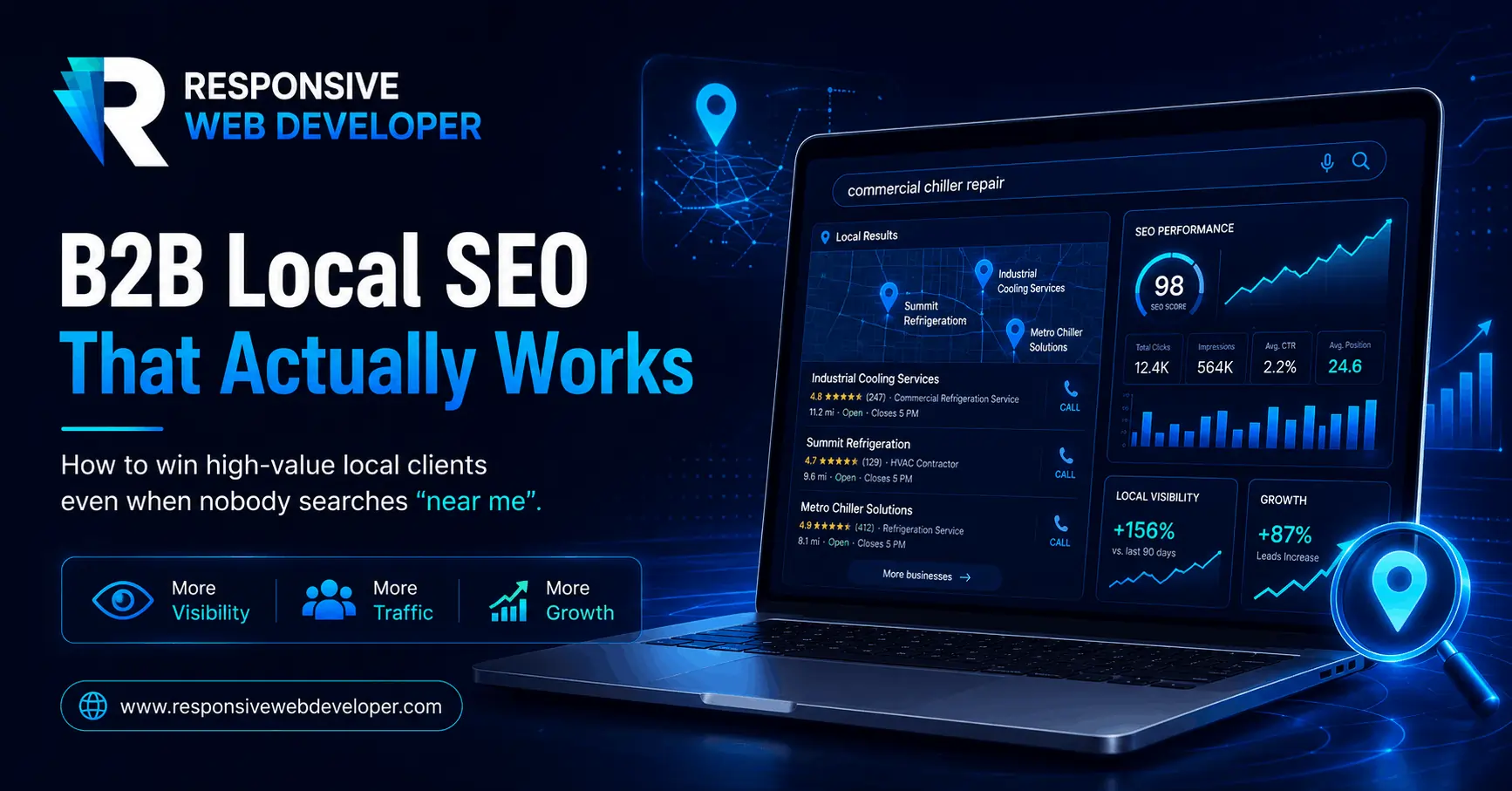
Your best prospect is a facilities director eleven miles away who has never typed “near me” in her life.
She typed “commercial chiller repair” from her desk at 7:40 a.m. Google localized the results anyway. A map pack loaded with three companies in her metro, she called two of them, and one of them won a $60,000 service contract. You weren’t in the box.
That gap is what B2B local SEO actually solves, and almost every guide on the topic misses it. The advice out there was written for pizza shops and orthodontists: claim your profile, ask for reviews, build citations, done. It falls apart when your buyer is a purchasing committee, your sales cycle runs 90 days, and nobody in procurement has ever left a Google review in their life.
Here is what works instead for companies selling to other businesses inside a service radius.
What makes local SEO for B2B a different game
The ranking mechanics are the same. Google still sorts local results by relevance, distance, and prominence. What changes is the raw material you have to feed those three factors.
| Signal | How it works in B2C | How it works in B2B |
|---|---|---|
| Search volume | High volume, explicit city terms | Low volume, high value, often no city in the query |
| Reviews | Customers leave them unprompted | Buyers are contractually or culturally discouraged from posting |
| Conversion event | Call, walk-in, booking | RFQ, spec sheet download, site visit request |
| Sales cycle | Minutes to days | Weeks to quarters |
| Physical presence | Storefront customers visit | Branch, yard, or warehouse nobody visits |
| Deal value | $40 haircut | $50,000–$100,000 in annual contract value (Norwest’s 2024 B2B Sales & Marketing Benchmark Report) |
Read that table again and one thing jumps out: B2B local SEO operates with less data and more money per outcome. Fewer searches, fewer reviews, fewer clicks, but a single map pack placement can pay for the year.
That asymmetry should change how you prioritize. Volume-based keyword thinking will steer you wrong from the first step.
The opportunity everyone skips: implicit local intent
Most B2B teams build their local keyword list the same way. They open a keyword tool, type “commercial electrical contractor Denver,” see 40 searches per month, and decide local isn’t worth the effort.
They just threw away the actual opportunity.
Google localizes results for queries that contain no geography at all. Search “commercial electrical contractor” from an office in Denver and you get Denver companies plus a map pack. The searcher never typed a city because they never had to. Google inferred it from their IP address, their device location, and their history.
That head term carries an estimated 3,600 U.S. searches per month, according to 2026 Google Keyword Planner data. The version with “Denver” bolted on carries 40. Your keyword tool showed you the wrong number, and you made a strategy decision on it.
How to find your implicit local keywords
Run this in an afternoon:
- List your 20 highest-value service and product terms with no city attached. Use the language buyers use, not your internal product names. “Pallet racking installation,” not “storage solutions.”
- Search each one in an incognito window or a rank tracker with location targeting set to your metro.
- Look for a map pack. If Google returns one, that term is a local keyword regardless of what your tool says about geo modifiers.
- Flag every term that triggers a pack. That flagged list is your real local SEO target set, and it is usually 10 to 50 times bigger in volume than the city-modified list you were working from.
- Track them with a geo-grid tool (Local Falcon, BrightLocal, Semrush Local) rather than a single-point rank checker. A flat national rank number tells you nothing about whether you show up two suburbs over.
The geo-grid step matters more than people expect. You might sit at position 2 from your own office and position 19 from the industrial park eight miles east where half your prospects work.
Set up a Google Business Profile for a company nobody visits
Your profile carries roughly a third of local pack influence according to Whitespark’s 2026 Local Search Ranking Factors survey. For most B2B companies it is also the single most neglected asset in the marketing stack.
The service area business (SAB) setup trips people up first. If customers don’t come to your address, Google requires you to remove that address from the profile and list service areas instead. Leaving a visible address on an SAB listing is one of the fastest routes to suspension, and Google has been suspending profiles at unusually high rates through 2026.
The B2B profile checklist
- Primary category is your highest-leverage field. “Commercial refrigeration service” and “HVAC contractor” pull completely different query sets. Check what the companies currently outranking you selected, then test. Change one variable at a time and watch your geo-grid for two weeks.
- Set service areas honestly. You get up to 20, and Google’s guidance suggests staying within roughly a two-hour drive of your base. Twenty distant cities won’t rank you in twenty cities. Mismatched service areas are a top suspension trigger.
- Fill the services list completely using the terminology in your RFQs, not your website’s marketing copy.
- Upload real photos. Your yard, your fleet, your crew on a job site, your warehouse racking. March 2026’s core update rewarded evidence of a real operation and punished the template look. Stock photography of a smiling handshake does nothing.
- Use Posts for proof, not promotions. Certifications earned, equipment added, a completed install at a named facility type, capacity to take emergency calls this quarter.
- Seed the Q&A section with procurement questions. Lead times, minimum order quantities, certifications and bonding, emergency response windows, whether you carry the insurance their legal team requires. These get read.
- Set hours to match your actual service model. If you run 24/7 emergency dispatch, saying “9 to 5” is a lie that costs you calls.
- Turn on notifications for profile edits. Google accepts community suggestions, and an incorrect edit to your category or hours can quietly wreck your visibility or trigger a review.
One warning about metrics: your profile dashboard will proudly report direction requests. For a company that ships on pallets and dispatches trucks, that number is noise. Ignore it.
Fix the B2B review drought
Review signals carry meaningful weight in the local algorithm, and B2B companies are structurally starved of them. A maintenance manager who is thrilled with your work still won’t post about your industrial coatings on Google Maps. Some enterprise buyers are explicitly barred from publicly endorsing vendors.
You solve this with process, not hope.
Ask the user, not the signer. The VP who approved the PO feels nothing. The plant technician who watched your crew get a line running again at 2 a.m. feels plenty. Ask that person.
Ask at the moment of relief. Right after the emergency callout, the successful commissioning, the passed inspection. Not 30 days later in a batch email.
Make it one tap. A QR code on the job closeout sheet. A short link in the technician’s text. Anything that requires a login hunt loses 90% of your yield.
Let field staff ask in person. A tech who says “would you mind leaving us a quick review, it really helps our crew” converts at a rate no email sequence touches. Build it into the closeout checklist.
Respect the ones who can’t. When a buyer’s policy prohibits public endorsement, ask for a LinkedIn recommendation to your account manager or a quotable line for a case study instead.
Never gate or incentivize. Filtering for happy customers before asking violates Google’s policy and gets reviews stripped.
Reply to every review with specifics. Name the service performed and the problem solved. Your replies are diligence material. Prospects read them while deciding whether to send you an RFQ, and they read your response to the one-star review most closely of all.
Reviews on G2, Clutch, or your industry’s vertical directory build credibility, but understand the division of labor: those support the buying decision, while Google reviews feed the map pack. Run both.
Build location pages that survive a human read
Google’s March 2026 core update, which finished rolling out on April 8, hit templated location pages hard. Sites running 200 near-identical pages with the city name swapped lost visibility at scale. That tactic is finished.
A location page earns its place when it contains things that could only be true of that location:
- The branch name, its own local phone number, and its real address
- Photographs of that actual facility, that team, and those trucks
- Named staff with roles and credentials
- What’s physically stocked or stationed there, including equipment and inventory
- Two or three project summaries from that territory, described by industry and problem solved even when the client is confidential
- State or municipal licenses and certifications that apply in that jurisdiction
- The real service radius, stated in plain language and matching your profile exactly
- Embedded map and schema markup identifying the location as a distinct entity
The rule for deciding how many pages to build: one per location where you have a genuine presence, meaning people, inventory, or a truck that parks there overnight. A service-area page for a city you’ve worked in twice is thin content wearing a costume.
Link internally from your main service pages down to location pages and back up. Both directions.
Local links, B2B edition
Citation signals have dropped to a small share of local ranking influence, so bulk directory submission is a waste of budget. Local relevance and topical authority are what move the needle now.
The good news: B2B companies have link sources their B2C neighbors can only envy.
- Manufacturer dealer locators. If you’re an authorized dealer, distributor, or certified installer, the brand almost certainly maintains a “where to buy” or “find a contractor” page. These are high-authority, geographically relevant links, and most companies never bother to confirm they’re listed correctly. Start here.
- Trade associations. Your industry body’s member directory, plus any regional chapter.
- Chamber of commerce and economic development organizations. Old-fashioned and still effective, because they signal a verifiable local operation.
- Local business journals. Fastest-growing company lists, expansion announcements, new facility openings, executive hires. Send the press release when you add a bay or a branch.
- Trade schools and community colleges. Sponsor an apprenticeship, donate equipment, get the partner page link.
- Supplier and partner sites. Case studies where you’re the customer, and vice versa.
- Regional trade show and industry event sponsorships. Exhibitor pages link out.
Ten links of this quality will outperform 200 generic directory submissions. That isn’t a stylistic preference, it’s how local prominence gets calculated now.
Get named in AI answers, not just the map pack
Local AI citations and local pack rankings run on separate systems. A company can be recommended inside an AI-generated answer without holding a top-three map position, and vice versa. In 2026 that means one visibility surface you may be tracking and one you almost certainly aren’t.
Audit yourself in ten minutes. Open ChatGPT, Gemini, and Perplexity, then ask each the question your buyer would ask: “who are the best commercial roofing contractors in Kansas City for a warehouse re-roof?” Note whether you’re named, who is, and what the AI cites as its source.
What tends to earn the mention:
- Consistent business information across your site, your profile, and every third-party listing, because these systems cross-check sources before trusting one
- Structured data on location and service pages that states plainly what you do, for whom, and where
- Content that answers procurement questions in complete plain-language passages, since AI systems extract passages rather than ranking pages
- Corroboration from sources other than your own website, including association listings, business journals, and review platforms
- Named authors with real credentials on technical content
Measure against pipeline, not phone calls
The fastest way to get local SEO defunded at a B2B company is reporting on profile views.
Track these instead:
Leading indicators, reviewed monthly
- Geo-grid rank for your flagged money terms, measured across your actual territory
- Review volume and velocity, plus average rating
- Profile calls and website clicks, with UTM parameters on the profile’s website link so the traffic is identifiable in analytics
Lagging indicators, reviewed quarterly
- Quote requests and RFQs attributed to organic and profile sources
- Sales-qualified opportunities created
- Closed-won revenue and average deal size from local search
Push profile and organic sources into your CRM as a lead source field and hold the line on it. A “call” isn’t a conversion when 40% of them are vendors and job applicants, so require lead qualification before anything counts.
Then set an evaluation window matched to your sales cycle. If deals take five months to close, judging a local SEO investment at 90 days will produce a false negative and kill a program that was working. Review leading indicators monthly and revenue at about seven months.
A 90-day starting sequence
Days 1 to 30. Claim and audit every profile, including branch listings you forgot existed. Fix SAB address and service area settings. Test your primary category. Clean up name, address, and phone data everywhere. Run a geo-grid baseline on ten money terms so you can prove movement later.
Days 31 to 60. Build the review request process into your service closeout, with the QR code and the script. Rewrite location pages for your top three branches to the standard above. Add schema. Seed the Q&A section.
Days 61 to 90. Chase the manufacturer locator listings and association directories. Send one press release to the local business journal. Set up CRM source tracking and build the dashboard. Re-run the geo-grid and compare.
The takeaway
B2B local SEO isn’t consumer local SEO wearing a blazer. Your buyers search differently, review differently, and buy on a timeline that makes standard measurement useless. The companies winning these searches figured out that the prize sits in localized head terms rather than low-volume city keywords, and they built a review process rather than waiting for reviews to show up.
Start with the implicit local intent audit. One afternoon, twenty keywords, an incognito window. You’ll find out very quickly whether Google is quietly showing a map pack to every prospect in your territory and leaving you out of it.
Related Articles:
- How to Choose the Best B2B SEO Agency (Buyer’s Guide)
- B2B SEO Best Practices That Drive Pipeline
- B2B SEO Solutions: Fix the Right Problem First
- B2B SaaS SEO: Rank, Place, or Skip Every Keyword
- B2B SEO Trends 2026: What Actually Moves Pipeline
- B2B SEO Specialist: Hire for Pipeline, Not Traffic
- B2B SEO Consultant: How to Hire One Who Moves Pipeline
- B2B SEO Expert: How to Hire One Who Drives Revenue
- B2B Marketing Agency: How to Choose One (2026 Guide)
- SEO for B2B Marketing: A Portfolio, Not a Calendar
- B2B SEO Statistics 2026: Where the Sources Disagree
- B2B Ecommerce SEO: The 2026 Pipeline Playbook
Last Updated on 2 months ago by Alipio Umiten IV
