





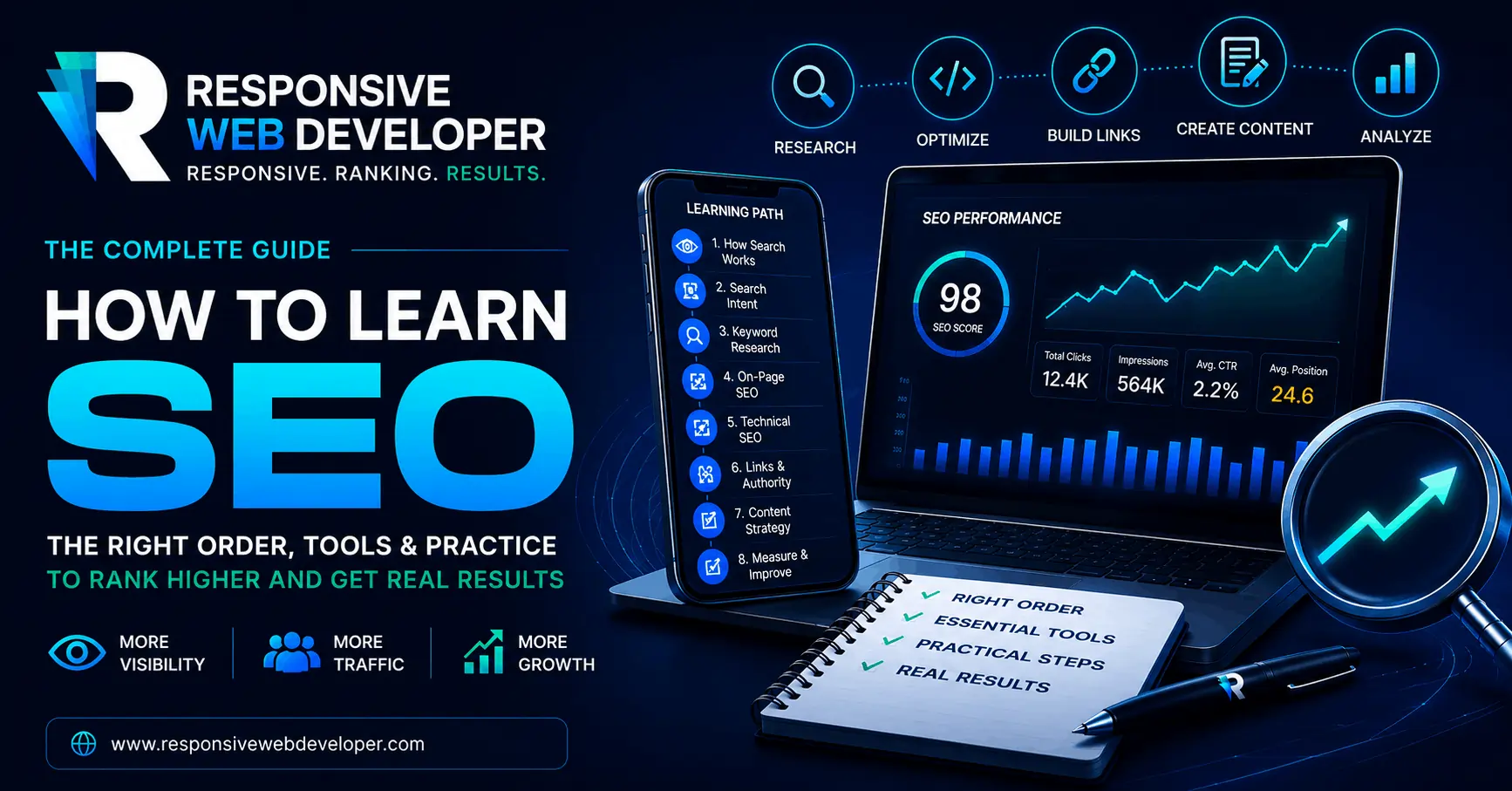
How to learn SEO starts with one simple rule: stop trying to learn everything at once.
Most beginners open dozens of tabs, watch conflicting YouTube videos, read outdated forum threads, and wonder which SEO tactic to try first. One expert tells you to build backlinks. Another says content matters most. Someone else insists AI has changed everything. The flood of advice creates confusion instead of progress.
You do not need more information. You need the right order.
The fastest way to learn SEO is to understand the fundamentals, build a website you control, practice each skill on real pages, and use real search data to see what works. Reading helps, but experience turns SEO knowledge into a skill.
This guide gives you a clear, step-by-step roadmap to learn SEO from scratch. You will learn the core skills in the right sequence, use free first-party resources and SEO tools, practice on your own site, and understand how long it realistically takes to become competent. You do not need an expensive course. You need a practical plan and the discipline to apply what you learn.
What learning SEO actually means
Search engines do three things. They crawl the web, following links and reading pages. They index what they find, storing pages in a massive database. Then they rank: when someone searches, the engine pulls pages from its index and orders them by relevance and authority. Every SEO skill exists to improve how your pages perform at one of those three stages.
Practitioners group the work into three pillars:
- Technical SEO: can search engines crawl, index, and load your pages efficiently?
- On-page SEO and content: does each page answer a specific search better than the alternatives?
- Off-page SEO: do other reputable sites link to you and vouch for your content?
Keep this map in your head as you study SEO. Every tactic belongs to one of the three pillars, and most beginner confusion comes from mixing them up.
Step 1: Start with Google’s own documentation
Before you read a single blog roundup, go to the source. Google publishes the rules it wants you to follow, and those documents are free, current, and written by the people who built the ranking systems.
- The SEO Starter Guide covers the fundamentals: how to structure a site, write titles, and make pages crawlable. Read it twice.
- Google Search Central hosts the full documentation library, a blog announcing updates, and a YouTube channel where Google search engineers answer real questions.
- The Search Quality Rater Guidelines are the handbook Google gives the human evaluators who test search results. It is advanced reading, but it shows you exactly what “quality” means to Google. Save it for month two.
Why first-party sources first? Because most SEO myths die the moment you read the primary document. When a guru claims a tactic works, you can check it against what Google actually publishes instead of taking a stranger’s word for it.
Step 2: Build a sandbox website
This is the single highest-leverage move in the entire roadmap. You cannot learn SEO by reading about it, the same way you cannot learn to swim by watching pool videos. You need a site where you can break things, test ideas, and watch the data respond.
A sandbox site is a low-stakes website you own outright. It does not need to be pretty. It needs to be real: a registered domain, actual pages, actual traffic potential. Here is the setup:
- Register a cheap domain. Pick a topic you know well: your neighborhood, a hobby, a profession you have worked in. A .com costs roughly $10 to $15 a year at any major registrar.
- Install WordPress on budget shared hosting, or build a static site on a free host. Either works. WordPress teaches you more about real-world site management.
- Verify the site in Google Search Console. This is where Google tells you what it has crawled, indexed, and ranked.
- Set up GA4 so you can see which pages get visits and where the visitors come from.
- Publish five pages of genuine content about your chosen topic. Real paragraphs, written for a real reader.
Total cost: about $50 for the year, less than a single textbook. What you get back is a laboratory where every lesson in this post becomes something you can touch.
Step 3: Learn the core skills one at a time, in this order
Beginners fail by learning everything at once. Work through these four skills in sequence, spending two to four weeks on each before you move on.
Keyword research and search intent
Keyword research is finding the exact phrases people type when they want what you offer. Search intent is the why behind the query: does the searcher want to buy something, learn something, or reach a specific site? A page that answers the wrong intent will not rank, no matter how well it is written.
Exercise: pick one topic from your sandbox site. Type your main phrase into Google and study the first page. Are the results how-to guides, product pages, or listicles? That pattern is the intent. Then open Google Keyword Planner (free with a Google Ads account) and collect 20 related phrases with their monthly search volumes. Choose one with clear intent and modest competition, and plan a page around it.
On-page optimization
On-page SEO is how you package a page so readers and search engines understand it fast. The title tag is your headline in search results. Headings break the content into a logical structure. Internal links connect your pages and spread authority between them. The meta description is your 150-character pitch to a searcher deciding whether to click.
Exercise: take one existing page on your sandbox site and rebuild it. Write a title tag under 60 characters with the main keyword near the front. Restructure the headings so each H2 answers a sub-question. Add three internal links to related pages. Write a meta description that promises a specific benefit. Resubmit the page in Search Console and watch what changes over the next month.
Technical SEO basics
Technical SEO sounds intimidating, but the beginner version is five questions. Can Google crawl your pages? Are they indexed? Does the site load quickly? Does it work on a phone? Are the Core Web Vitals, Google’s speed and stability metrics, in a healthy range?
Exercise: run your sandbox site through PageSpeed Insights and record the Core Web Vitals scores. Then open the Pages report in Search Console and confirm every page you published is indexed. If one is missing, request indexing and find out why it was skipped. Fix a single speed issue, even something small like compressing your largest image.
Link building and authority
Links from other sites act as votes. When a reputable site links to your page, Google reads it as an endorsement, and pages with strong backlink profiles tend to rank higher. Backlinko’s analysis of 11.8 million Google search results found that the #1 ranking result had an average of 3.8 times more backlinks than pages ranking in positions #2 through #10. You earn links by publishing things worth citing, then telling the right people those things exist.
Exercise: create one genuinely useful resource on your sandbox site, something like a local guide or a small data roundup that others would want to reference. Find ten blogs or local organizations that might link to it, and email five of them a short, personal pitch. Expect mostly silence. The point is learning the process, not instant wins.
Step 4: Get fluent with free tools
You can learn SEO end to end without paying for a single tool. The free stack covers everything a beginner needs:
- Google Search Console shows your impressions, clicks, average positions, and indexing status. It is the most important SEO tool you will ever use.
- GA4 tells you what visitors do after they arrive.
- Screaming Frog’s free tier crawls up to 500 URLs and flags broken links, missing titles, and redirect problems.
- Ahrefs Webmaster Tools, free for sites you verify as your own, audits technical health and shows your backlink profile.
- For keyword research, Google Keyword Planner, autocomplete suggestions, and the People Also Ask box cost nothing and come straight from real searches.
One warning: do not confuse tool fluency with SEO skill. Tools answer questions. They do not teach strategy. A beginner with a clear hypothesis and Search Console will outlearn a tool collector with five subscriptions and no plan.
Step 5: Follow practitioners, not gurus
The SEO industry has a signal problem. For every practitioner who tests ideas on real sites, there are ten accounts selling certainty they have not earned. Your feed shapes your mental model, so choose carefully.
A handful of reputable sources is enough. Search Engine Land covers industry news with real reporting. The Moz and Ahrefs blogs publish well-tested tactical guides. The r/SEO community on Reddit offers unfiltered practitioner discussion, as long as you treat every claim there as a hypothesis. Subscribe to two or three newsletters, not twenty.
Then apply the filter that separates students from spectators: test every interesting claim on your sandbox site before you believe it. Someone says short title tags rank better? Shorten yours and measure. Someone says FAQ schema boosts clicks? Add it and compare click-through rates in Search Console. Hot takes are free. Data from your own site is worth more.
Step 6: Get real reps
Once you can do the basics on your own site, do them for someone else. Real stakes accelerate learning faster than any sandbox ever will.
- Optimize a friend’s small business site: fix the title tags, rewrite the service pages, set up Search Console.
- Take small freelance gigs on the usual marketplaces, priced low while you build a track record.
- Volunteer SEO help for a nonprofit. Many have established domains and neglected sites, which makes them forgiving places to practice.
- Grow a niche content site of your own and try to earn from it.
Document everything. Before-and-after screenshots of impressions climbing. A page moving from position 40 to position 8. A local business getting its first organic leads. A portfolio of ranking improvements beats any certificate when you pitch a client or apply for a job.
How long does it take to learn SEO?
Honest answer: longer than a weekend, shorter than a degree.
| Stage | Timeframe | What you can do |
| Fundamentals | 2 to 6 weeks of focused study | Explain crawling, indexing, and ranking; do basic keyword research and on-page edits |
| Working competence | 6 to 12 months of consistent practice | Run a full site audit, build a content plan, show measurable ranking gains |
| Mastery | Ongoing | Adapt to algorithm changes, lead strategy, teach others |
The fundamentals stage moves fast if you follow the steps above. Competence takes months because SEO results lag: Google needs time to recrawl, reindex, and rerank your changes. Mastery never really finishes, because search itself keeps changing. The practitioners who last treat learning as part of the job, not a phase before it.
Common mistakes when learning SEO
Most people who fail to learn SEO make one of these five mistakes. All of them are avoidable.
- Consuming without practicing. Watching 40 hours of tutorials feels productive and teaches you almost nothing. Every hour of study needs an hour of doing on your sandbox.
- Obsessing over algorithm-update news. Core updates matter at the strategy level, but refreshing coverage every day teaches you anxiety, not skill. Check in monthly, then get back to work.
- Buying an expensive course in week one. You do not yet know what you do not know, so you cannot judge course quality. Finish the free path first; most people never need to pay.
- Copying tactics without understanding intent. Mimicking a top-ranking page’s format without matching the searcher’s intent produces a page that looks right and ranks nowhere.
- Quitting at month two. SEO results take months by design. The gap between doing the work and seeing the payoff is where most learners walk away, right before the compounding starts.
Do you need an SEO course or certification?
No, and also sometimes. It depends on how you learn.
The self-taught path works. Everything in this post is free or nearly free, and 35.2% of SEO professionals surveyed by Ahrefs said they were self-taught, while another 53.6% learned SEO on the job. Only 9% said they learned through a course. If you can follow a roadmap without external pressure, you do not need to spend anything beyond the sandbox domain.
Structured courses earn their price in one scenario: you want a curated curriculum, deadlines, and feedback, and you know you will not stick to a self-directed plan. If that describes you, a well-reviewed course is a reasonable purchase. Just be clear about what you are paying for. You are buying structure, not secret knowledge. There is no secret knowledge.
Certifications are a nice-to-have at best. Employers and clients hire on demonstrable results. A case study showing you took a page from position 35 to position 5 outweighs any badge on a profile. If a certificate motivates you to finish a curriculum, fine. If you are collecting them instead of building a portfolio, stop.
Your first week starts now
Here is the whole roadmap in one sentence: SEO is learned by doing, on a real site, with real data. The documentation is free. The tools are free. The practice site costs less than a nice dinner. What separates people who learn SEO from people who only read about it is a domain registration and the willingness to publish something imperfect.
So here is your assignment for this week. Register the sandbox domain. Connect Search Console. Run the keyword research exercise from Step 3: pick a topic, study the intent on page one, collect 20 phrases, choose one target, and publish the page. Then open Search Console in two weeks and watch Google meet your site for the first time.
Every working SEO professional started exactly where you are now, staring at an empty domain and a blinking cursor. The ones who made it pressed publish.
Frequently Asked Questions About How to Learn SEO
Can I learn SEO on my own?
Yes, you can learn SEO on your own. Start with the fundamentals, including keyword research, search intent, on-page SEO, technical SEO, and link building. The most effective way to learn is through hands-on practice, so create or use a website where you can test strategies and track the results with tools such as Google Search Console and Google Analytics.
What is the best way to learn SEO?
The best way to learn SEO is to combine structured learning with real-world practice. Study the fundamentals of keyword research, content optimization, technical SEO, and link building, then apply what you learn to an actual website. Use Google Search Console and analytics tools to monitor rankings, traffic, indexing, and user behavior so you can understand which changes are producing results.
Can SEO be self-taught?
Yes, SEO can be self-taught. Many SEO professionals build their skills through online courses, industry resources, experimentation, and hands-on experience. A structured learning plan is helpful, but practical experience is just as important. Because search engines and SEO best practices continue to evolve, successful self-learning also requires staying informed and regularly testing new strategies.
How long will it take to learn SEO?
You can usually learn the basic concepts of SEO within a few weeks to a few months of consistent study and practice. Becoming confident enough to manage complete SEO campaigns can take six months to a year or longer, depending on how much hands-on experience you gain. SEO is an ongoing discipline, so even experienced professionals continue learning as search technologies and best practices change.
Is SEO difficult to learn?
SEO is not necessarily difficult to learn, but it can take time to understand how all the different parts work together. Beginners can quickly learn concepts such as keywords, search intent, title tags, content optimization, and internal linking. More advanced areas, including technical SEO, competitive analysis, and link building, require additional practice and experience. The key is to learn one area at a time and apply it to real websites.
How do I teach myself SEO?
Teach yourself SEO by following a structured learning path and practicing on a real website. Begin with keyword research and search intent, then learn on-page SEO, technical SEO, content optimization, internal linking, and link building. Use free resources and tools such as Google Search Console and Google Analytics to measure your results. Testing your own strategies will help you understand SEO much faster than studying theory alone.
How long will it take me to learn SEO?
You can learn the fundamentals of SEO within one to three months if you study and practice consistently. Developing intermediate or advanced skills usually takes six to twelve months or longer because you need real-world experience with rankings, content, technical issues, and competition. The more frequently you work on actual websites and analyze the results, the faster your SEO skills will develop.
Can I learn SEO myself?
Yes, you can learn SEO yourself. Start with reliable learning resources, practice what you learn on your own website, and monitor your results over time. Focus first on keyword research, search intent, content optimization, technical SEO, and link building. As you gain experience, you can move into more advanced topics such as SEO audits, competitor analysis, structured data, and content strategy.
Can you do SEO yourself for free?
Yes, you can do SEO yourself for free. Many essential SEO activities, including keyword research, content optimization, internal linking, technical checks, and performance monitoring, can be completed using free tools. Google Search Console, Google Analytics, Google Trends, and PageSpeed Insights can provide valuable data without a paid subscription. The main investment is your time, learning, and consistent effort.
Is Google SEO hard to learn?
Google SEO basics are relatively easy to learn. Most beginners can understand keywords, search intent, on-page optimization, internal linking, and basic technical SEO within a few weeks or months. The challenge comes from mastering more advanced strategies and adapting as Google Search evolves. Consistent practice, testing, and performance analysis are essential for developing stronger SEO skills.
Can I teach myself SEO?
Yes, you can teach yourself SEO. Start by learning the fundamentals and applying them to a website where you can test different strategies. Practice keyword research, content optimization, technical SEO, internal linking, and link building, then use Google Search Console and analytics tools to measure your progress. Hands-on experience is one of the most effective ways to turn SEO knowledge into practical skills.
Related Articles:
-
- SEO Pricing: How Much Does SEO Cost in 2026? (Real Data)
- B2B SEO Services: The 2026 Buyer’s Guide
- Why SEO Is Important in 2026: 7 Data-Backed Reasons
- How to Do SEO in 2026: A 7-Step Plan for Beginners
- Is SEO Dead? 2026 Data Says No, But Clicks Are Dying
- How to Work in SEO: 7-Step Career Guide (2026)
Last Updated on 1 day ago by Alipio Umiten IV