





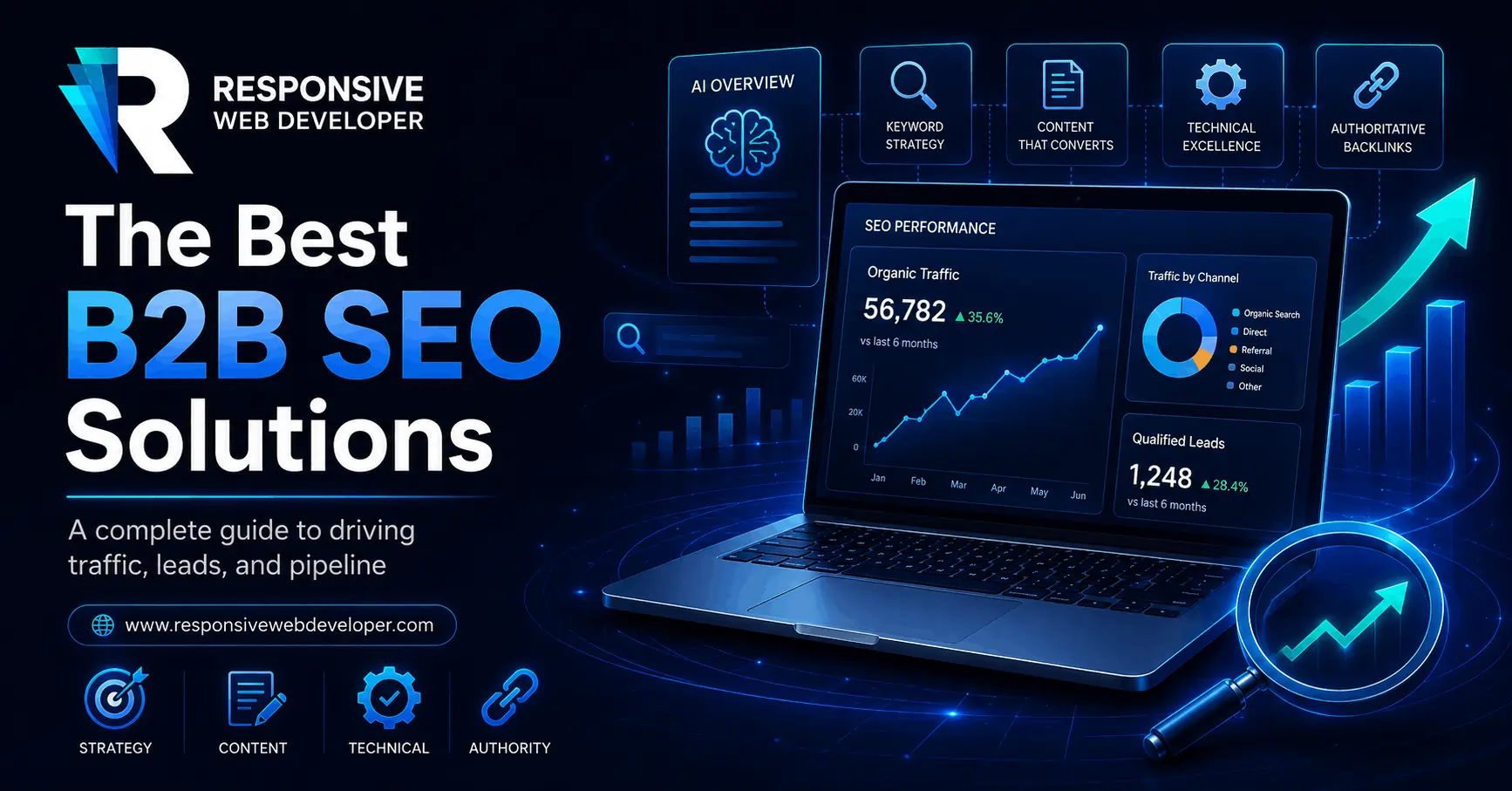
Your traffic chart points up and to the right. Your pipeline is flat. Somewhere between those two facts, your budget is leaking.
That gap is the reason most B2B SEO solutions disappoint. They borrow tactics built for consumer brands, chase high-volume keywords, and report a traffic number that never becomes a sales conversation.
Here is the reframe that fixes it: there is no single best B2B SEO solution. There is only the right solution for the specific problem your program has right now. Buy the wrong one and you pour money into content when your site can’t be crawled, or into links when your pages convert nobody.
This guide helps you diagnose which problem you have, then points you to the solution that fixes it and the tools or people you need to execute.
What Are B2B SEO Solutions?
B2B SEO solutions are strategies and services designed to help business-to-business companies attract qualified buyers through organic search. They typically include keyword research based on buyer intent, content creation for each stage of the sales funnel, technical SEO, link building, and optimization of product or service pages. The goal is not just to increase website traffic, but to generate sales-qualified leads, build pipeline, and drive revenue.
Why “B2B SEO Solutions” Isn’t One Thing You Buy
Search for the best B2B SEO solution and you get a wall of tool logos and agency pitches, each claiming to be the answer. That framing is the trap.
A working B2B SEO program is a stack, not a purchase. It has four layers, and a weakness in any one caps the results of the rest:
- Strategy: which keywords, which buyers, and which funnel stage you target first.
- Content: the pages that earn rankings and convince a skeptical buying committee.
- Technical: the site health that lets those pages get crawled, indexed, and cited.
- Authority: the links and mentions that make search engines and AI models trust you.
On top of those sits a delivery decision: run it in-house, hire an agency, use freelancers, or blend all three. The best solution for SEO in B2B is whatever combination produces pipeline for how your company sells. So before you spend a dollar, figure out which layer is broken.
Why B2B Search Breaks the B2C Playbook
Most B2B SEO solutions fail for one reason. They treat B2B search like consumer search with bigger deal sizes. Three constraints make that assumption expensive.
You sell to a committee, not a person. A typical B2B purchase runs through several stakeholders, from the end user to finance to the executive who signs. Each one searches for different things and cares about different proof. Your content has to satisfy readers who barely agree on the problem.
The sales cycle is long, so attribution is messy. A prospect might read your comparison page in March and sign in September after five more touchpoints. Last-click reporting will never hand SEO the credit, which is exactly why teams fall back on traffic as a proxy.
The keywords carry low volume and high value. “Best payroll software for construction firms” might pull a few hundred searches a month. A consumer marketer would ignore it. Run the math instead. Say 300 monthly searchers include 10 real buyers, your average contract is $30,000, and you close 20% of them. That one page influences $60,000 a quarter, and it compounds every month it holds the ranking. Volume is a vanity input here. Intent is the signal.
Once you accept these rules, the question changes. You stop optimizing for how many people arrive and start optimizing for whether the right people find you at the right moment.
Diagnose Your Bottleneck Before You Buy Anything
Here is the part most guides skip. The symptom you can see rarely names the problem you have. Match yours below, then jump to the solution it points to.
- Traffic is up, pipeline is flat. You have plenty of top-of-funnel blog posts and almost no pages for buyers who are ready to act. Fix: target buying intent (Solution 1).
- You publish constantly, but rankings stay flat. Your content is scattered across disconnected posts with no depth or internal linking. Fix: build topical authority (Solution 2).
- You rank, but AI answers steal the click. A summary resolves the query before anyone reaches your page. Fix: optimize to be cited (Solution 3).
- Great content, no rankings at all. Search engines may not be able to crawl, index, or load your pages. Fix: the technical foundation (Solution 4).
- Rankings and traffic look great, but leadership wants to cut the budget. You are reporting inputs nobody funds. Fix: measure pipeline (Solution 5).
Most programs have one dominant bottleneck. Solve that first instead of buying the whole menu at once.
Solution 1: Target Buying Intent, Not Search Volume
The fastest way to make B2B SEO pay is to reverse the usual keyword priority. Most guides tell you to start broad and build awareness. In B2B, start at the bottom of the funnel and work up.
Map keywords to three buying stages:
- Problem-aware: “why is our sales pipeline stalling.” The buyer feels the pain but doesn’t know the category yet.
- Solution-aware: “sales pipeline management tools.” They know a category exists and want to compare approaches.
- Vendor-aware: “[competitor] alternatives,” “[competitor] vs [competitor],” “[category] pricing.” They are close to a decision.
Vendor-aware searches convert best, and they face less competition because writing them well takes real product knowledge. Build these page types first:
- Comparison pages (“X vs Y”) that weigh you fairly against alternatives.
- Alternatives pages (“best [competitor] alternatives”) that capture buyers already in motion.
- Pricing and ROI pages, where intent runs highest.
- Use-case and integration pages that match how buyers describe their need.
Bottom-of-funnel pages convert at a far higher rate than educational posts. Build your money pages first, then expand up the funnel once they earn. That order front-loads revenue and buys the authority to compete for broader terms later.
Solution 2: Build Topical Authority, Not a Content Farm
Scattered blog posts don’t build authority. Concentrated depth does. Google rewards sites that cover a subject thoroughly over sites that publish one clever post about everything.
The proven structure is a pillar page on a core topic, supported by a cluster of focused articles, all tied together with internal links. A payroll company might build a pillar on “accounts payable automation,” then surround it with articles on compliance, software comparisons, and industry-specific workflows, each linking back. That structure signals expertise to search engines and gives buyers a path from their first question to your product.
Internal linking alone can lift organic traffic meaningfully. It is one of the highest-leverage and most underused moves available.
Then go one step further and organize by your ideal customer, not just by keyword. Build solution pages and case-study clusters segmented by industry or role: “for healthcare,” “for logistics,” “for teams under 50.” This mirrors how buyers search and how AI systems match content to a specific asker.
One caution worth heeding: depth beats breadth. Companies that flooded the web with thousands of pages outside their expertise have watched Google’s helpful-content systems erase a large share of their traffic. Go deep in your lane. Publish nothing about office snacks to chase clicks.
Solution 3: Get Cited by AI, Not Just Ranked
Here is the shift no B2B SEO solution can ignore. A growing share of buyers now start research inside an AI summary, opening ChatGPT, Perplexity, or Google’s AI Overviews to build a shortlist before they visit a single site.
That splits your job in two. Traditional SEO gets your page ranking. Answer Engine Optimization, sometimes called Generative Engine Optimization, gets your content quoted inside the AI answer. You need both, because these systems overwhelmingly pull citations from pages that already rank well.
To make your content easy to cite:
- Answer the question in the first sentence under each heading, then elaborate. Models lift clean, self-contained statements.
- Keep those answer blocks tight, roughly 40 to 60 words, and specific. Concrete figures and definitions get pulled more than vague prose.
- Add an FAQ section with FAQPage schema so machines can parse your questions and answers.
- Build mentions off your own domain, on industry publications, LinkedIn, and community threads, since AI models weigh what the wider web says about you.
- Check that your robots.txt allows the AI crawlers you want citing you. You cannot be quoted by a system you have blocked.
Ranking still matters. The goal now is to earn the ranking, then make the page quotable.
Solution 4: Fix the Technical Foundation
None of the above ranks or gets cited if machines can’t read your site. Technical SEO is the plumbing, and B2B sites tend to spring the same leaks as they accumulate landing pages, gated assets, and old campaign URLs.
Keep this part boring and correct:
- Crawlability and indexation: make sure important pages are reachable in a few clicks and indexed, and that thin or gated pages aren’t wasting crawl budget.
- Core Web Vitals: slow B2B sites, often bloated by marketing scripts, lose rankings and patience.
- Site architecture: group related content so a crawler and a buyer can both find any key page fast.
- Structured data: schema helps search engines and AI answers understand context, from FAQs to products.
- Gated content: if your best material lives behind a form, give search engines an ungated version to index, or you’re invisible for those terms.
A technical audit rarely wins headlines, but it is often the cheapest win available. On enterprise sites with thousands of URLs, fixing crawl waste and internal linking usually beats publishing more on a broken base.
Solution 5: Measure Pipeline, Not Pageviews
Rankings and traffic are inputs. In B2B they can also mislead, because the long sales cycle hides SEO’s real contribution behind last-click reporting. The fastest way to get your budget cut is to report sessions. The fastest way to grow it is to report pipeline.
Tie your program to metrics leadership already tracks:
- Organic-sourced leads (MQLs and SQLs).
- Pipeline influenced by organic search, measured with multi-touch attribution so long journeys get credit.
- Revenue and closed deals attributed to organic.
- Cost per acquisition versus paid, where organic usually wins by a wide margin.
Set expectations up front too. B2B SEO typically takes several months to break even, and ranking is slower than it used to be. That lag is the reason starting now beats waiting: authority compounds, and every month you delay is a month a competitor’s lead gets harder to overtake. When you can show that organic sourced a specific figure in pipeline last quarter, SEO stops being a cost center and becomes a channel worth expanding.
Who Should Execute: In-House, Agency, Freelance, or Tools
Once you know the bottleneck, decide who fixes it. Each option carries a clear trade-off.
- In-house team: deepest product and customer knowledge, best when SEO is a long-term core channel, but slow and expensive to build.
- Specialist B2B agency: fast access to experience and process, good when you need momentum. Vet hard for B2B, because an agency built on consumer tactics will sell you traffic you can’t bank.
- Freelancers: flexible and affordable for specific gaps like a technical audit or a content sprint, but you carry the strategy and coordination.
- Tools: an accelerant, never a strategy. Ahrefs and Semrush for research, Google Search Console (free and non-negotiable) for real query data, Screaming Frog for technical crawls, and a content optimizer like Clearscope or Surfer for coverage. In 2026, add one that tracks your visibility inside AI answers, not just Google positions.
A simple rule by situation. If you have the expertise but not the time, buy tools. If you have neither, hire a B2B specialist agency with in-house oversight. If you have deep domain expertise and can be patient, build in-house and add tools later. The most common winning setup is a hybrid: an in-house owner who holds strategy and product context, execution horsepower from an agency or freelancers, and a lean tool stack underneath.
The Bottom Line
The best B2B SEO solution is not a tool you buy or a tactic you copy. It is the specific fix for the specific problem your program has: intent when your traffic doesn’t convert, authority when your content doesn’t rank, AI citations when summaries steal the click, technical work when nothing gets crawled, and pipeline reporting when leadership wants proof.
Start small and specific this week. Run the diagnosis above, name your one dominant bottleneck, and fix that before touching anything else. For most teams, that means auditing existing pages, sorting them by funnel stage, then building the two or three bottom-of-funnel pages you are missing. Get those cited and converting, then expand.
Do that, and your SEO starts paying you back in revenue, not just rankings.
Related Articles:
- B2B SEO Best Practices That Drive Pipeline
- B2B SEO Trends 2026: What Actually Moves Pipeline
- B2B SaaS SEO: Rank, Place, or Skip Every Keyword
- B2B SEO Specialist: Hire for Pipeline, Not Traffic
- B2B SEO Consultant: How to Hire One Who Moves Pipeline
- B2B SEO Case Study: 5 Plays That Move Pipeline
- B2B SEO Audit: Fix What’s Costing You Pipeline
- SEO for B2B Companies: Diagnose Before You Cut It
- B2B Tech SEO: Your Whole Market Fits on One Sheet
- SEO for B2B Marketing: A Portfolio, Not a Calendar
- B2B SEO Statistics 2026: Where the Sources Disagree
- B2B Local SEO: The Playbook Most Marketers Get Wrong
- B2B SEO Keywords: How to Choose Ones That Convert
- B2B Ecommerce SEO: The 2026 Pipeline Playbook
- Best SEO Platform for B2B: A 2026 Buyer’s Guide
Last Updated on 1 month ago by Alipio Umiten IV
