





B2B SEO Strategy
You can rank first for your best keyword and still lose the deal in week six.
The person who found you is rarely the person who kills the purchase. A security engineer asks about SOC 2. A CFO asks what this replaces. Procurement asks who else runs it at your scale. If your site has nothing to say to any of them, your champion goes quiet and the deal dies inside a committee you never met.
Most B2B SEO strategy work never gets near that problem. It opens a keyword tool, sorts by volume, and produces articles that attract readers with no budget and no signing authority. The traffic report looks healthy. The pipeline report does not.
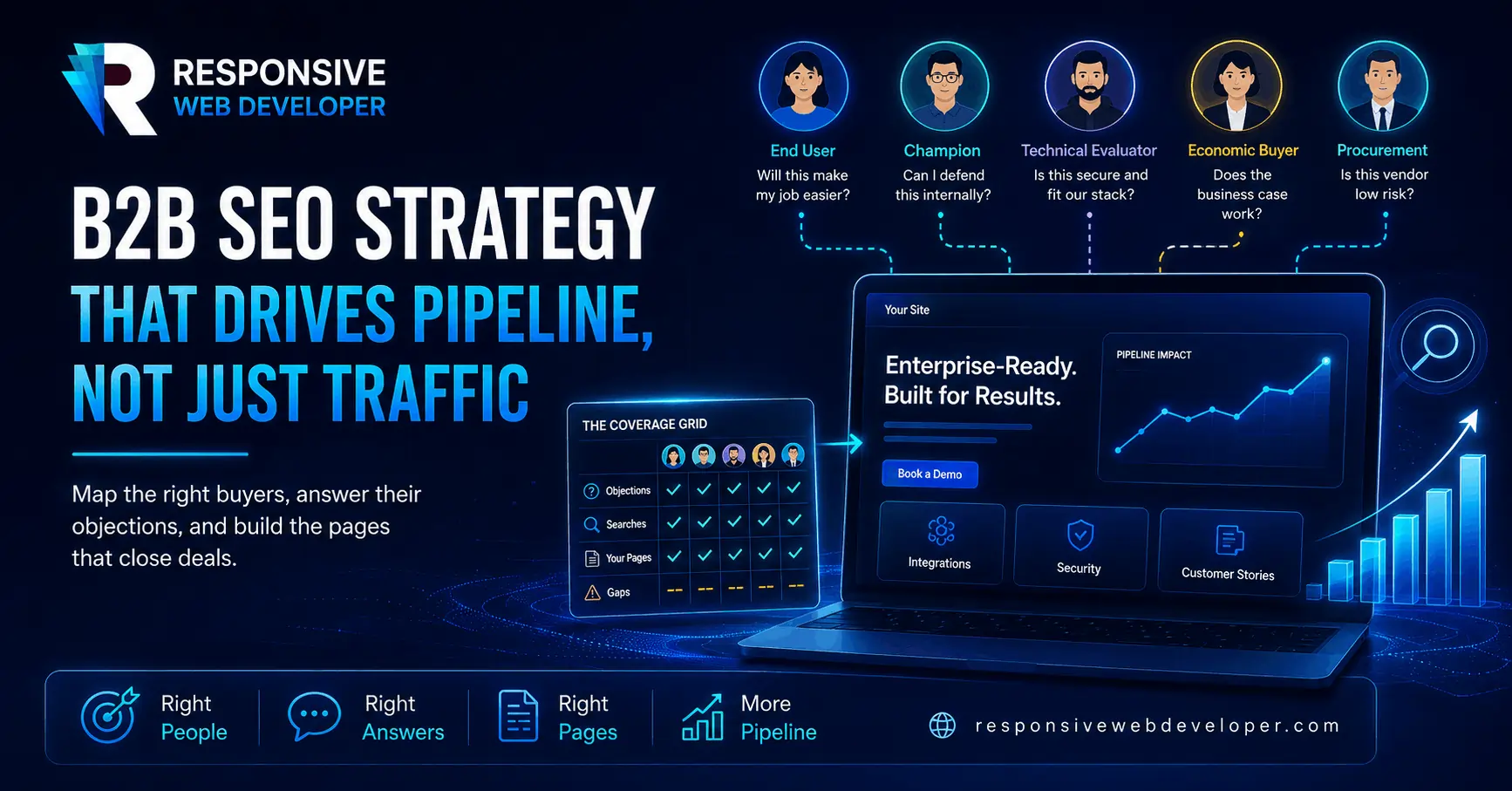
This guide treats B2B SEO as a coverage problem. Map the people who can block a deal, the objection each one raises, and the page that resolves it. Then look at which cells are empty. Those gaps are your roadmap, and they are almost always the shortest route from organic search to a booked demo.
Traffic is a proxy. Coverage is the strategy.
A B2B SEO strategy is not a content calendar. It is a promise: for every question that can stall a deal, there is a page that answers it, and the right person can find that page at the moment they ask.
Three facts about business buying force this reframe.
The buyer is a group, not a person. A single purchase pulls in a champion, an end user, a technical evaluator, an economic buyer, and someone in procurement whose job is to find reasons to say no.
The cycle is long and non-linear. Someone reads your explainer in February and books a demo in July after four other touches. Last-click attribution will tell you SEO contributed nothing. It is wrong.
Volume is low and value is high. A keyword with 90 searches a month can be worth more than one with 90,000, because those 90 people are the only ones who can sign the contract. Keyword tools cannot see that. Your CRM can.
Once you accept those three, the question stops being “what can we rank for?” and becomes “which beliefs does a deal require, and do we own the page that creates each one?”
Build the grid: roles, stages, objections
The grid is a spreadsheet. It takes an afternoon and it will outperform most keyword audits you have paid for.
Step 1: List the roles that can say no
Pull your last ten closed-won deals and your last ten closed-lost. Write down every job title that touched them. You will usually land on four to six roles, and one of them will surprise you. IT security shows up on deals nobody thought were technical. Legal shows up on anything touching customer data.
Step 2: Write the belief, not the keyword
For each role, finish this sentence: “Before this person approves, they need to believe ____.”
The VP of Engineering needs to believe it will not break production. The CFO needs to believe the cost case survives contact with a spreadsheet. The end user needs to believe their Tuesday gets easier, not harder.
Every one of those is a content brief. None of them came from a keyword tool.
Step 3: Turn each belief into a query, then a page
Now work backward to what that person actually types.
| Role | What they must believe | What they search | The page that resolves it |
|---|---|---|---|
| End user | This makes my job easier | “how to reduce manual sales reporting” | Workflow guide with real screenshots |
| Champion | I can defend this internally | “[category] ROI,” “how to build a business case for [category]” | Business case template, ROI calculator |
| Technical evaluator | This fits our stack safely | “ Salesforce integration,” “SOC 2 compliance checklist” | Integration page, security page, docs |
| Economic buyer | The math works | “[category] pricing,” “is [category] worth it” | Pricing explainer, named case study with numbers |
| Procurement | This vendor is not a risk | “[competitor] alternatives,” “[brand] vs [brand]” | Honest comparison page, customer logos, compliance page |
Step 4: Find the empty cells
This is the whole exercise. Go cell by cell and ask two questions: do we have a page for this, and does it rank or get cited?
Most B2B sites are dense at the top left (educational content for practitioners) and empty everywhere else. That emptiness has a name. It is the reason your traffic climbs while your win rate does not, and it is why a competitor’s comparison page shows up in the AI answer your buyer reads on the day they build their shortlist.
Fill the bottom row first
Standard SEO advice says build awareness content, grow an audience, nurture people down. For B2B, invert it. Start where intent is highest and money is closest.
Bottom-of-funnel pages are unglamorous, so most competitors build them badly or not at all. That is your opening. They also carry information nobody can synthesize from thin air: your pricing logic, your integration behavior, a named customer’s measured result. And commercial queries trigger AI summaries far less often than informational ones, so the clicks still arrive.
Build or upgrade these before you publish another explainer:
- Comparison pages. “[You] vs [Competitor].” Be specific and be fair. Say where the competitor wins and buyers will trust the section where you do.
- Alternatives pages. “[Competitor] alternatives” catches people already unhappy with a rival. Lay out the real field, include yourself, let fit do the selling.
- Use-case and industry pages. “[Product] for [industry]” answers the exact question a specific buyer is asking.
- Integration pages. “[Product] + [tool]” removes the technical evaluator’s veto.
- Pricing and ROI pages. Anyone searching cost signals is close to a decision.
- Case studies with real numbers. “[Customer] cut onboarding time by [X]% in [Y] weeks” is proof no competitor and no model can invent.
A single strong comparison page can outperform fifty blog posts on pipeline.
Score keywords for intent, not volume
Once the grid tells you which pages to build, keyword research becomes a scoring exercise instead of a fishing trip. Rate every candidate term from 1 to 5 on four axes:
- Buyer intent. Would someone searching this be evaluating a purchase?
- ICP fit. Does this searcher look like your best customers?
- Business relevance. Can your product plausibly be the answer on the page?
- Winnability. Can you compete given your authority today?
The rule that saves the most wasted quarters: if you cannot explain the path from a keyword to revenue in one sentence, it is not a priority.
And mine your own sources before you open a tool. Sales call recordings, support tickets, lost-deal notes, and G2 reviews contain the exact phrasing your market uses. Reddit threads and industry Slack groups surface questions months before they show up as search volume anywhere.
Clusters give the grid a structure
Search engines reward depth on a subject, not a single lucky page. One article signals a dabbler. Fifteen interconnected pages signal an authority.
Pick two or three themes you can credibly own, then build each as a pillar page surrounded by cluster pages that go deep on subtopics. Link the clusters back to the pillar, the pillar out to each cluster, and both toward the commercial pages the grid told you to build.
Depth in a narrow lane compounds. Breadth across lanes you have no claim to does the opposite, and can actively suppress the pages you care about.
Internal linking is the free lever most B2B teams underuse. Every new page should link to the two or three existing pages it naturally supports, with descriptive anchor text. “See our sales forecasting software” beats “learn more” for readers and crawlers alike.
Cover the answers, not just the blue links
Ranking is now half the job. B2B SEO search marketing has to account for AI Overviews, ChatGPT, Perplexity, and Gemini, because vendor research is exactly the kind of task buyers hand to an assistant. Someone typing “top alternatives to [Vendor X] for mid-market manufacturing” is deep in a purchase decision. You want to be in that answer.
Two things drive citations, and neither is keyword density.
Be the source worth quoting. Lead sections with a clear, self-contained answer, then expand. Use clean headings, plain definitions, and concrete numbers with dates. Add structured data (Organization, Product, FAQ) where it truly applies, and skip the tricks like fake ratings on comparison pages, because they backfire.
Be present where the models look. AI answers lean heavily on third-party sources. Your standing on G2, in relevant subreddits, and on trusted industry sites shapes how you get described before a buyer ever reaches your domain.
Then measure it. Run your top 30 to 50 buyer prompts through the major assistants once a month and log which ones name you and which name a competitor. That log is the AI-era version of a rank tracker.
Build what a summary cannot replace
The content most resistant to being flattened into a paragraph shares one trait: the value does not survive extraction.
Original research and proprietary benchmarks get cited, and the citation points back to you. Calculators, assessments, and templates deliver their value through use, so the click survives. Opinionated comparisons, backed by specifics on where each option wins and loses, are hard to synthesize. Named case studies with quantified outcomes cannot be fabricated.
If a page’s entire value is a definition, assume that definition gets handed to the searcher for free.
Keep the foundation from leaking
None of this replaces technical hygiene. It sits on top of it.
- Crawlability and indexation. Confirm your revenue pages are indexed and not orphaned. Check Search Console coverage after every redesign.
- Site architecture. Keep key pages within a few clicks of the homepage.
- Speed and Core Web Vitals. Slow B2B sites lose rankings and demos.
- Structured data. Mark up entities so both search engines and language models parse your context correctly.
- Gated content. A PDF behind a form is invisible to search. Publish an indexable summary page, then offer the deeper cut to people who opt in.
None of it is exciting. All of it is the price of entry.
Measure the way finance does
If you change one number this year, change your primary one. Rankings describe activity. Pipeline describes results.
Report in three layers:
- Leading: rankings on bottom-of-funnel terms, impressions, share of voice on ICP queries, and your monthly AI citation rate.
- Converting: demo requests and trials from organic, plus conversion rate broken out by page type. A comparison page and an awareness guide should never be judged by the same metric.
- Lagging: pipeline sourced and influenced by organic, MQL-to-SQL rate, and closed-won revenue.
Attribution in B2B is messy and always will be. Two practical fixes carry most of the weight: a “How did you hear about us?” field on your demo form, and multi-touch reporting that credits SEO’s assist instead of only the last click. Aim for directionally right and consistently measured, and stop pretending last-click tells the truth.
Set the timeline expectation before anyone asks. Meaningful pipeline from a B2B SEO strategy typically takes months, not weeks, depending on your domain authority and publishing pace.
Your first move this week
Book 60 minutes with two salespeople and ask three questions. What do prospects ask right before they buy? Which competitors keep coming up, and why do we lose? What does the market misunderstand about our category?
Take the answers and build the grid for one product. Fill in the roles, the beliefs, the queries. Then count the empty cells and ship the one closest to a signature, which is almost always a comparison or alternatives page.
That is a week of work. It will tell you more about where your B2B SEO strategies are leaking than a quarter of keyword research.
The takeaway
B2B SEO does not fail from a lack of content. It fails from gaps in coverage: an objection nobody answered, a role nobody wrote for, a decision-stage query a competitor owns.
Build the grid. Fill the bottom row first. Earn depth in one lane instead of breadth across ten. Get cited by the answer engines your buyers already trust. Then measure the only number that keeps the budget: pipeline.
Audit your ten highest-effort pages this week and ask one question of each: is this earning pipeline, or just sessions? Rebuild everything that fails the test, starting with the pages closest to a buying decision.
Related Articles:
- How to Choose the Best B2B SEO Agency (Buyer’s Guide)
- Best B2B SEO Services: Vet the Agency, Then Yourself
- B2B SEO Best Practices: A 2026 Pipeline Playbook
- B2B SEO Solutions: Fix the Right Problem First
- B2B SaaS SEO: Rank, Place, or Skip Every Keyword
- B2B SEO Trends 2026: What Actually Moves Pipeline
- B2B SEO Specialist: Hire for Pipeline, Not Traffic
- B2B SEO Consultant: How to Hire One Who Moves Pipeline
- B2B SEO Expert: How to Hire One Who Drives Revenue
- SEO for B2B Companies: Diagnose Before You Cut It
- B2B Marketing Agency: How to Choose One (2026 Guide)
- B2B Tech SEO: Your Whole Market Fits on One Sheet
- SEO for B2B Marketing: A Portfolio, Not a Calendar
- B2B SEO Statistics 2026: Where the Sources Disagree
- B2B Local SEO: The Playbook Most Marketers Get Wrong
- B2B Enterprise SEO: The 3 Ceilings That Cap Growth
- B2B SEO Keywords: How to Choose Ones That Convert
- B2B Ecommerce SEO: The 2026 Pipeline Playbook
- Best SEO Platform for B2B: A 2026 Buyer’s Guide
Last Updated on 3 months ago by Alipio Umiten IV
