




What Is Off Page SEO?
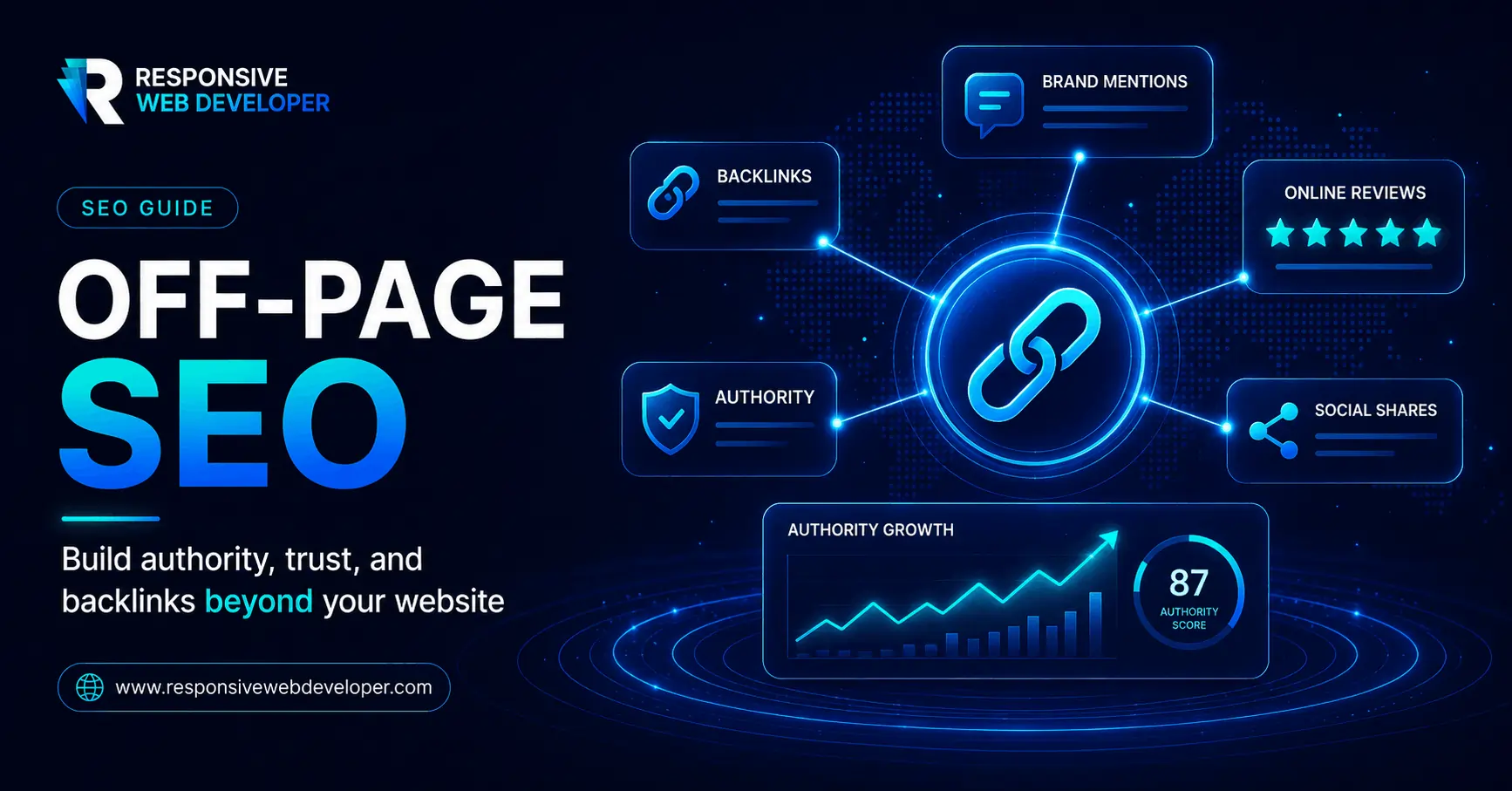
Off-page SEO is the work you do outside your website to support its visibility in search. It includes earning links from other websites, managing relevant business listings, and building a reputation through reviews and independent coverage.
Start by choosing one useful page to promote, identifying people who would benefit from it, and giving relevant publishers a reason to reference it. If you serve customers locally, also check your business information and establish a consistent process for requesting honest Google reviews.
The goal is to earn useful exposure and relevant visitors. No tactic or backlink count guarantees higher rankings.
How off-page SEO fits with other SEO work
The distinction is where the work happens:
- On-page SEO: Improve your page’s content, headings, titles, and internal links.
- Technical SEO: Help search engines access and index your pages, and keep the site functioning properly.
- Off-page SEO: Earn references and attention elsewhere, such as a publication linking to your guide or a customer reviewing your business.
A backlink is a link from another website to yours. Google uses link analysis systems, including PageRank, to help assess what pages cover and how useful they may be. Links are one part of its ranking systems. Google’s ranking systems guide.
Before promoting a page, check that it loads, provides what its title promises, and is available for indexing. Sending visitors to an incomplete or broken page wastes the opportunity.
Choose a starting point that matches your situation
Use this table to choose your first project. It is a planning aid, not a ranking formula.
| Your situation | Start here | Why this is a useful first step |
|---|---|---|
| You serve customers in person | Check eligible business profiles, correct listing errors, and request honest reviews | Helps people find accurate local information and assess your business |
| You have a useful guide, tool, or original dataset | Introduce it to relevant editors and resource-page owners | Gives publishers something specific to reference |
| Publications already mention your business | Check for incorrect details, missing links, or links to broken pages | Builds on existing awareness and fixes reader access |
| You have specialist knowledge but little content | Offer a focused contribution to a relevant publication or podcast | Provides a reason to feature your expertise |
| Your site has little useful content | Improve one destination page before starting outreach | Gives readers and publishers a reason to visit |
Choose one primary activity you can sustain. A short, carefully selected contact list is a practical starting point.
Practical ways to build your off-page presence
Earn links to resources people can use
Link building means working to earn links from other websites. Begin with a resource that solves a specific problem: a comparison worksheet, an illustrated tutorial, a calculator, or research with a clearly explained method.
Publishing the resource happens on your site. Introducing it to relevant publishers is the off-page part.
Use this process:
- Choose a specific audience. Identify who needs the resource and what they can accomplish with it.
- Find relevant pages. Look for publications, association websites, or resource lists that already cover the subject.
- Read each page. Identify a specific gap your resource fills. Skip prospects with no clear connection.
- Send a concise, individual pitch. Explain the reader benefit and provide the most relevant destination URL.
- Record the response. Track useful feedback, published references, and visits. Respect refusals and avoid repeated unsolicited messages.
Two related opportunities are link reclamation, correcting a broken or outdated link to your own content, and broken-link outreach, suggesting your resource as a replacement for an unavailable page on another site. Offer a replacement only when it serves the original link’s purpose.
An existing brand mention can also be worth reviewing. If a link would help readers find the cited resource, ask the publisher to add one. The publisher decides what belongs on the page.
Contribute expertise through digital PR
Digital public relations focuses on earning online coverage. A useful contribution might be an expert explanation, a documented finding, a relevant interview, or a well-supported response to a journalist’s request.
Start with the publication’s audience. Offer evidence, explain its limits, and make the source easy to verify. A small study with a transparent method can be more useful to an editor than a broad claim with no supporting data.
Guest articles and podcast appearances can serve a similar purpose. Choose outlets that reach people interested in your subject and contribute something specific. Editorial coverage may include a link, an unlinked mention, or neither; assess its audience value before committing time.
Improve local listings and request honest reviews
For businesses that serve customers in person, Google Business Profile can be a useful starting point. Eligibility generally requires in-person customer contact, with defined exceptions. Online-only businesses are ineligible. Check Google’s eligibility requirements before creating a profile.
Keep your business name, contact information, hours, category, and location or service area accurate. Correct outdated information on relevant directories and professional association listings. A local citation is an online reference to business details such as its name, address, and phone number; it may have no website link.
Google says local results depend mainly on relevance, distance, and how well known a business is. More reviews and positive ratings can help local ranking. This applies to local results, so it should not be generalized into a claim that reviews automatically improve every website’s rankings. Google’s local ranking guidance.
Invite customers to share their actual experiences, without filtering invitations by the rating you expect. Do not offer discounts or gifts for reviews, purchase reviews, or discourage negative feedback. Google prohibits incentivized reviews and selectively soliciting positive ones. Google Maps contribution policy.
Respond constructively to feedback and check each platform’s rules before requesting reviews there.
Use social media and communities for distribution
Share useful material where people discuss your subject. Answer the discussion directly, disclose relevant affiliations, and link only when the destination adds useful detail and the community permits it.
Google includes social promotion and community engagement among ways to help people discover content. That supports using these channels for distribution; it does not establish a guaranteed ranking benefit from likes or shares. Google’s website promotion guidance.
Track relevant visits, inquiries, and relationships that develop. Keep social engagement and unlinked mentions separate from backlinks in your reporting.
How to assess a link opportunity
Evaluate the actual page and its readers before considering a website’s numerical score.
- Audience: Would the people reading this page have a reason to use your resource?
- Purpose: Does the link support a claim, provide a source, or help complete a task?
- Editorial standards: Does the publisher review contributions and provide accountable authorship?
- Placement: Would the reference fit naturally into the content?
- Destination: Does it lead directly to the promised information on a working page?
Third-party authority scores can help organize research, but treat them as tool-specific indicators. Google says these services do not have access to its internal ranking data, and their predictions may not materialize. Google’s guidance on third-party SEO tools.
You may also encounter link attributes: sponsored identifies paid placements, ugc identifies user-generated content, and nofollow qualifies other links. These describe the relationship to the linked page. A qualified link can still give readers a route to your website. Google’s link attribute guidance.
Tactics that create avoidable risk
Google’s link-spam policies cover practices such as buying links for ranking credit, excessive link exchanges, automated link creation, and low-quality directory links. Large-scale guest-post campaigns with keyword-heavy links can also violate those policies. Google’s link-spam policy.
Paid advertising and sponsorships can have legitimate marketing value. If you pay for a placement, the publisher should qualify its links appropriately; Google recommends rel="sponsored" and also accepts nofollow. Do not purchase a promise of ranking credit. Google’s paid-link guidance.
Avoid making automated “toxic link” scores a routine cleanup target. Google says most sites do not need its disavow tool, which asks Google to disregard specified links. Its stated use is for substantial numbers of artificial or spammy links that have caused, or are likely to cause, a manual action. Incorrect use can harm search performance. Google’s disavow guidance.
A first-month plan with a limited time budget
Hypothetical example: An independent US bookstore has a functioning website, a claimed Business Profile, and an existing book-club discussion guide. The owner can spend 10 hours this month improving its off-page presence. There is no paid-placement budget.
The objective is to introduce that guide to relevant local readers and record the response. These hours are an illustrative allocation, not a benchmark or performance forecast.
| Week | Time | Work to complete |
|---|---|---|
| 1 | 2 hours | Record current search clicks and referral visits. Check business information and existing links to the guide. |
| 2 | 3 hours | Improve the guide’s weakest section. Identify five relevant library, book-club, or community resource pages and read their submission policies. |
| 3 | 3 hours | Send individual pitches explaining how the guide helps each audience. Share a useful excerpt through an appropriate community channel. |
| 4 | 2 hours | Review responses, published references, and visits. Note objections and choose one improvement for the next outreach round. |
If the guide needs substantial work, reduce the outreach list and spend more time on the resource. If editors find it useful but decline links, use their feedback to assess its distribution potential. A first month can produce useful learning even when rankings remain unchanged.
Measure exposure, search performance, and business results separately
Keep a simple spreadsheet with the referring page, destination URL, contact date, response, published link or mention, and any observed visits or inquiries.
Review three types of evidence:
- Exposure: Relevant coverage, new links, and distinct websites linking to you. These websites are called referring domains.
- Search performance: Clicks and impressions for the promoted pages and relevant searches. Google Search Console’s Performance report provides these metrics.
- Business results: Purchases, registrations, calls, or qualified inquiries, using website analytics and customer records where available.
Use Search Console’s Links report to inspect known links, but expect incomplete coverage. Google says it provides a sample, not a comprehensive inventory, and it does not identify links as nofollow. Search Console Links report documentation.
Compare similar periods and record other changes, including new content, promotions, and seasonal demand. A traffic increase after outreach is evidence to investigate, not proof that one backlink caused it.
There is no dependable deadline for off-page SEO results. Google notes that search-related changes can take hours to months to appear, and some produce no noticeable improvement. Treat the first month as a work schedule, not a ranking deadline. Google’s guidance on SEO timing.
Start with one page, one audience, and one activity from the decision table. Record your baseline, complete the work, and use the response to choose the next step.
Frequently Asked Questions About Off Page SEO
Here are quick answers to common questions about off-page SEO.
What is considered off-page SEO?
Off-page SEO includes activities performed outside your website to improve its visibility, reputation, and authority. Common examples include earning relevant backlinks, gaining brand mentions, receiving customer reviews, building local citations, conducting digital PR, and participating in industry communities.
Backlinks are an important part of off-page SEO because Google uses links to discover pages and understand their relevance. However, link quality, relevance, and authenticity matter more than quantity. Paid, spammy, or manipulative link-building practices can violate Google’s spam policies.
What is the basic difference between on-page and off-page SEO?
On-page SEO focuses on optimizing elements within your website, such as content, headings, internal links, page titles, and user experience. Off-page SEO involves activities outside your website, including earning backlinks, building brand mentions, gaining reviews, and improving your online reputation.
In simple terms, on-page SEO helps search engines understand your website, while off-page SEO helps establish its credibility and authority.
Is off-page SEO still relevant?
Yes, off-page SEO is still relevant. High-quality backlinks, credible brand mentions, positive reviews, and digital PR can strengthen your website’s reputation, increase referral traffic, and support its visibility in search results.
However, off-page SEO is no longer about collecting as many links as possible. Relevance, quality, and authenticity matter more than quantity. This is especially important for AI-assisted content, which should provide accurate, original, and genuinely useful information rather than relying on backlinks to compensate for low-quality content.
What is an example of off-site SEO?
An example of off-site SEO is earning a backlink from a reputable industry website that references your research, guide, product, or expertise. Other examples include gaining brand mentions, receiving genuine customer reviews, appearing in media coverage, contributing expert insights, and maintaining accurate business listings.
Blog comments, forums, and directories may support visibility when they are relevant and genuinely useful, but they should not be used primarily to create artificial backlinks.
Is off-page SEO harder than on-page SEO?
Off-page SEO can be more challenging than on-page SEO because you have less direct control over the results. While you can update your own content, headings, and technical elements, off-page SEO often depends on other websites, customers, or publishers linking to, reviewing, or mentioning your brand.
It usually requires strong content, relationship building, outreach, and patience to earn credible endorsements.
What are the three main components of off-page SEO?
The three main components of off-page SEO are:
- Backlinks: Relevant, high-quality links from reputable websites.
- Brand signals: Online mentions, reviews, citations, and recommendations that strengthen your reputation.
- Digital promotion: Activities such as public relations, content outreach, partnerships, and community engagement that increase awareness and earn coverage.
For backlinks, quality and relevance are generally more important than the total number of referring domains or the use of keyword-rich anchor text.
What is most useful for off-page SEO optimization?
The most useful off-page SEO strategies focus on earning genuine trust, visibility, and relevant mentions across the web. Effective techniques include digital PR, guest contributions on reputable industry websites, expert outreach, link-worthy content, customer reviews, brand mentions, and accurate local business citations.
Directory submissions and profile creation can still be helpful when the websites are reputable and relevant to your industry. However, mass submissions to low-quality directories or profiles created only for backlinks are unlikely to provide meaningful SEO value.
What are common off-page SEO mistakes?
Common off-page SEO mistakes include buying backlinks, posting spammy blog comments, participating in excessive link exchanges, using automated link-building services, and submitting a website to irrelevant or low-quality directories.
Other mistakes include prioritizing the number of backlinks over their quality, using overly optimized anchor text, and publishing low-value guest posts solely to gain links. Effective off-page SEO should focus on earning relevant mentions, links, and reviews through useful content, genuine relationships, and reputable sources.
Blog commenting and forum participation can still help build visibility and relationships when your contributions are relevant and helpful, but they should not be used merely to place backlinks.
Which is an example of off-page SEO?
An example of off-page SEO is earning a backlink from a reputable industry website that references your content, research, product, or expertise. Other examples include receiving positive customer reviews, gaining brand mentions, appearing in media coverage, and maintaining accurate business listings.
These activities take place outside your website and can help improve its visibility, reputation, referral traffic, and credibility.
Why do we do off-page SEO?
Off-page SEO helps improve your website’s visibility, reputation, and credibility across the web. High-quality backlinks, brand mentions, customer reviews, digital PR, and social promotion can introduce your business to new audiences and generate referral traffic.
These signals may also support stronger search visibility, helping attract more qualified visitors and creating additional opportunities for leads, conversions, and sales.
Does social media help off-page SEO?
Yes, social media can support off-page SEO indirectly by increasing the visibility and reach of your content. When blog posts, research, infographics, videos, or other useful resources are shared widely, they are more likely to attract brand mentions, referral traffic, media coverage, and natural backlinks.
Social engagement itself is not a direct substitute for backlinks, but it can help the right people discover your content and create opportunities for off-page signals that strengthen your online presence.
Which is more important, on-page SEO or off-page SEO?
Both on-page and off-page SEO are important, and they work best together. On-page SEO helps search engines understand your content and ensures visitors have a useful experience, while off-page SEO strengthens your website’s reputation through backlinks, reviews, mentions, and digital promotion.
If your website is new or poorly optimized, on-page SEO should usually come first. Once you have strong, helpful content and a solid website foundation, off-page SEO can help expand your authority, visibility, and reach.
Last Updated on 5 days ago by Alipio Umiten IV
