




Most LLMO projects start in the wrong place. A team rewrites forty pages, adds schema to all of them, ships an llms.txt file, and three months later discovers the CDN was blocking OpenAI’s crawler the entire time.
That is not a content problem. It was never a content problem. But almost every guide on the subject hands you a tactics list instead of a diagnosis, so teams work hard in the wrong order and conclude the channel doesn’t work.
LLMO, or large language model optimization, is the practice of getting your content retrieved, cited, and recommended inside AI-generated answers from ChatGPT, Google’s AI Overviews and AI Mode, Perplexity, Gemini, Claude, and Copilot. The mechanics are knowable. What separates the brands that get cited from the ones that don’t is usually one specific failure point, not a general lack of effort.
This guide covers what LLMO actually means, the five gates your content has to clear before an AI will name you, which tactics survive contact with real data, and how to find out which gate you’re stuck at this week.
What is LLMO?
LLMO is the practice of optimizing your content, site, and off-site presence so that language models retrieve, trust, and reference your information when generating an answer.
The unit of success changes from SEO’s. A search engine returns ten links and lets the user choose. An AI assistant returns one synthesized answer that names three or four sources. You are cited, mentioned, recommended, or absent. There is no page two of a ChatGPT response.
That changes what winning looks like:
| SEO measures | LLMO measures |
|---|---|
| Rankings and impressions | Citation rate and mention rate |
| Clicks and CTR | Share of voice against competitors |
| A ranking URL | A retrievable passage, claim, or entity |
| Traffic | Recommendation rate and accuracy |
LLMO vs GEO vs AEO vs SEO
Four acronyms, one job, heavy overlap:
- SEO targets ranked links in a search index.
- AEO (answer engine optimization) targets becoming the extracted answer: snippets, voice, People Also Ask.
- GEO (generative engine optimization) targets visibility inside generated answers. It has the strongest pedigree, coined in a 2023 paper by Aggarwal et al. from Princeton, Georgia Tech, IIT Delhi, and the Allen Institute for AI, presented at KDD 2024.
- LLMO frames the same goal around the model and its retrieval layer.
Google’s own position, published in its guide to generative AI features, is that optimizing for its AI experiences is optimizing for the search experience, and therefore still SEO. That is a fair description of Google’s surfaces and a weak one for everything else, since ChatGPT and Perplexity run their own crawlers, indexes, and selection logic. Conductor’s 2026 benchmark puts roughly 87% of visible AI referral traffic on ChatGPT, and OpenAI has published nothing equivalent to Google’s guidance.
Pick a term your team understands. Arguing about the label is the least valuable work available to you.
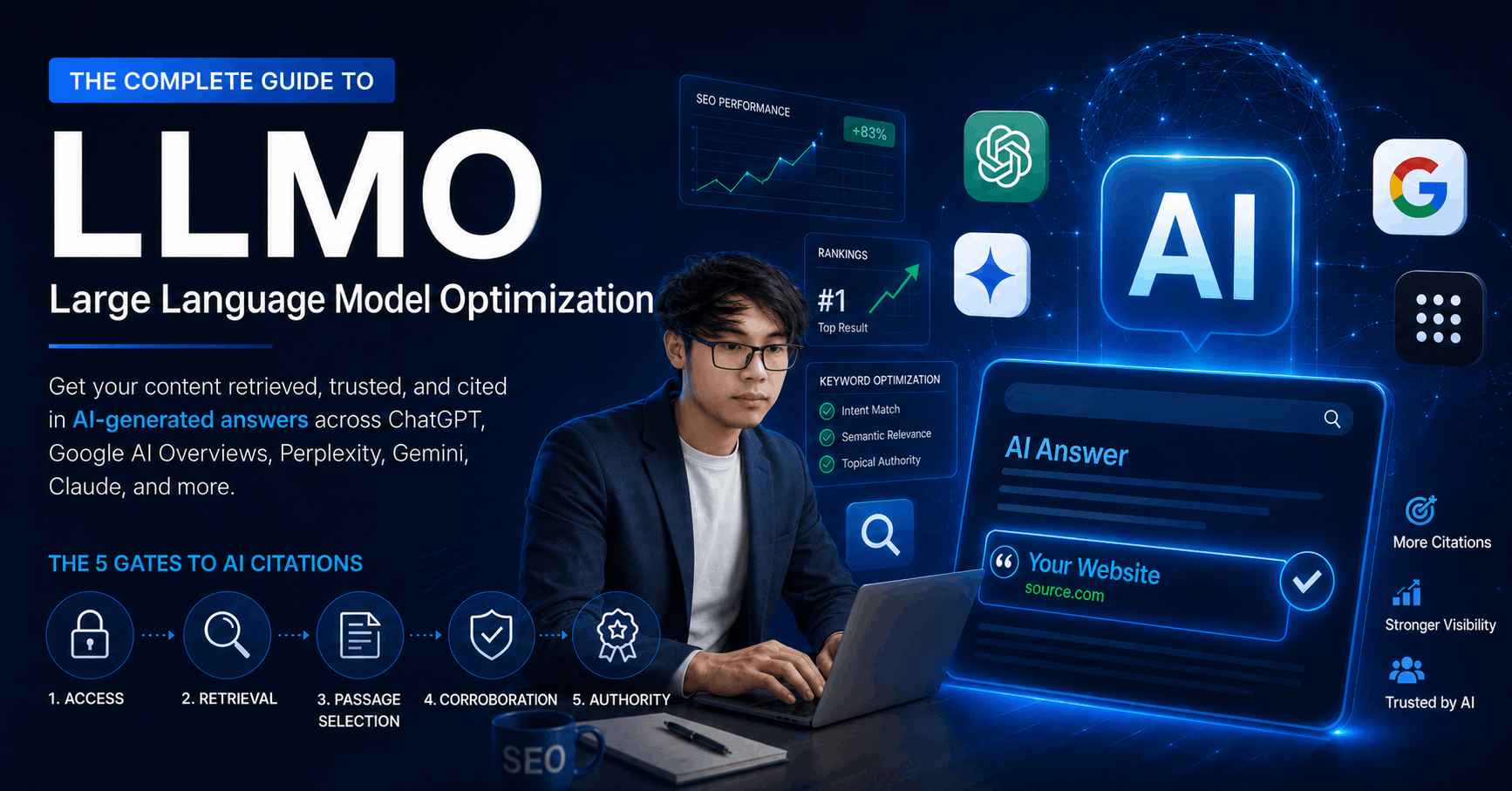
The five gates between your page and an AI citation
Your content has to clear five checkpoints in sequence. Fail one and everything downstream is wasted. Work through them in order.
Gate 1: Access
The bots have to reach you, and they are not interchangeable. OpenAI runs GPTBot for training, OAI-SearchBot for its search index, and ChatGPT-User for live fetches during a conversation. Anthropic runs ClaudeBot, Perplexity runs PerplexityBot, and Google-Extended governs Gemini training.
How it fails: A blanket robots.txt block written in 2024 to keep your content out of training also removes you from live retrieval. Or robots.txt is fine and your WAF is quietly returning 403s to every AI user agent.
Ten-minute test: Grep your server logs for GPTBot, OAI-SearchBot, ChatGPT-User, ClaudeBot, and PerplexityBot. Absence is a finding. Then check your CDN and bot-mitigation rules, not just robots.txt.
Fix: Allow the crawlers whose surfaces you want to appear on. Blocking them is a legitimate business decision. Doing it by accident is not.
Gate 2: Retrieval
AI search rarely searches what the user typed. It decomposes the prompt into sub-queries and runs them in parallel, a mechanic Google documents as query fan-out. Its own example expands a question about a weedy lawn into separate searches for herbicides, chemical-free removal, and prevention. Independent analyses put the fan-out at roughly 8 to 20 sub-queries for a complex question.
How it fails: You hold position one for your head term and lose anyway, because the model never ran your head term. A “best CRM software” page that never states a price, a seat limit, or an integration list loses every sub-query where those specifics get retrieved.
Ten-minute test: Take your most commercially important query and write down the ten sub-questions hiding inside it. Check which ones your site answers with a standalone passage.
Fix: Cover the cluster, not the keyword. The gaps are exactly where a competitor gets quoted instead of you.
Gate 3: Passage selection
Retrieved pages get split into semantically coherent chunks, embedded, and scored individually. The engine is not citing your page. It is citing a passage that has to make sense with nothing around it.
How it fails: Your pricing answer sits under 1,400 words of positioning copy. Or the section’s real answer only lands after three paragraphs of setup, so the extracted chunk is incoherent.
Ten-minute test: Copy any single H2 section out of your best page and read it cold. If it needs the paragraphs above it to make sense, it cannot be lifted.
Fix: Lead every section with a direct, self-contained answer in the first 40 words, then elaborate. Include the subject: write “LLMO is…” rather than “It is…”. One fact per sentence. Tables for anything comparative.
Gate 4: Corroboration
Systems compare passages across sources and favor claims more than one source supports. A claim that exists only on your own domain reads as marketing. The same claim across three third-party sources reads as consensus.
How it fails: This is where most well-optimized sites stall, and no amount of on-site work closes it. Citations concentrate hard in a small set of domains. In Google AI Overviews, the top 1% of domains capture close to half of all citations. Across engines, Reddit, Wikipedia, YouTube, LinkedIn, and major publishers dominate.
Ten-minute test: Run your top five buyer questions through ChatGPT and Perplexity and list every domain cited instead of you. That list is your PR target list.
Fix: Earn legitimate presence on those domains. Industry roundups, expert commentary, review platforms, genuine community participation. Google explicitly warns that chasing inauthentic mentions is less useful than it sounds, and its spam systems apply to generative features. Manipulating Reddit is a fast way to get banned.
Gate 5: Representation
Being mentioned and being represented well are different problems, and only one of them makes money.
How it fails: One reported case involved a company appearing in 85% of tracked prompts while converting almost nobody, because the model consistently described it as expensive. Stale pricing, discontinued products, and confused brand identity all produce technically-present, commercially-useless citations.
Ten-minute test: Ask four assistants “what does [your company] do and who is it for?” and read the answers as a skeptical buyer would.
Fix: Keep entity data consistent everywhere: same company description, same category language, same pricing, same facts across your site, your business profiles, directories, and third-party listings. Contradictions across sources make a model hedge, and hedging reads as a recommendation for someone else.
What the evidence actually supports
Not all LLMO advice carries equal weight. Sorted by how much evidence stands behind it:
Tier 1: Measured in controlled research
The Princeton GEO study tested nine optimization methods across GEO-bench, a benchmark of 10,000 queries, and measured visibility changes inside generated responses. Three won consistently:
- Add statistics. Replace qualitative claims with specific numbers. “Many teams struggle with attribution” is weak. “Only 14% of marketers track AI search as a separate channel” is retrievable.
- Add quotations. Attributable quotes from credible third parties.
- Cite your sources. Inline references to named studies and reputable publications raised the odds of being cited yourself, with the strongest effect on pages not already ranking near the top.
Together these lifted visibility by up to 40%. A fourth finding deserves more attention than it gets: improving fluency and readability alone produced gains of 15 to 30% with no new information added. Dense writing works against you even when the facts are good.
And the anti-finding: keyword stuffing scored roughly 8% below the unoptimized baseline. The old lever is now a liability.
Tier 2: Strong circumstantial evidence
Off-site mentions beat backlinks. This is the finding that should reorder most content calendars. In Ahrefs’ study of 75,000 brands, branded web mentions correlated with AI visibility at 0.664, while backlinks correlated at 0.218, roughly a third as strong. Muck Rack’s May 2026 analysis found 84% of AI citations traced back to earned editorial coverage rather than brand-owned or paid placements.
Correlation is not causation here. Well-known brands earn mentions because they are well known. Treat mention-building as the most defensible use of budget, not a guaranteed lever.
Freshness. Ahrefs’ analysis of nearly 17 million citations found cited content running about 25.7% fresher than the organic top ten. Cosmetic refreshes do not fool current models. Swapping 2025 for 2026 in a headline changes nothing; revised figures and genuinely changed conclusions do.
Original data. If you publish the number, every answer about that number has to come through you. A survey of your own customers, a benchmark from your own logs, or a teardown of your own failed experiment gives a model something it can only get from you.
Platform-specific strategy. One synthesis of tracked citations found only around 11% of domains cited by both ChatGPT and Perplexity. A single content strategy does not win every surface.
Tier 3: Rituals with data against them
llms.txt. Ahrefs checked all 137,210 domains in its web analytics dataset that received traffic in May 2026 and found that 97% of llms.txt files got zero requests that month. Of the requests that did arrive, AI retrieval bots accounted for roughly 1%; the largest requester category was SEO audit tools. A separate SE Ranking study of about 300,000 domains found no predictive relationship between having the file and citation frequency, and removing it from their model improved accuracy. Google’s Gary Illyes confirmed Google doesn’t support it, and John Mueller compared it to the long-dead keywords meta tag.
There is one legitimate use: helping an AI coding assistant that has already arrived on your site find the right developer docs. That is navigation for a visitor you already have. Ship it if you want. Do not let an agency bill it as a deliverable.
Schema as an AI lever. Ahrefs ran a causal test between August 2025 and March 2026: 1,885 pages that added JSON-LD against roughly 4,000 matched controls. Null effect on ChatGPT and Google AI Mode, slightly negative on AI Overviews. Keep schema for rich results and entity clarity. Do not expect it to buy citations, and do not let it displace work on visible content.
Chasing individual answers. AI responses vary between runs, especially for vague or saturated queries. Optimizing around one screenshot of one ChatGPT response is not a strategy.
Is the traffic worth the effort yet?
Two numbers pull in opposite directions, and honest planning needs both.
Volume is small. Conductor’s 2026 benchmarks put AI referral traffic at roughly 1.08% of all website traffic. Google organic still drives the overwhelming majority of sessions for nearly everyone.
Quality is high. Semrush’s 2026 data shows AI-referred visitors converting at about 4.4x the rate of standard organic. Ahrefs found that the 0.5% of its traffic arriving from AI search drove 12.1% of signups. Adobe Digital Insights tracked the flip directly: AI referral traffic converted 38% worse than non-AI traffic in March 2025 and 42% better by March 2026.
Now the caveat almost nobody quotes. A 12-month study of 973 websites by Schulze and Kaiser found ChatGPT referrals underperforming Google organic on transactional purchases by around 13%. The reconciliation is that AI referrals over-perform in research-heavy categories like B2B SaaS, professional services, and finance, and under-perform in impulse categories like apparel and grocery.
Translation: if your buyer researches before purchasing, LLMO deserves budget now. If your buyer impulse-buys, treat it as a watching brief. A 2026 Gartner survey of 646 B2B buyers found that 45% had used AI during a recent purchase, confirming that AI assistants are already influencing nearly half of modern B2B buying journeys.
How to measure LLMO without fooling yourself
Measure two layers, because traffic alone will mislead you.
Layer one: a prompt panel you run yourself. Write 25 to 50 real buyer questions across three clusters: brand queries, category queries (“best tools for X”), and comparison queries (“A vs B”). At least 70% should be non-branded, since branded prompts flatter you and teach you nothing. Run them monthly across the engines your audience actually uses and log four things:
- Citation rate: how often an answer links to a URL you own. Practitioner benchmarks put strong visibility above 20% on a buyer-intent set, though this varies enormously by category.
- Mention rate: how often your brand appears in the answer text, cited or not.
- Share of voice: your mentions as a percentage of all brand mentions, against three to five named competitors.
- Sentiment and accuracy: how the model describes you, which is where the expensive errors surface.
Run each prompt more than once per cycle. A single observation is noise, not data.
Layer two: traffic, treated as a floor. Build a GA4 channel group for AI referrals with session source matching a regex like chatgpt\.com|perplexity\.ai|claude\.ai|gemini\.google\.com|copilot\.microsoft\.com, ordered above Referral. ChatGPT appends utm_source=chatgpt.com to citation links; Gemini, Claude, and Perplexity generally do not, so those visits depend on a referrer header that often doesn’t survive in-app browsers or copied links. Independent 2026 estimates of referrer-less AI sessions range from about a third to over half.
For Google’s surfaces specifically, Search Console now includes a generative AI performance report, and Bing Webmaster Tools has an AI Performance dashboard covering citations and cited pages. Those are the only first-party views anyone gets.
Apply skepticism to the statistics in every LLMO article, this one included. Most circulating figures come from companies selling AI visibility software, and they disagree with each other by wide margins. Your own before-and-after data is worth more than all of it.
Your first 30 days, in gate order
- Days 1 to 3, Gate 1. Audit crawler access in robots.txt, CDN, WAF, and server logs. Confirm key content exists in rendered HTML. Fix anything blocking.
- Days 4 to 7, Gate 4 baseline. Run 25 buyer prompts across ChatGPT, Perplexity, Gemini, and Google AI Mode. Log mentions, citations, descriptions, and every domain cited instead of you. Keep the raw output; this is your control group.
- Days 8 to 14, Gate 3. Rewrite your ten highest-intent pages into question-shaped sections with a self-contained answer in the first 40 words. Replace one vague claim per page with a specific, sourced, first-hand fact.
- Days 15 to 21, Gate 2. Fill the cluster gaps your baseline exposed. Add the sub-questions competitors answer and you don’t.
- Days 22 to 28, Gate 4. Pitch three placements on the exact domains from your baseline. Publish one piece of original data nobody else has.
- Days 29 to 30, Gate 5. Correct your entity data everywhere it’s wrong, then re-run the panel and compare mention rate and share of voice against week one.
Then repeat monthly. LLMO is a cadence, not a project.
The takeaway
LLMO is less a new discipline than a shift in what counts as winning. Citations replace rankings, passages replace pages, and specificity beats keyword density by a wide margin. The tactics with real evidence behind them are unglamorous: be reachable, be specific, be extractable, be corroborated, and be described accurately.
The tactics with no evidence behind them are being sold aggressively right now. Ask any vendor pitching you for the data.
Start at Gate 1 this week. Check your logs for the five crawler names above, then write down 25 questions your best customers ask right before they buy and run them through four assistants. One afternoon of that tells you which gate you’re stuck at, and that single answer is worth more than any dashboard you could buy.
Frequently asked questions about LLMO
What is large language model optimization?
Large Language Model Optimization (LLMO) is the process of improving how content, systems, or models perform within the large language model ecosystem. In digital marketing, it usually refers to optimizing content so AI platforms can easily understand, trust, mention, and cite a brand. The term may also refer to improving model accuracy, response quality, speed, and computational efficiency.
What does llmo mean?
LLMO stands for Large Language Model Optimization. It describes the practice of optimizing content and digital information for visibility in AI-generated answers. Related terms include Generative Engine Optimization (GEO), Generative AI Optimization (GAIO), Answer Engine Optimization (AEO), and AI Search Optimization.
What does LLM mean for AI?
LLM stands for Large Language Model. It is a type of artificial intelligence trained on large amounts of text to understand and generate human-like language. LLMs can answer questions, summarize information, translate text, write content, and support conversational AI tools such as ChatGPT and Claude.
What is the LLMO strategy?
An LLMO strategy focuses on creating clear, accurate, authoritative, and well-structured content that AI systems can easily understand and use in their answers. It typically includes answering specific user questions, using concise definitions, adding credible sources, strengthening brand authority, implementing structured data, and maintaining consistent information across multiple platforms.
How to do LLM SEO?
To improve LLM SEO, create useful content that directly answers your audience’s questions and is easy for AI systems to interpret. Use clear headings, concise explanations, factual evidence, expert authorship, original research, relevant statistics, and trustworthy citations. You should also ensure that AI crawlers can access your website, implement structured data, earn mentions from reputable sources, and maintain a consistent brand presence across the web.
Is Chat GPT LLM or nlp?
ChatGPT is an AI application powered by large language models, while natural language processing (NLP) is the broader field of technology that enables computers to understand and generate human language. An LLM is a type of NLP model that uses deep learning and large datasets to produce contextually relevant text.
What is the difference between GPT and LLM?
An LLM, or Large Language Model, is a broad category of AI models designed to understand and generate language. GPT, which stands for Generative Pre-trained Transformer, is a specific family of large language models developed by OpenAI. Every GPT model is an LLM, but not every LLM is a GPT.
How does LLM work internally?
An LLM first divides a user’s input into smaller units called tokens and converts them into numerical representations known as embeddings. Its transformer architecture then analyzes the relationships between those tokens and predicts the next token based on context and probability. This process is repeated one token at a time until the model produces a complete response.
What is the difference between ML and optimization?
Machine learning uses data to identify patterns and make predictions or decisions. Mathematical optimization evaluates possible solutions to determine the best option based on defined objectives and constraints. In practice, machine learning may predict what is likely to happen, while optimization helps determine the best action to take.
What is LLM SEO also called?
LLM SEO is also known as Large Language Model Optimization (LLMO), Generative Engine Optimization (GEO), Generative AI Optimization (GAIO), AI Search Optimization, and sometimes Answer Engine Optimization (AEO). Although these terms can have slightly different definitions, they generally describe the process of increasing a brand’s visibility, mentions, recommendations, and citations in AI-generated answers.
Last Updated on 2 months ago by Alipio Umiten IV
