





Every business owner eventually gets the email: “I visited your website and noticed it isn’t ranking on Google.” That pitch works because it names a real fear. Your customers search for what you sell. Your competitors show up first. And you have no reliable way to judge what SEO services actually involve, what they should cost, or whether the stranger in your inbox can deliver any of it.
This guide gives you that judgment. You’ll learn what a legitimate SEO service includes, how pricing works, the red flags that should end a sales call, and a repeatable method for finding a strong SEO company in your city.
No jargon, no sales pitch. Just what you need to buy SEO the way you’d buy any professional service: with your eyes open and a checklist in hand.
What Is an SEO Service?
An SEO service is professional work performed to improve a website’s visibility in organic (unpaid) search results. Search engine optimization is the discipline. The service is the labor: research, technical fixes, content, and outreach done by an agency, consultant, or freelancer so search engines rank your pages higher for the things your customers type into Google.
Think of the difference between tax software and a CPA. Both target the same outcome. One is a tool you operate; the other is expertise you hire. “SEO services” spans that whole range, from a one-time audit to a full monthly program run by a team.
One more distinction matters before you spend a dollar. Ads rent your visibility; SEO earns it. Pause a Google Ads campaign and your traffic stops that afternoon. Well-executed SEO keeps producing visits long after the work ships, which is why smart buyers treat it as an asset rather than an expense.
What Do SEO Services Include?
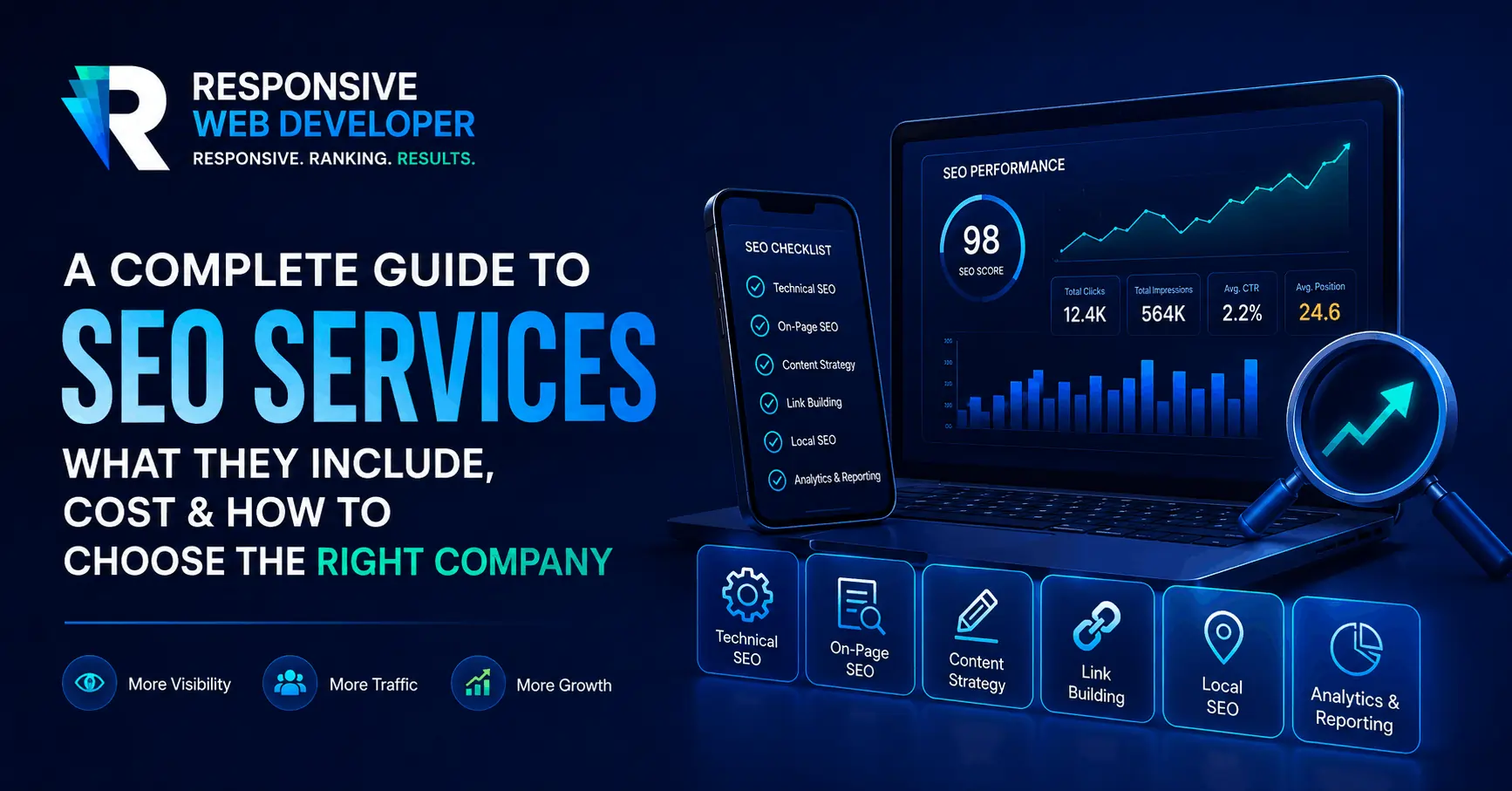
Reputable providers work across six core areas. The mix shifts with your site and your market, but a proposal that skips several of these deserves hard questions.
1. Technical SEO
Technical SEO makes sure search engines can find, crawl, and index your site without friction. It’s invisible to visitors and decisive for rankings.
Typical deliverables:
- A full technical audit with prioritized fixes
- Crawl error, broken link, and redirect cleanup
- XML sitemap and robots.txt configuration
- Page speed and Core Web Vitals improvements
- Structured data (schema markup)
- Mobile usability fixes
A classic failure in this category: an online store accidentally blocks its own category pages in robots.txt. No amount of brilliant content can rank pages Google isn’t allowed to read.
2. Keyword Research and On-Page SEO
This is the matchmaking layer. The provider identifies the exact phrases your buyers use, maps each phrase to a page, then tunes those pages: title tags, meta descriptions, headings, internal links, image alt text, and the copy itself.
The changes look small and move real numbers. Rewriting a homepage title from “Home | Smith LLC” to “Denver Family Law Attorney | Smith LLC” tells Google, in five words, exactly who should find that page.
3. Content Strategy and Creation
Content is where most retainer hours go, because Google ranks pages, and pages need substance worth ranking. Expect keyword-driven briefs, new service and landing pages, articles that answer real buyer questions, and refreshes of older pages that have slipped.
Quality beats volume here. Two genuinely useful articles a month outperform eight thin ones, and Google’s guidance has pushed in that direction for years.
4. Link Building (Off-Page SEO)
Links from other reputable websites act as votes of confidence, and earning them is the hardest part of SEO. Legitimate tactics include digital PR, guest contributions to industry publications, reclaiming unlinked brand mentions, and local sponsorships.
One relevant link from a respected industry site outweighs a hundred directory listings. Be wary of anyone selling links by the bundle; cheap link schemes violate Google’s spam policies and can trigger penalties that cost far more to clean up than the package cost to buy.
5. Local SEO
If customers visit your location or you serve a defined area, local SEO decides whether you appear in the map results. The work includes optimizing your Google Business Profile, building consistent name-address-phone citations, earning and responding to reviews, and creating location pages.
For a plumber, dentist, or restaurant, this is often the highest-ROI work in the entire engagement.
6. Analytics and Reporting
Every legitimate SEO service measures itself. At minimum: Google Analytics and Search Console properly configured, rank tracking on agreed keywords, and a monthly report tied to business outcomes.
A good report answers three questions in plain English: what we did, what changed, and what we’ll do next. If a report only shows rankings and never mentions leads, calls, or revenue, you’re being shown motion instead of progress.
What Do SEO Services Cost?
Three pricing models dominate the market:
- Monthly retainer. The standard for ongoing work. Small-business retainers commonly land at, with agencies typically charging more than freelancers for comparable scopes.
- Project-based. A fixed fee for a defined deliverable, such as a technical audit or a site migration.
- Hourly consulting. Common for strategy, training, or second opinions, at rates of.
Do the arithmetic on cheap SEO. A $99-per-month package must cover sales, account management, software, and profit before a single hour of real optimization. Whatever remains buys templated reports and directory submissions, and sometimes spammy links you’ll later pay a professional to remove.
Judge cost against customer value, not against the cheapest quote. If one new client is worth $3,000 to your business, a program that produces a few clients a month justifies its retainer many times over.
How to Choose an SEO Company
No licensing body governs SEO. Anyone with a laptop can sell it tomorrow, which is exactly why the vetting falls on you. Strong providers share a recognizable profile:
- Case studies with real numbers from businesses like yours
- Plain-language explanations of their methods, with no “proprietary secrets”
- Realistic timelines measured in months, not days
- Clarity about who actually does the work on your account
- You keep ownership of your website, content, and analytics accounts
- Contracts with reasonable exit terms, such as 30 to 90 days’ notice
Six questions to ask on the sales call:
- Which of my keywords would you prioritize first, and why?
- Can I speak with a current client in a similar industry?
- What does month one look like compared to month six?
- How exactly do you build links?
- What happens to the work and the accounts if we part ways?
- Which KPIs will you report on, and which will you commit to moving?
Vague answers to questions four and five end more bad engagements before they start than any other filter.
Red Flags That Should End the Conversation
- Guaranteed #1 rankings, or guarantees of any specific position
- Claims of a special relationship with Google (Google has stated publicly that no such thing exists)
- Secret techniques they can’t explain “for competitive reasons”
- Promised results within days or a couple of weeks
- Prices too low to cover skilled labor
- Link packages sold by quantity
- Refusal to give you admin access to your own analytics
- Cold emails claiming they “found serious errors” on your site
Any one of these is a warning. Two or more is your answer.
Who Are the Best SEO Companies?
Honest answer: the best SEO company is the one with proven results for businesses like yours, and no generic top-ten list can identify it. Fit beats fame. A famous enterprise agency that serves airlines will be a poor match for a twelve-room boutique hotel, and the reverse is just as true.
A market reality makes this worse. How many SEO companies are there? Nobody can count precisely because no registration exists, but industry analyses estimate tens of thousands of agencies worldwide, and directory platforms like Clutch have listed 40,000+ SEO providers. That enormous supply is good news for buyers who vet carefully and bad news for buyers who pick from an ad.
It also explains the “best of” list economy. Many rankings you’ll find are sponsored placements, affiliate roundups, or lists published by an agency that put itself at #1. Use directories like Clutch, G2, or UpCity as longlist builders: filter by industry, budget, and verified reviews, then do your own vetting. Treat every ranking as a starting point, never a verdict.
What About the Best SEO Company in Denver (or Any City)?
Searches like “best SEO company in Denver” return the same problem in local form: lists built to sell placement rather than inform you. Skip the lists and run this five-step method instead. It works in Denver, and it works everywhere else.
- Search like your customers do. Google two or three “[your service] Denver” phrases and note which local businesses rank. Then find out who handles their SEO; ranking clients are the best advertisement an agency can have.
- Build a shortlist from verified reviews. Pull Denver agencies from Clutch and Google reviews, and require a meaningful review count, not three five-star ratings posted last month.
- Ask for a local, relevant case study. You want before-and-after organic traffic and lead numbers for a Denver-area business in a comparable industry.
- Check their own visibility. An SEO company that can’t rank for anything competitive itself is telling you something.
- Interview at least three. Ask all six questions from the section above and compare the proposed deliverables line by line, not just the price.
Two agencies quoting identical monthly fees can differ wildly in hours, content volume, and link work. The line-by-line comparison is where the real differences surface.
Where GoDaddy SEO Fits (and Where It Doesn’t)
“What is GoDaddy SEO?” comes up constantly because millions of small businesses already host there. GoDaddy currently sells two different things under the SEO banner, and buyers routinely confuse them.
The built-in SEO tool. Most Websites + Marketing plans and the Digital Marketing plan include a guided SEO wizard. It analyzes your site, uses AI to suggest keywords, walks you through optimizing titles, descriptions, and pages, then tracks basic rankings from a dashboard. GoDaddy’s own documentation notes that changes can take up to eight weeks to influence rankings.
GoDaddy SEO Services. This is the done-for-you tier: GoDaddy’s team performs on-site and off-site optimization, and the service works even if your site is hosted elsewhere. Per their product pages, the off-site work leans on directory submissions, short blog-style posts placed on external sites, and social bookmarking. Independent reviews have criticized the depth of that approach, particularly the very short content and comment-style link placements.
The fair verdict: builder-based tools like GoDaddy’s handle table stakes well. They’ll get your titles written, your pages indexed, and your basics covered, which is genuinely enough for a low-competition local site. What they don’t provide is what competitive rankings require: sustained content strategy, real link earning, and deep technical work. Solo operation with no budget? Start with the tool. Business where search traffic drives revenue in a contested market? Budget for a specialist.
The Bottom Line
SEO services are not magic, and they’re not a scam. They’re skilled labor: technical work, content, links, and measurement that you can scope, price, and verify like any other professional engagement. The buyers who get burned are the ones who couldn’t name the deliverables. Now you can.
Your next step takes ten minutes. Open Google Search Console today (it’s free), record your current clicks and impressions, and make every SEO company you interview explain, specifically, how their service will move those two numbers. The good ones will love the question. The rest will show themselves out.
Frequently Asked Questions About SEO Services
How many SEO companies are there?
No official registry exists, so every figure is an estimate. Industry analyses suggest tens of thousands of agencies operate worldwide before counting freelancers, and major directories list 40,000+ providers. The practical takeaway: supply is enormous, quality varies wildly, and vetting is your job.
How long do SEO services take to work?
Expect early signals, such as improved indexing and long-tail rankings, within roughly three months, and meaningful traffic growth over six to twelve. Competitive keywords take longer. Anyone promising page one in two weeks is selling something other than SEO.
What’s the difference between SEO services and SEM or PPC?
SEO earns unpaid rankings; SEM and PPC buy ads at the top of results. Ads deliver instant, rented traffic that stops when the budget does. SEO builds slower, compounding, owned traffic. Mature marketing programs usually run both and use paid-search data to sharpen organic targeting.
Can I do SEO myself instead of hiring a service?
Yes, for the foundations. Claim your Google Business Profile, install Search Console, write clear titles, and publish pages that answer real customer questions. Free tools and patience cover a surprising amount of ground. The honest constraint is time: SEO rewards consistent weekly effort, and most owners hire help the month they admit that effort isn’t happening.