





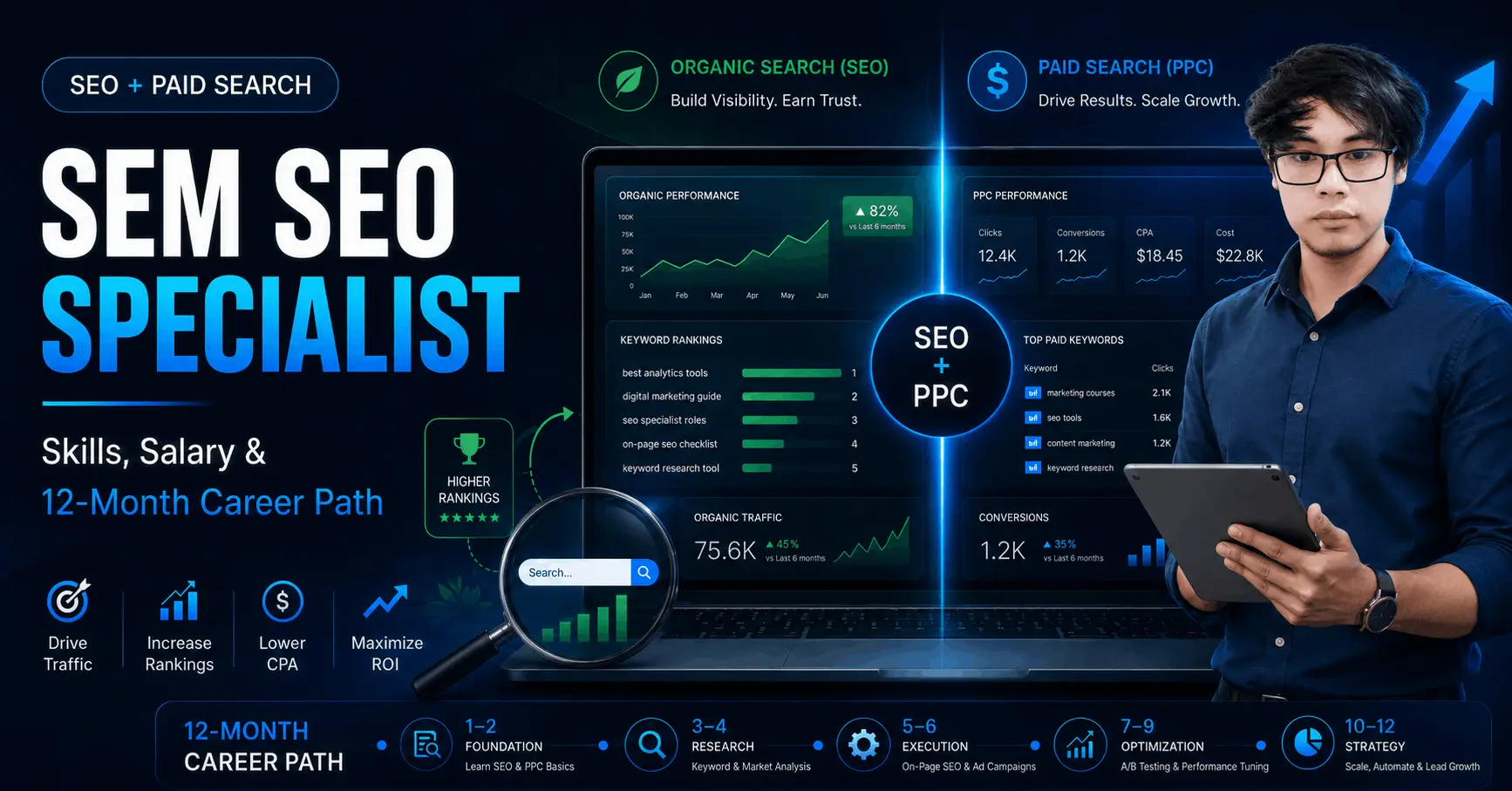
SEM SEO Specialist is the person who decides whether a company should buy search traffic, earn it organically, or use both strategies together.
Your company ranks first organically for a valuable keyword. At the same time, it pays $6.20 per click for an ad directly above that result. Does the ad protect revenue, or does it waste money on clicks the company would receive anyway?
A SEM SEO specialist must answer that question with data, defend the decision, and explain the financial impact while the CFO watches.
The role often confuses aspiring marketers because employers define it differently. One job posting asks for technical SEO audits, content optimization, and internal linking. Another asks you to manage a $200,000 Google Ads budget while hitting a target cost per acquisition. A third combines both roles and adds email marketing. After reading several listings, you may still have no idea what to study first.
This guide gives you a clear path forward. You will learn what a SEM SEO specialist actually does, which decision drives the entire role, what skills hiring managers test, how to become job-ready in 12 months, and which portfolio projects can help you earn interviews.
What Is a SEM SEO Specialist?
A SEM SEO specialist manages both organic search and paid search for the same business, and is accountable for one combined result: qualified traffic at a cost the company can sustain.
Two clarifications, because job listings garble this constantly.
SEM has drifted. Textbooks define search engine marketing as the umbrella covering paid and organic together. Job boards almost always use SEM to mean paid search only, usually Google Ads and Microsoft Advertising. Assume the job-board definition when you read a posting, then confirm it in the first interview by asking which budget you’d own.
PPC is broader than SEM. Paid social and display are also pay-per-click. SEM means ads on search engines specifically. All SEM is PPC. Not all PPC is SEM.
The title exists because splitting the two functions creates waste. When separate teams run each channel, companies routinely bid on terms they already own organically, or ignore paid search terms that convert cheaply and would be easy organic wins. Nobody owns the tradeoff. The hybrid specialist does.
Who hires for it: mid-market companies roughly in the $2 million to $50 million revenue range, small agencies serving regional clients, and early-stage startups where one marketer owns acquisition. Enterprises usually split the roles because volume forces specialization, although lean teams still exist at larger firms. In OpenAsset’s 2024 survey of 360 architecture, engineering, and construction marketing professionals, 69% reported working on marketing teams with fewer than 10 people, including respondents from large and enterprise organizations.
SEO vs SEM: The Difference That Actually Matters
| SEO | SEM (paid search) | |
|---|---|---|
| How you get the click | Earn the ranking | Buy the placement |
| Speed to results | 3 to 12 months | Same day |
| Cost per click | No charge from the engine | Set by auction |
| If you stop | Traffic decays slowly | Traffic stops instantly |
| Testing speed | Months | Days |
| Main levers | Content, technical health, authority | Bids, targeting, ad copy, landing pages |
Organic traffic is not free. You pay in content production, developer hours, tools, and links. You just don’t pay the auction.
The useful framing: paid search rents traffic, organic search owns it. Renting is fast, flexible, and stops the moment the invoice does. Owning takes months and capital, then keeps producing. A specialist who understands both decides which queries deserve rent and which deserve a mortgage.
The One Decision That Defines the Role
Most guides list tactics. Here is the framework that actually separates a specialist from a coordinator.
Treat every commercially relevant query as a line item with four possible verdicts.
Rent it. Buy the click now. Correct when organic competition is entrenched, the query converts, and the payback math on content plus links stretches past a year.
Own it. Fund content and technical work, skip the ads. Correct when CPCs are high relative to the value of a conversion, the SERP rewards depth, and you have a realistic path into the top three.
Both. Buy now and build in parallel. Correct for high-value commercial terms where you need revenue this quarter and durable position next year.
Neither. Correct more often than beginners expect. High volume with weak intent, or a SERP dominated by a format you can’t credibly produce, means walk away and spend elsewhere.
Three inputs drive the verdict: what renting costs per acquired customer, what owning costs and how long it takes to pay back, and how much of that paid spend is actually incremental.
The payback math, with real numbers
A payroll software company evaluates the query “payroll software for restaurants.”
Rent side:
- CPC: $18.40
- Landing page converts visitors to demo requests at 3.1%
- Cost per demo: $18.40 ÷ 0.031 = $594
- Demos close at 22%, so cost per customer: $594 ÷ 0.22 = $2,698
- First-year contract value: $9,600 at 80% gross margin = $7,680 gross profit
Renting works. The math clears comfortably.
Own side:
- Query volume: 1,300 searches a month
- Position three captures roughly 10% of clicks on a standard organic results page. A 2025 meta-analysis estimated a 10.2% click-through rate for the third organic position, while SISTRIX’s analysis of more than 80 million keywords found an 11% mobile average. Actual CTR varies substantially when ads, local results, featured snippets, or other SERP features appear. At 1,300 monthly searches, a conservative 10% assumption produces about 130 clicks a month.
- Cost to get there: one strong comparison page, an original data study, and targeted outreach, budgeted at $9,000 over five months
- Those 130 monthly clicks would cost $2,392 a month to rent
The organic investment pays back in under four months of equivalent traffic value, then keeps producing.
Verdict: Both. Fund the organic build, hold paid spend steady while rankings mature, then run a controlled paid pullback once the page holds position three and measure what actually disappears.
Walk into an interview with reasoning like that and you outclass every candidate who can only recite match types.
The incrementality question you will be asked
“We spend $40,000 a month on branded search. Should we cut it?”
A weak answer says yes, because you already rank first for your own name. A strong answer says: run a geo holdout. Pause brand campaigns in matched regions for four weeks. Measure total branded sessions and revenue across both channels, not just organic lift. Expect partial recovery rather than full, because competitors bid on your brand and ads occupy space above the fold.
A large-scale study covering thousands of brands found that brand ads increased clicks by only 1% to 4% when no competitors were present, but competitors captured 18% to 42% of clicks from brands that faced paid-search competition and did not advertise. In other words, defensive brand bidding may add little on an uncontested results page but become highly valuable when competitors crowd the paid positions. Then decide with a number in hand.
That answer is the job.
What a SEM SEO Specialist Does in a Typical Week
Rough time split in a mid-level in-house role:
- 30% paid operations. Bid adjustments, negative keyword sweeps, budget pacing, ad copy tests, shopping feed fixes.
- 25% organic execution. Content briefs, on-page work, internal linking, technical tickets.
- 20% measurement and reporting. Dashboard maintenance, conversion tracking QA, monthly readouts.
- 15% research. Keyword expansion, SERP feature analysis, competitor gap audits.
- 10% stakeholder work. Explaining to a VP why sessions fell while revenue rose.
The unglamorous truth: a meaningful share of any week goes to conversion tracking that broke, a developer deploy that no-indexed a template, or a product feed rejecting 400 SKUs. The tactical work people imagine, writing keywords into pages, is maybe a third of the job. The rest is diagnosis and negotiation.
Skills Employers Actually Screen For
Paid search
- Campaign and ad group structure that maps to real search intent
- Match type behavior now that close variants are loose, plus disciplined negative keyword management at account, campaign, and ad group level
- Smart Bidding strategies, and recognizing when Target CPA quietly strangles volume
- Quality Score diagnosis: expected CTR, ad relevance, landing page experience
- Performance Max structure and how to stop it from eating brand traffic
- Shopping feed basics if the company sells products
SEO
- Keyword research with intent classification, not volume sorting
- On-page work: titles, headings, internal links, entity coverage
- Technical audits: crawlability, indexation, canonicals, redirect chains, Core Web Vitals, structured data, JavaScript rendering
- SERP format diagnosis. If the top ten results are comparison tables and you published a 2,000-word essay, the content isn’t underperforming. It’s the wrong format.
- Content briefs a writer can execute without a follow-up meeting
Measurement (the tiebreaker)
Most applicants can launch a campaign. Far fewer can prove what it did.
- GA4 deep enough to build explorations and debug broken conversion events, not just read default reports
- Google Search Console at query level, including regex filtering and honest period comparisons
- Conversion tracking setup through Google Tag Manager, plus offline conversion imports if the business closes over the phone
- Looker Studio dashboards blending Ads, GA4, and Search Console into one view
- Spreadsheets at a working level: pivot tables, XLOOKUP, regex
- Enough SQL to pull your own data when the analytics team is backed up. Rare in applicants, and it shows.
The skill nobody lists
Translating channel metrics into money. “Impression share dropped 12%” means nothing to a CFO. “We stopped showing up for our three highest-margin queries, worth roughly $18K a month” gets you a budget increase. Same fact, different currency.
Tools: Learn These Six First
Free and non-negotiable: Google Search Console, Google Analytics 4, Google Ads (including Keyword Planner), Google Tag Manager, Looker Studio, Screaming Frog on its free 500-URL tier.
Add once you’re working: Ahrefs or Semrush (pick one, go deep), a Screaming Frog license for large crawls, Microsoft Clarity or Hotjar for landing page behavior, BigQuery when spreadsheets stop scaling.
Skip for now: AI content generators, link marketplaces, and rank trackers with beautiful dashboards and shallow data. None will get you hired, and two can get a client penalized.
Every paid tool teaches you a proprietary interface. Search Console and Google Ads teach you the system itself. A specialist who reads those two closely outperforms one who exports third-party reports and reformats them.
How to Become a SEM SEO Specialist: A 12-Month Plan
This assumes 8 to 10 hours a week alongside another job and no prior experience.
Months 1 to 3: fundamentals and a live sandbox
Complete the Google Ads Search certification and the Google Analytics certification through Skillshop. Both are free and take an afternoon each. Read Google’s Search Essentials documentation properly rather than skimming a summary of it.
Then buy a domain in a topic you know well and build a small site. Connect Search Console and GA4 from scratch, including at least one conversion event you defined yourself. Property setup is a skill on its own and most beginners get it wrong.
Publish eight to twelve pages targeting one tight keyword cluster. Cluster depth moves rankings for a new site. Scattered topics don’t.
Milestone: two certifications, a live property, and a working conversion event you tested yourself.
Months 4 to 6: spend your own money
Put $300 to $500 through a Google Ads account over several weeks. The amount is small. The lesson is not. Nothing teaches match types like watching your own money leave for the query “free.”
Track a real conversion, even a newsletter signup. Untracked ad spend teaches nothing. Add negatives every single week until the reflex is automatic.
Milestone: one live campaign with conversion data and a documented log of what you changed and why.
Months 7 to 9: technical depth and other people’s accounts
Crawl your site and three competitors with Screaming Frog. Fix redirect chains, duplicate titles, orphan pages, slow templates. Screenshot before and after.
Then find three real businesses: a nonprofit, a local service company, and a friend’s store. Offer a free technical audit or account review with prioritized recommendations. You’ll encounter messy real-world data—duplicate tracking, broken tags, and developers who do not reply—that no tutorial can simulate. Google Ad Grants work with nonprofits is especially useful because qualifying organizations receive up to $10,000 per month in in-kind advertising for text-based ads on Google Search. The grant is not cash, unused funds do not roll over, and organizations must maintain a qualifying website and comply with the program’s policies.
Eligibility starts with being registered and verified as a charitable organization in a supported country. Government entities, hospitals and healthcare organizations, and schools or universities are generally excluded, although qualifying charitable or philanthropic arms associated with healthcare and educational institutions may be eligible.
Milestone: one completed technical audit with before-and-after data, plus one external account reviewed.
Months 10 to 12: package and apply
Build the dashboard, write the case studies, and start applying. Details on both below.
Rewrite your résumé around outcomes rather than tasks. “Cut cost per lead 34% by restructuring 12 campaigns around query intent” beats “Managed Google Ads campaigns.”
Apply to agency roles alongside in-house ones. Agencies hire junior hybrids more often because they need people who can cover several small accounts, and you’ll see more account types in one year than three years in-house would show you.
Milestone: three portfolio pieces, a live dashboard link on your résumé, 20 applications sent.
Three Portfolio Pieces That Get Interviews
1. A query-to-channel allocation plan. Take 50 keywords in one niche. For each, show organic difficulty, current CPC, estimated conversion value, and your rent/own/both/neither verdict with the reasoning. This is the single strongest piece you can build, because it demonstrates the actual decision the job requires. Almost no junior applicant has one.
2. A blended dashboard. In Looker Studio, combine Google Ads, GA4, and Search Console into one view showing blended cost per acquisition across both channels. Hiring managers need this and most teams don’t have it.
3. A prioritized technical audit. Crawl a mid-sized public site, find the ten highest-impact issues, and rank them by estimated traffic gain against developer effort. The prioritization is what’s being assessed, not the finding. Anyone can generate a 300-row crawl report.
Structure every case study the same way: starting position with dates, your hypothesis, what you changed, the result including what failed, and what you’d do differently. If the work was under NDA, anonymize the client and report percentage changes. That’s standard practice and no interviewer will object.
One honest case study beats five vague ones. Never invent results.
Do Certifications and Degrees Matter?
Certifications get you through HR filters. They do not get you hired, because the Google Ads certification is free and takes a few hours, so every applicant has it.
Worth the time: Google Ads Search, Google Ads Measurement, Google Analytics, and Microsoft Advertising if the role touches Bing. Get them in week one, then spend your energy on work you can show.
Not worth paying for: expensive “SEO master certification” programs from private providers. SEO has no certification with meaningful hiring weight. A portfolio replaces it.
No degree is required. This field hires on demonstrated results more readily than most marketing disciplines. A candidate with the free certification and a live dashboard showing $400 of managed spend beats a candidate with six certificates and no account access, every time.
Salary and Career Path
Compensation tracks four things more closely than your title: in-house versus agency, industry, ad budget under management, and city. Someone managing $500,000 a month in spend commands a different number than someone managing $5,000, regardless of tenure.
There is no standardized salary series for the hybrid “SEM SEO specialist” title, so the closest benchmarks are SEO specialist and paid-search specialist roles. Robert Half’s 2026 starting-salary data illustrates the regional spread:
| Representative market | Entry | Mid-level | Senior |
|---|---|---|---|
| Midwest — Columbus, Ohio | $64,000–$67,000 | $77,000–$78,000 | $87,000–$92,000 |
| South — Dallas, Texas | $72,000–$75,000 | $86,000–$87,000 | $97,000–$102,000 |
| Northeast — Boston, Massachusetts | $84,000–$88,000 | $100,000–$102,000 | $113,000–$119,000 |
| West Coast — San Jose, California | $83,000–$87,000 | $99,000–$101,000 | $112,000–$118,000 |
These are starting-base-salary benchmarks, not total compensation. Robert Half defines the entry tier as someone new to the role or still building skills, the midpoint as a candidate with moderate experience, and the high tier as someone with extensive or specialized expertise.
For a broader national check, the U.S. government category that includes search marketing strategists reports annual wages of $58,350 at the 25th percentile, $78,760 at the median, and $108,310 at the 75th percentile. Treat those as market anchors rather than strict experience bands.
The typical ladder:
- Specialist (0 to 2 years): execution, reporting, campaign hygiene under supervision
- Senior specialist or search manager (2 to 5 years): channel strategy, budget ownership, managing freelancers
- Head of acquisition or performance marketing lead (5+ years): channel mix, forecasting, team building
- Director of growth or demand generation: pipeline targets across paid, organic, and lifecycle
General patterns: agencies pay a lower base with faster skill accumulation and higher burnout risk. In-house pays better at the senior end with slower variety and better access to revenue data. Freelancing has the highest ceiling and the highest variance, and becomes viable after roughly three years of referenceable results.
Pay climbs fastest in ecommerce, B2B SaaS, and high-value lead generation such as legal, medical, and financial services, where one conversion justifies aggressive bidding.
How AI Search Changes the Job
AI Overviews and answer engines resolve a growing share of informational queries without sending a click. An Ahrefs study of 300,000 keywords found that, as of December 2025, the presence of an AI Overview was associated with a 58% lower average click-through rate for the top-ranking organic page.
The researchers compared informational keywords that displayed AI Overviews with a matched set that did not and used aggregated Google Search Console data to measure the change. At the same time, paid-search costs keep climbing. WordStream and LocaliQ’s 2025 benchmark found that average Google Ads CPC rose 12.88% year over year to $5.26 across the industries studied; its 2026 edition subsequently reported an average CPC of $5.42.
A single-channel specialist responds to this badly. The SEO person publishes more articles into a shrinking click pool. The paid person raises bids. Three adjustments make more sense:
Shift organic effort down the funnel. Comparison, pricing, “best X for Y,” and local queries still send clicks because people want to evaluate and buy. Definitional content increasingly does not.
Optimize for citation, not just ranking. Clear structure, direct answers near the top, original data, and consistent entity information across the web make a page quotable by AI systems.
Track branded search as an outcome metric. If AI surfaces mention your brand without sending a click, branded search growth is how you detect the effect.
The rote parts of this job (bulk keyword lists, first-draft ad copy, basic audits) are being automated. The judgment about where the next dollar goes is becoming the whole job, which makes the hybrid specialist more valuable rather than less.
Five Mistakes That Stall Hybrid Careers
- Reporting traffic and rankings instead of revenue. Rankings are an input. Nobody funds inputs.
- Running the channels as separate reports. If paid and organic never appear in the same view, cannibalization and synergy both stay invisible.
- Skipping conversion tracking setup. If you can’t build measurement, you’ll spend your career defending someone else’s numbers.
- Avoiding developers. Technical SEO is delivered through other people. Specialists who write clear tickets ship fixes. The rest maintain spreadsheets.
- Never touching the paid side because SEO feels safer. That choice removes the fastest feedback loop in the discipline and caps your ceiling.
The Takeaway
A SEM SEO specialist is not half an SEO and half a paid search manager stitched together. It’s one job: allocating search demand across two channels based on evidence, and knowing which lever moves the number faster.
The technical skills are learnable in a few months. The judgment about where the next dollar goes is what companies actually pay for.
Start this week. Pick ten keywords your business or your own site cares about. Pull organic position and clicks from Search Console. Pull CPC and conversion data from Google Ads. Then write one sentence per keyword explaining whether you’d rent it, own it, do both, or walk away, and why.
That document is your first portfolio piece. Build it against a real account and you’re already doing the job.
Frequently Asked Questions About SEM SEO Specialist
Is SEM the same as PPC?
No. SEM is paid advertising on search engines. PPC covers any pay-per-click advertising, including social and display. All SEM is PPC. Not all PPC is SEM.
Should I learn SEO or SEM first?
Start with paid. The feedback loop runs in days rather than months, so you learn keyword intent, ad relevance, and conversion behavior far faster. Then apply what you learned to organic. Learn measurement alongside both from day one.
How long does it take to become job-ready?
Nine to twelve months of consistent, hands-on work is realistic for an entry-level hybrid role. Twelve months of tutorials without touching a live account is not.
Do I need coding skills?
No. Basic HTML, HTTP status codes, JavaScript rendering concepts, and site architecture will let you diagnose problems and write tickets developers respect. SQL and Python become useful as datasets grow, but neither gates an entry-level role.
Can one person really do both well?
At small and mid-size companies, yes, and it’s often better than splitting the work because the channels stop competing for credit. At enterprise scale, query volume forces specialization.
Is SEO a dying career because of AI search?
Publishing generic informational content is dying. Understanding search demand and capturing it profitably is not. Specialists who work across organic and paid, and who can prove revenue impact, are better positioned than they were five years ago.
Related Articles:
- SEO Professionals: The 5-Document Hiring Test
- SEO Specialist Job Description: Template + What to Cut
- International SEO Consultant: How to Hire and Integrate
- WordPress SEO Expert: Hire for Diagnosis, Not Reports
- Technical SEO Specialist: What They Do, When to Hire
- What Does a Senior SEO Specialist Do?
- SEO Analyst Salary 2026: What You’ll Actually Earn
- On Page SEO Expert: The 5 Verdicts That Fix Pages
- SEO KPIs: The 6 Numbers That Multiply Into Revenue
- Best SEO Company: How to Choose One Without Guessing
Last Updated on 1 month ago by Alipio Umiten IV
