





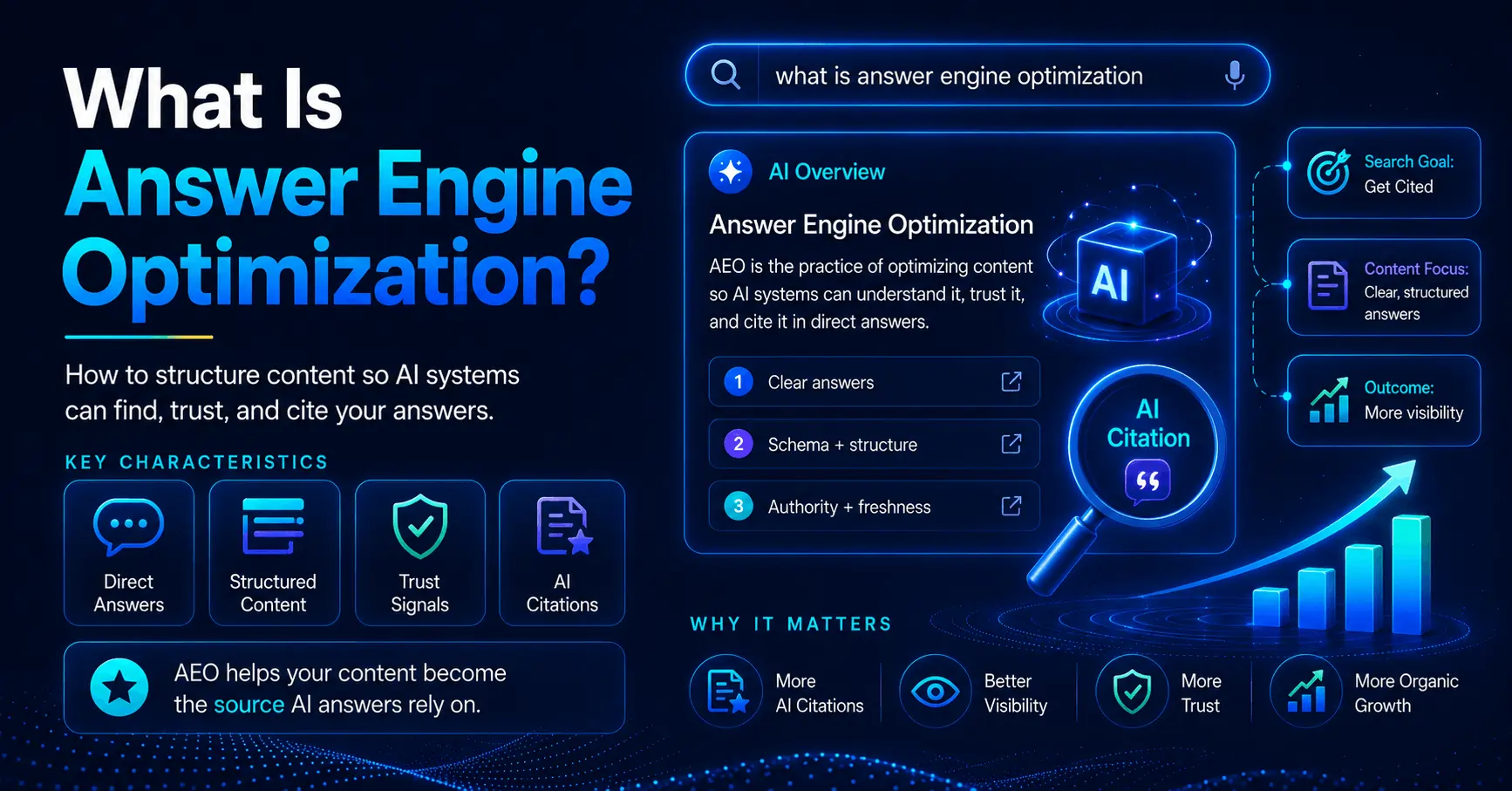
What Is AEO?
Answer engine optimization (AEO) is the practice of improving content and online information to increase its visibility in systems that provide direct answers. Its goals include accurate citations, brand mentions, and relevant recommendations.
Start with useful content, verifiable facts, and accessible pages. Google treats optimization for its AI search features as part of SEO.
What does an answer engine do?
An answer engine gives a direct response to a request. The response might appear in a search results page, a chat interface, or a voice assistant.
Different answer formats use different methods. Google’s featured snippets display a short excerpt from a website. Generative engines can combine information from several sources into a new response. How featured snippets work, GEO research paper.
Google AI Overviews and AI Mode provide responses with supporting links. ChatGPT search can also retrieve current web information and link to sources. These are examples of experiences an AEO program might monitor. Google’s AI features documentation, OpenAI’s search documentation.
That creates several possible outcomes. Your page could be cited as a source, your company could be named, or your product could be recommended. Those outcomes are different: a citation to your tutorial does not automatically mean the system recommends your business.
AEO vs. SEO vs. GEO
Use these as overlapping planning terms:
| Term | Main focus | Practical work |
|---|---|---|
| SEO: search engine optimization | Helping search engines discover and present useful content across search features | Technical access, relevant content, internal links, and search performance |
| AEO: answer engine optimization | Improving how information and brands appear in direct answers | Clear explanations, accurate business details, and monitoring citations and mentions |
| GEO: generative engine optimization | Improving visibility in responses produced by generative AI | Content that supports accurate synthesis, source attribution, and measurement of generated answers |
The GEO research paper defines its objective around visibility in generative engine responses. Industry usage overlaps: HubSpot, for example, uses AEO broadly for work on citations and mentions in answer engines. Original GEO paper, HubSpot’s terminology explanation.
Keep SEO as the foundation. Add AEO monitoring when you need to learn how answer systems represent your subject or business. If your work focuses on AI-generated responses, many of the activities will also be described as GEO. You do not need three separate content strategies.
How to start with answer engine optimization
1. Choose a specific reader task
Begin with something your audience needs to learn or complete. Useful starting points include customer support requests, on-site searches, sales conversations, and search queries associated with existing pages.
“Export project data” is a clearer task than “learn about our software.” It tells you what information the page must provide.
Match the task to the right page. Product specifications belong on product pages. Instructions belong in help documentation. A broad explanation belongs in an article. AEO work can involve any of these formats.
Prioritize a page where your organization can provide reliable information, especially when current content leaves a practical gap.
2. Check that relevant systems can access the page
Ask the person managing your website to check crawler access, indexing controls, and links from related pages. Important information should be available as text, including details currently shown only in images. These checks follow Google’s published website guidance. Google’s technical and content recommendations.
For Google’s generative AI features, a page must be indexed and eligible for a search snippet, and the site must be included through its Search Console setting. Eligibility does not guarantee appearance. Google’s current eligibility guidance.
For ChatGPT search, review access for OAI-SearchBot. OpenAI documents GPTBot separately for potential model-training use. A site can allow search crawling while declining training crawling. OpenAI’s crawler documentation.
3. Give a direct answer, then provide the necessary detail
Put the main answer near the beginning of the relevant section. Follow it with the conditions, evidence, examples, or instructions a reader needs to use it correctly.
For a product task, explain who can perform it, where to begin, what the result includes, and any exclusions. For a comparison, state the criteria and explain which option suits each need.
Use descriptive headings and tables when they make the information easier to follow. Treat this as an editorial recommendation, not a proven formula for earning AI citations.
Support consequential claims with sources. If you publish original findings, describe the method and limitations. Credit real authors or reviewers and explain their relevant experience. Google’s content guidance emphasizes original value, clear sourcing, and accurate authorship. Google’s helpful content guidance.
4. Keep business and product facts consistent
Review names, features, prices, availability, and contact details across the pages and profiles you control. Keep historical information clearly labeled so readers can distinguish it from current information.
When an answer contains an error about your business, inspect its cited sources. Correct outdated information on your own pages and request factual corrections from other publishers when appropriate. If the underlying sources are accurate, the generated response itself may be wrong.
Monitor the result after corrections. Updating a source gives systems better information to retrieve; it does not establish when a particular answer will change.
A worked example: improving a help page
The following example uses a fictional project management application. All product behavior is assumed for demonstration.
Suppose a reader wants to export tasks before closing an account.
Weak opening:
Our flexible export features give you control of your data and make moving to another platform easy.
More useful opening:
Workspace owners can export active and archived tasks as a CSV file from Settings > Export. The file includes task titles, statuses, and due dates. Attachments and comments are excluded. Download attachments separately before closing the account.
The revised version provides five usable details: the required role, available records, file format, menu location, and exclusions. It also prevents a reader from assuming the export contains everything.
A complete help page would then explain the export steps, show the relevant screen, and document any recovery or retention limits. Every detail would need to match the actual product.
Reuse this pattern:
Direct answer → conditions → steps → limitations → supporting evidence.
The example demonstrates a clearer answer. It is not evidence that the revision would receive more AI citations.
Do you need special schema or AI files?
Structured data, often called schema markup, labels information on a page in a machine-readable format. It can help Google interpret content and make a page eligible for supported rich results. The markup should describe information visitors can see. Google’s structured data introduction.
However, Google says its generative search features require no special schema markup. It also says Google Search ignores llms.txt files. Those statements concern Google Search; other services may have different uses for such files. Google’s guidance on AI optimization myths.
Be careful with older FAQ advice. Google discontinued FAQ rich results starting May 7, 2026. A useful FAQ section can still serve readers, but adding FAQ markup no longer produces that Google search feature. Google’s deprecation notice.
Avoid creating thin pages for every wording variation. Group related information around the task your reader needs to complete.
How to measure AEO
Measure visibility, accuracy, and business outcomes separately. A mention, a citation, and a visit tell you different things.
| Measure | What to record | What it cannot establish alone |
|---|---|---|
| Citation frequency | How often monitored responses link to your site, and which pages they cite | Total audience reach or recommendation strength |
| Brand mentions | How often your name appears and the surrounding context | A link, endorsement, or sale |
| Answer accuracy | Correct and incorrect claims about your offering | How frequently all users encounter those claims |
| Referral visits and conversions | Identifiable visits from answer services and the actions those visitors complete | Exposure that produces no click or an untracked later visit |
Use platform reporting where available. Google’s Generative AI performance report for Search reports impressions from AI Overviews and AI Mode, with breakdowns including page, country, date, and device. Its stated scope is impressions, so avoid treating it as a complete conversion report. Search Console report documentation.
Bing’s AI Performance reporting covers citations across Microsoft Copilot, AI-generated summaries in Bing, and selected partner integrations. Microsoft explains that citation counts do not indicate ranking or placement within an answer. Bing’s reporting documentation.
Build a small, repeatable baseline
Choose a fixed set of relevant prompts. Include discovery prompts that do not name your business and accuracy checks that do. Keep those groups separate: naming a company in the prompt tests a different outcome from seeing it appear unprompted.
Record the exact prompt, platform, date, search mode, cited URLs, brand mentions, and factual errors. Use fresh conversations with consistent settings and repeat the checks to look for patterns.
Hypothetical calculation: Test 10 prompts three times on one platform, producing 30 responses. If six responses cite your site, your observed citation rate is 6 ÷ 30 = 20%. Count each response once, even if it contains several links to your site.
That percentage describes your test set. It does not mean your site appears in 20% of all AI searches. Keep separate results for each platform and use the same method when comparing periods.
Log content changes alongside the results. A change in citations after an edit can guide further investigation, but it does not prove the edit caused the change.
Start with one page you can improve
Choose a page that addresses a real reader need and contains information you can verify. Record its current visibility, correct access problems, and improve the answer using the example above. Then check the published page and monitor the same prompts over time.
Your first deliverable is a more useful, accurate page and a baseline for assessing its visibility. Expand the work as the evidence supports it.
Frequently Asked Questions About AEO
What does AEO mean?
AEO stands for Answer Engine Optimization. It is the process of optimizing your content so AI-powered search tools can easily understand, extract, and present it as a direct answer to a user’s question. A strong AEO strategy can help your brand appear in AI-generated responses, featured snippets, voice-search results, and other answer-based search experiences.
What is an AEO vs SEO?
SEO, or Search Engine Optimization, focuses on helping web pages rank in traditional search results and attract clicks. AEO, or Answer Engine Optimization, focuses on making content easy for search engines and AI platforms to use in direct answers.
Simply put, SEO helps people find your page, while AEO increases the likelihood that your content will be quoted, summarized, or cited in an answer. The two strategies work best together.
What is AEO AI?
AEO stands for Answer Engine Optimization. It is the practice of structuring and improving online content so AI-powered platforms, such as ChatGPT, Google AI Overviews, Perplexity, and Gemini, can understand it and potentially use it when answering user questions.
AEO is closely related to Generative Engine Optimization, or GEO, although the terms are sometimes used in slightly different ways. Both focus on improving a brand’s visibility in AI-generated search experiences.
Is AEO a real thing?
Yes. As more people use AI tools and answer-based search features, businesses are adapting their content strategies to improve visibility on these platforms.
AEO involves providing clear, accurate, well-structured, and authoritative information that AI systems can confidently interpret and use. It is not a replacement for traditional SEO, but an extension of how content is optimized for modern search behavior.
Is AEO replacing SEO?
No, AEO is not replacing SEO. The two strategies complement each other.
SEO provides the technical foundation, relevance, authority, and discoverability that search engines and AI systems use to evaluate content. AEO builds on that foundation by making information clear, concise, well-organized, and easy to use in direct answers.
For the strongest online visibility, businesses should incorporate both SEO and AEO into their content strategy.
Last Updated on 6 days ago by Alipio Umiten IV
