





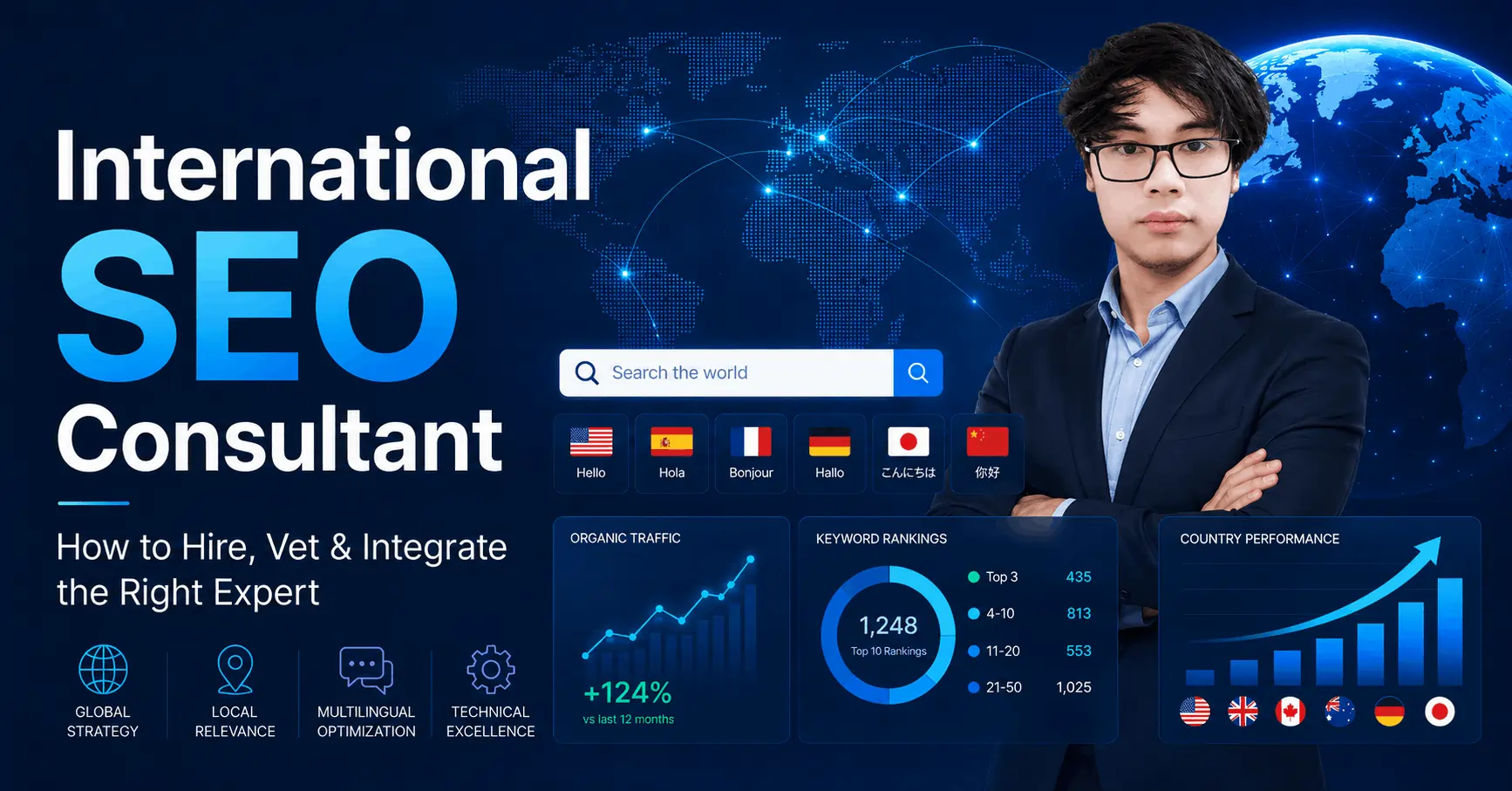
International SEO Consultant support becomes essential when your website performs well in one market but fails to gain visibility in another.
Your German site launched eleven months ago. Your team produced accurate translations, published detailed content, and followed the same strategy that worked in your home market. Yet a competitor that launched in March now outranks you for every important commercial keyword. Your team cannot explain why, and publishing more content will not fix the underlying problem.
A skilled international SEO consultant identifies what blocks your performance across countries and languages. They help you choose the right market strategy, URL structure, technical setup, localization process, and reporting model. More importantly, they turn those decisions into actions that your internal teams can implement.
Many international SEO projects fail even when the consultant delivers the correct diagnosis. The recommendations remain buried in an audit, developers never receive clear tickets, regional teams join too late, and decision-makers delay critical changes.
This guide explains what international SEO consulting includes, how to find a credible consultant, and how to integrate them with your internal team so their recommendations reach production and produce measurable results.
What Is International SEO Consulting?
International SEO consulting is the practice of making one business rank across multiple countries and languages without those versions competing against each other in search results.
That last clause carries the weight. Ranking in a single market is a solved problem. The difficulty starts when six versions of a product page exist and Google has to decide which one belongs to which audience. Get it wrong and your Spanish page outranks your Mexican page in Guadalajara, your UK content cannibalizes your US content, and three markets sit invisible.
Two problems get conflated constantly:
- Multi-regional SEO: targeting different countries, often in the same language. A US site, a UK site, and an Australian site, all in English.
- Multilingual SEO: targeting different languages, sometimes within one country. Canada in English and French. Switzerland in German, French, and Italian.
Most companies have both at once, which is where the cost sits.
A consultant working at this level typically owns market selection, domain and URL architecture, hreflang implementation and monitoring, in-market keyword research, localization strategy, technical geo-signals, and market-segmented reporting. In China, Russia, South Korea, and Czechia, Baidu, Yandex, Naver, and Seznam also have their own indexing rules and hosting expectations.
What It Is Not
It is not translation project management. It is not a monthly link package aimed at ten countries. And it is not domestic SEO run several times over. A generalist who has only worked on single-market sites tends to treat hreflang as a checkbox rather than a system, which is how errors spread across thousands of URLs without anyone noticing for a quarter. In a study of 374,756 domains using hreflang, Ahrefs found that 67% had at least one implementation issue, including 15.3% with pages missing reciprocal tags, the return-tag error that breaks the connection between localized versions.
The Five Decisions You Cannot Cheaply Reverse
Here is the framing that should drive your hire. International SEO produces hundreds of possible tasks, but only about five decisions are expensive or impossible to undo. Everything else can be corrected in a sprint.
- Domain and URL architecture. ccTLDs, subdirectories, or subdomains. Reversing this means a full migration with redirect maps, hreflang rewrites, and analytics reconfiguration. It is the single most consequential call in the engagement.
- Which markets you commit to. Launching six countries at 20% quality is worse than launching one properly, because you inherit maintenance debt in all six.
- The content ownership model. Whether headquarters publishes globally, regions publish autonomously, or a governed hybrid runs between them. Changing this later means renegotiating with every country team.
- How hreflang is generated. A templated, automated system scales. Manual annotation breaks the first time someone launches 400 products, and rebuilding it means touching every template.
- How performance is segmented. If reporting is aggregate from day one, weak markets stay hidden behind a strong home market for a year, and by then you have spent the budget.
Vet consultants on these five. Scope the first engagement around these five. Force them in week one, before anyone writes a 40-page audit.
Everything else, meta titles, internal links, content refreshes, is reversible and can wait its turn in the backlog.
Do You Actually Need One?
Hire a consultant when at least two of these are true:
- You have three or more country or language versions live, or plan to within six months.
- Search Console shows the wrong country version appearing for queries in a given market.
- Secondary markets generate less than half the organic clicks their share of validated local search demand would predict, despite having localized equivalents for at least 80% of the home market’s indexable commercial pages.
- You are about to migrate, consolidate, or split domains.
- Your engineering team has asked what hreflang is more than once.
Skip the retainer when you have one additional English-language market, a subfolder, and 30 pages. Buy a few advisory hours instead. Also skip it if your primary domain has unresolved technical problems, because international SEO multiplies whatever state your site is already in.
Where to Hire an International SEO Consultant
The strong ones rarely rank first for this term, which rewards content budgets rather than practitioners. Four realistic channels, each with a distinct failure mode.
Independent specialists. Usually the best value when you already have execution capacity and need direction rather than hands. Find them where they publish: technical SEO writeups, conference talks at events like BrightonSEO and SMX, and detailed answers in practitioner communities. Referrals from in-house leads in your vertical remain the highest-signal source. Risk: one person has a bandwidth ceiling. Ask about capacity before signing.
Boutique agencies. Five to thirty people, often with native speakers on staff for the markets they serve. Right when you need strategy plus delivery, such as in-market writers or a developer who can ship fixes your engineers cannot fit in. Risk: the pitch team is not the delivery team. Put named people in the contract.
Global network agencies. Suited to enterprises in fifteen or more markets with procurement and compliance requirements. Risk: cost, staffing churn, and “international expertise” that resolves to one specialist supporting fourteen accounts.
Marketplaces. Toptal, Upwork’s expert tier, and similar platforms work for bounded tasks: audit hreflang across 6,000 URLs, deliver a prioritized error list. Treat them as a channel for defined work, not for strategy ownership.
What It Costs
Consultants price hourly, by fixed project, or on a monthly retainer, and globally focused work generally commands higher fees. In Ahrefs’ survey of 439 SEO providers, consultancies most commonly charged $100–$150 per hour, $2,501–$5,000 per month, and $5,001–$10,000 per project. Providers serving worldwide markets averaged $106.69 per hour, $3,473.74 per month, and $8,056.56 per project—13.6%, 123.1%, and 40.8% more, respectively, than providers serving local markets.
Two heuristics. Be suspicious of anyone who quotes before understanding your domain structure, CMS, and development capacity, because those three factors determine most of the effort. And an audit priced well below a month of engineering time is usually an audit you will never implement.
Vetting: Six Questions That Separate Practitioners From Presenters
Skip the case study deck. Ask these.
- “Walk me through a domain structure decision you got wrong.” Anyone with real tenure has one. The answer shows whether they reason in tradeoffs or apply rules.
- “When would you argue against ccTLDs?” A correct answer weighs existing domain authority, budget, legal entity structure, and local trust requirements. A blanket preference with no conditions is a template.
- “How do you research keywords in a language you don’t speak?” You want a defined process: native reviewer validation, local competitor SERP analysis, in-market tooling, query pattern checks. “Translation tools have gotten good” ends the call.
- “Which of our markets would you deprioritize?” Consultants who serve every market equally are selling hours. Good ones tell you market four has thin demand and a dominant incumbent, so it waits two quarters.
- “Our dev team has a ten-week backlog. What do you do?” The right answer involves ruthless prioritization and writing tickets in the format your engineers accept. The wrong answer is a 200-item audit sorted alphabetically.
- “What do you need from us to succeed?” Strong candidates name roles and hours immediately: analytics access, a named dev contact, a decision-maker for URL changes, contact with the localization vendor. Vagueness here predicts a stalled engagement.
Ask for two references from engagements that ran longer than six months. Short ones can look successful simply because nothing has broken yet.
Red flags: guaranteed rankings, a proposal that never names your specific markets, translation and SEO bundled at a suspiciously low blended rate, and no questions about your internal approval chain.
How to Integrate an External SEO Consultant With Your Internal Team
The consultant’s expertise is rarely the bottleneck. The bottleneck is whether five internal groups act on it: engineering, content and localization, regional managers, legal or brand, and analytics. Each can independently stall the program, and regional managers do it most often, because recommendations arrive as an implied criticism of their market.
Integration is your job, not theirs. Six moves.
1. Name one internal owner before the contract is signed
One person, named, with roughly four to six hours a week committed for the first quarter. Not a committee, not “marketing.” They need enough seniority to get a meeting with the German country manager and enough authority to move a ticket up a sprint.
Without this role, recommendations compete with every other backlog request and lose, because nobody internally is accountable for them.
2. Grant access on day one
Nothing burns a retainer faster than three weeks waiting on read access. Prepare before kickoff: Search Console for every property variant, analytics, staging environment, CMS at draft-and-preview level, log files or an agreed process for pulling them, rank tracking, and your project management tool as a full member rather than a guest.
3. Write down decision rights before the audit lands
| Decision | Consultant | Internal owner | Engineering | Local teams |
|---|---|---|---|---|
| Market prioritization | Recommends | Decides | Informed | Advises |
| Domain and URL architecture | Recommends | Decides | Assesses feasibility | Consulted |
| Hreflang logic | Specifies | Prioritizes | Implements | Informed |
| In-language keyword targets | Leads research | Approves | Informed | Validates |
| Content localization | Sets standards | Budgets | Informed | Produces |
| Monitoring and QA | Runs | Reviews | Fixes | Informed |
Two rules make this hold. The consultant never owns a decision that costs money. Local teams always hold a validation role, because a keyword set that reads oddly to a native speaker damages trust faster than it earns clicks.
The architecture row causes the fights. Settle it in week one.
4. Make regional managers co-authors, not recipients
Have the consultant interview each regional lead in the first fortnight. Ask what they believe holds their market back. Two things follow: you get commercial context no crawl reveals, and the regional lead becomes a co-author rather than a target. Co-authors approve things. Targets stall them.
5. Require tickets, not recommendations
A recommendation reads: implement hreflang across localized pages.
A ticket reads: add hreflang annotations to XML sitemaps for /de/, /fr/, and /es/, each URL carrying self-referencing and reciprocal tags for all live locales plus x-default pointing to /en/, validated against zero return-tag errors in Search Console after the next crawl.
One of those gets built. Require the consultant to write findings directly into Jira or Linear in the format your engineers accept, then have an engineering manager size the top ten in one session. Ten sized tickets beat a 180-page audit.
6. Wire them into localization before translation happens
If your translation vendor never sees the target keywords, your localized pages will not contain them. This happens constantly. Send a per-market keyword brief to translators before work starts, and add a review step where an in-market reviewer checks copy against search intent rather than only linguistic accuracy.
Then set a cadence and protect it: a weekly 30-minute blockers-only session with the internal owner and an engineer, a monthly written update by market that circulates to leadership, and a quarterly re-prioritization. Cancel the weekly and the program drifts within a month.
Finally, build the exit into the contract. Documented launch standards, a hreflang QA checklist, keyword briefs by market, and a recorded training session. A consultant who resists this is selling a subscription rather than an outcome.
What Good Looks Like in the First 90 Days
Days 1 to 14. Access provisioned. Decision-rights table signed. Interviews completed with engineering, content, and one contact per priority market. Technical crawl and hreflang baseline done. No recommendations yet.
Days 15 to 45. Market prioritization and architecture recommendation delivered, debated, and decided. Findings converted into sized tickets inside your existing tracker. In-market keyword research for the priority market only.
Days 46 to 90. Top technical fixes shipped and verified on staging before release. Keyword briefs in the hands of translators. Segmented reporting live so every market has its own view. A six-month roadmap agreed by regional leads rather than presented to them.
If day 90 arrives and nothing has shipped, the cause is almost never the consultant’s knowledge. It is the internal owner or the ticket conversion step.
Judging Whether It Is Working
Rankings lag implementation by months, which makes them a poor early management metric. Track leading indicators by market instead of in aggregate:
- Tickets shipped against tickets raised, monthly
- Indexed pages per market version, trending toward parity with published pages
- Hreflang errors in Search Console, trending toward zero
- Correct-version impressions, meaning the right country page appears for in-country queries
- Time from recommendation to deployment
If that last metric is measured in quarters, the problem is internal and no consultant can fix it for you. Set expectations on revenue in advance, too. Google advises that, in most cases, an SEO needs four months to a year to implement improvements and begin seeing potential benefit, and notes that some changes can take several months to be reflected in Search.
For a market entered from zero, month three is therefore an implementation checkpoint, not a credible verdict on pipeline. Evaluate early search signals after four to six months and meaningful commercial impact over a six-to-twelve-month window, measured from the date the priority recommendations reach production.
The Takeaway
Hiring an international SEO consultant is the easier half of this. The return comes from two things: scoping the engagement around the five decisions you cannot cheaply reverse, and building the internal path their work has to travel.
One named owner. Access on day one. Decision rights in writing before the audit. Tickets instead of slides. Regional managers as co-authors. Do those five and the expertise you are paying for reaches the market.
Before you send a single outreach message, write a one-page brief covering your target markets, current domain structure, CMS, available development capacity, and who signs off on URL changes. Then open every call with the six vetting questions above. The candidate who asks the sharpest questions back about that brief is usually the one worth hiring.
Frequently Asked Questions About International SEO Consultant
What is the difference between international and local SEO?
Local SEO targets customers inside a defined geographic area, usually through business profiles, location pages, and proximity signals. International SEO manages country and language targeting across markets, often through separate domains, subdirectories, or localized page versions.
Should I hire a consultant or an agency?
A consultant when you have internal execution capacity and need senior direction. An agency when you also need content production, localization, and link acquisition managed across several markets simultaneously.
Should an international SEO consultant speak every target language?
No. They should have a reliable process for working with native speakers and regional reviewers. Anyone claiming independent fluency across every market is less credible than someone who explains how local validation works.
Can our existing SEO agency handle international?
Sometimes. Ask them the six vetting questions above. If they cannot answer the ccTLD question or the non-English keyword research question, bring in a specialist for the architecture phase and let your incumbent execute.
Related Articles:
- B2B SEO Specialist: Hire for Pipeline, Not Traffic
- B2B SEO Consultant: How to Hire One Who Moves Pipeline
- B2B SEO Expert: How to Hire One Who Drives Revenue
- SEO Professionals: The 5-Document Hiring Test
- How to Hire an SEO Freelancer Without Wasting 6 Months
- SEO Salary 2026: Three Markets, One Job Title
- How to Become an SEO Expert: The Feedback Loop Method
- SEO Certification 2026: The Two Numbers That Matter
- SEO Specialist Job Description: Template + What to Cut
- WordPress SEO Expert: Hire for Diagnosis, Not Reports
- SEO Marketing Specialist: What the Job Actually Is
- SEO Specialist Skills: 12 That Matter and How to Test Them
- Technical SEO Specialist: What They Do, When to Hire
- What Does a Senior SEO Specialist Do?
- SEO Analyst Salary 2026: What You’ll Actually Earn
- On Page SEO Expert: The 5 Verdicts That Fix Pages
Last Updated on 1 month ago by Alipio Umiten IV
