





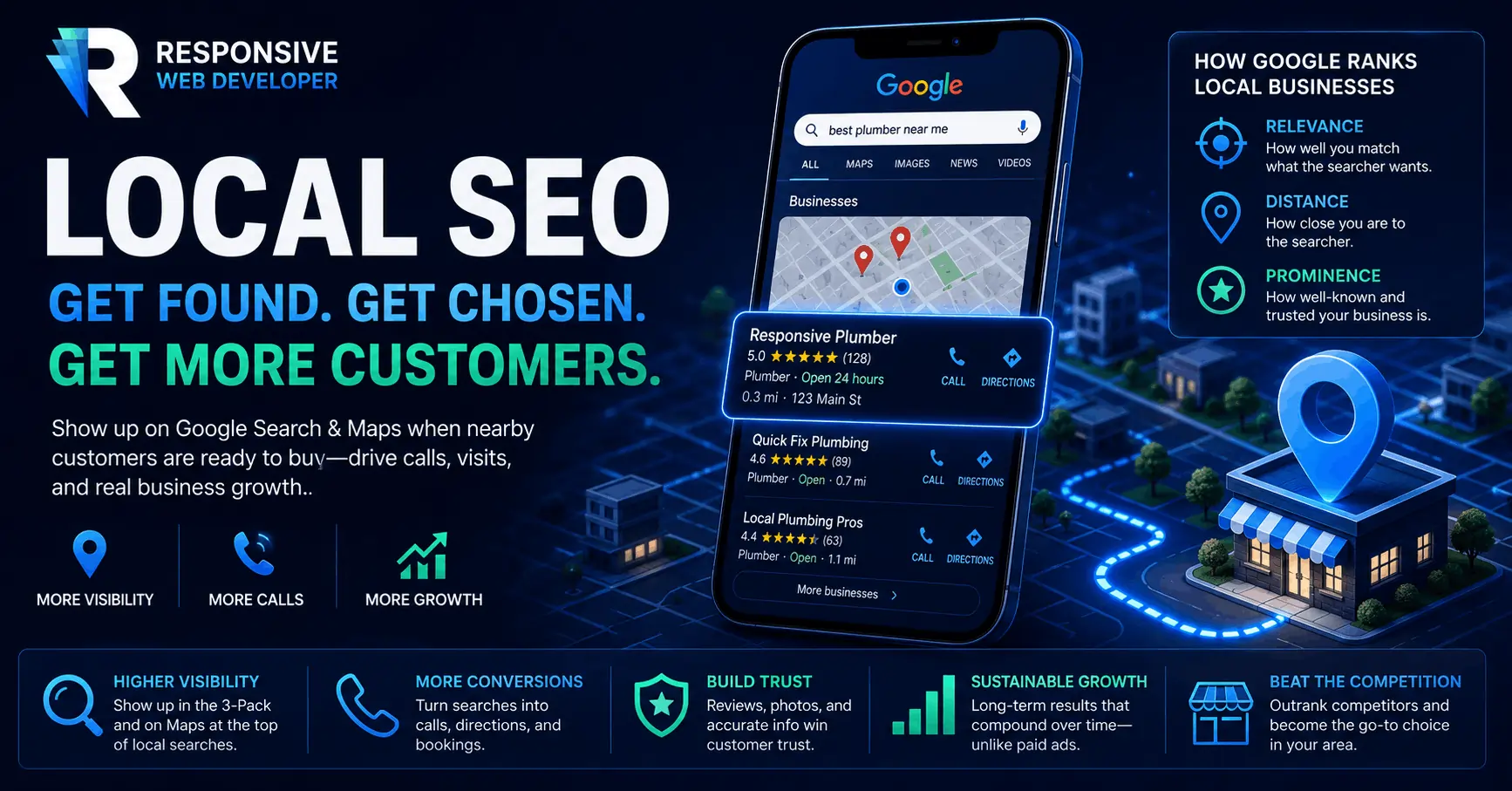
Local SEO helps nearby customers find your business when they are ready to buy. Every day, people in your area search Google for the products and services you offer. Google often shows them a map with three local businesses. Your goal is to earn a place in that top group.
You do not need a national brand or a massive marketing budget to compete. Google rewards businesses that provide the most relevant, trustworthy, and convenient answer to a local search. With the right strategy, a small business can outrank larger competitors and turn local searches into calls, bookings, visits, and sales.
This guide explains how local SEO works, what influences local rankings, and which seven steps you should take first. You will learn practical strategies that improve visibility and drive revenue, without confusing jargon or empty tactics.
What Is Local SEO?
Local SEO (local search engine optimization) is the process of improving your online presence so your business appears when people search for products or services in your area. It targets queries with local intent: “emergency plumber near me,” “dentist in Tampa,” “coffee shop open now.”
When Google detects local intent, it changes the results page. Instead of the usual listings, searchers see a map with three business listings (the “map pack” or “local pack”), followed by localized organic results. Local SEO is the work of earning a spot in both.
In plain terms, local SEO means giving Google clear, consistent answers to four questions:
- Who are you? Your business name, category, and offerings.
- Where are you? Your address, or the areas you serve.
- What do you do? The services, products, and problems you solve.
- Why should people trust you? Reviews, ratings, links, and mentions across the web.
Answer those questions more clearly than the shop down the street, and you climb. Every tactic in this guide serves one of the four.
And it’s not just for storefronts. Service-area businesses like plumbers, electricians, and mobile groomers compete in the same local results. If your revenue comes from a defined geographic area, SEO for local visibility applies to you. Within a broader digital marketing plan, local SEO is the channel that captures people already looking for you, rather than interrupting people who aren’t.
Local SEO vs. Traditional SEO
| Traditional SEO | Local SEO | |
|---|---|---|
| Goal | Rank content for a topic, often nationally | Rank a business for nearby searchers |
| Main battleground | Organic listings | Map pack, Google Maps, localized organic results |
| Key asset | Your website | Google Business Profile plus your website |
| Top signals | Content, backlinks, technical health | Categories, reviews, citations, proximity, plus the classics |
| Competition | Potentially global | The businesses within a few miles |
The two overlap. A strong website lifts your local rankings, and local signals feed your organic visibility. But local SEO runs on its own algorithm, with its own result types and its own playbook. If you serve customers in person or within a service area, it isn’t a subset of your SEO strategy. It is your SEO strategy.
How Does Local SEO Work?
Google runs a separate ranking system for local results, and unlike most of its algorithms, it has publicly named the three factors it weighs: relevance, distance, and prominence. Google also states that businesses cannot request or pay for better local rankings, which is worth remembering the next time an agency promises exactly that.
Understanding these three factors is the closest thing local SEO has to a formula.
1. Relevance
How well does your business match what the person searched? Google reads your Google Business Profile categories, your listed services, your website content, and even the words inside your reviews to figure out what you actually do. A profile categorized as “Plumber” with a detailed water heater repair listing will match “water heater repair near me.” A vague, half-finished profile forces Google to guess, and it guesses conservatively.
You control relevance almost entirely. It’s the easiest factor to improve, which is why it comes first in the strategy below.
2. Distance
How far is your business from the searcher, or from the location named in the query? Someone searching “pizza” at 7 p.m. sees pizzerias within a tight radius, and that radius shifts block by block. Two people a mile apart can see completely different map packs for the same search.
Here’s the honest part most guides skip: you cannot optimize distance. Your building is where it is. What you can do is stop losing on the other two factors, because Google regularly ranks a slightly farther business with stronger relevance and prominence above a closer one with a weak profile.
3. Prominence
How well-known and trusted does your business appear, online and off? Google estimates this from your review count and ratings, links pointing to your website, and mentions of your business across the web (called citations).
Prominence takes the longest to build, which is exactly why it becomes your strongest moat once you have it.
The Two Result Types Run on Different Fuel
The map pack pulls most of its signals from your Google Business Profile: categories, reviews, photos, completeness. The localized organic results pull mostly from your website: content, local on-page SEO, and backlinks.
This is why a business can dominate the map yet stay invisible in organic results, or the reverse. A complete local SEO campaign feeds both engines.
Why Local SEO Matters
The case for local SEO rests on intent. Someone searching “transmission repair near me” isn’t researching a blog post. They have a broken car and a credit card.
A few numbers make the point:
- Nearly half of Google searches, 46% carry local intent, according to a Google representative speaking at a 2018 local-search event.
- Google found that 76% of people who search on a smartphone for something nearby visit a business within 24 hours.
- The map pack captures a substantial share of local-search attention: 42% of people searching for a local business click a result inside Google’s Map Pack, which typically appears above the standard organic listings.
Beyond the stats, three structural advantages make local SEO one of the most cost-effective channels a local business can run.
It’s high-intent traffic you don’t pay for per click. Local ads work, but they stop the moment your budget does. Rankings keep sending calls at 2 a.m. on a holiday weekend.
It compounds. Every review, citation, and local link you earn this month is still working for you next year. Compare that to a boosted social post that dies in 48 hours.
It levels the field. In a five-mile radius, a well-optimized independent shop beats a national chain’s neglected listing. Google rewards the best local answer, and “best” is something you can influence.
One more thing worth knowing in 2026: the same signals feed AI-generated answers. When an AI assistant recommends “a reliable family dentist in Denver,” it draws on business profiles, reviews, and structured local data. Strong local SEO fundamentals are exactly what make your business citable there too.
How Do You Know If You Need Local SEO?
Run this 30-second test. You need local SEO if any of these are true:
- Customers visit your physical location (store, office, clinic, restaurant).
- You travel to customers within a defined service area.
- People find businesses like yours by searching “near me” or a service plus a city name.
- Competitors appear in the map pack for searches you should own.
- Phone calls, walk-ins, or local bookings drive your revenue.
If you checked even one box, local search is a revenue channel you’re either winning or handing to a competitor. There’s no neutral. The only businesses that can safely skip it are fully online companies with no geographic customer base; for them, traditional SEO is the better investment.
For a quick reality check, open an incognito window and search your main service plus your city, then again with “near me.” Missing from the map pack and page one? You have work to do. Outranked by competitors with fewer reviews and worse work? You have urgent work to do.
Local SEO Strategy: 7 Steps in the Right Order
Most guides hand you 40 tactics with no priority. That’s how owners end up writing blog posts nobody reads while their Google Business Profile sits unclaimed. Order matters, so work through these steps in sequence. Each one builds on the last.
Step 1: Claim and Optimize Your Google Business Profile
Your Google Business Profile (formerly Google My Business) is the single highest-leverage asset in local SEO. It feeds the map pack, Google Maps, and the panel that appears when someone searches your name.
Do this, in order:
- Claim and verify your profile at google.com/business. Unverified profiles barely rank.
- Use your exact real-world business name. Stuffing keywords into the name field (“Summit Plumbing | Best Denver Plumber 24/7”) violates Google’s guidelines and risks suspension.
- Choose the most specific primary category. Pick “Plumber,” not “Contractor,” if plumbing is your core. This is the most impactful field on the entire profile. Add secondary categories for other genuine services.
- List every service or product with a short description. These feed relevance directly.
- Set accurate hours, including holidays. Nothing burns trust like “Open” on a locked door.
- Write a plain-language description: what you do, where, and for whom.
- Upload real photos of your exterior, interior, team, and work, then keep adding monthly. Fresh photos signal an active business.
- Turn on messaging, publish Google Posts for offers and updates, and answer the Q&A section before strangers answer it for you.
A complete profile isn’t a one-time task. Treat it like a storefront window: refresh it, or it starts to look abandoned.
Service-area businesses should hide their address and define the areas they genuinely cover instead. Never create fake locations or virtual offices to widen your map coverage. Listings get suspended for it, and the customer experience is terrible.
Step 2: Get Your Citations Consistent
A citation is any online mention of your NAP: name, address, and phone number. Think Yelp, Apple Maps, Bing Places, Facebook, industry directories, and the chamber of commerce site. Google cross-references these to confirm you’re a real, stable business.
When your address reads “123 Main St, Suite 4” in one place, “123 Main Street #4” in another, and an old location in a third, you erode the exact trust you’re trying to build. The fix:
- Pick one exact format for your name, address, and phone number.
- Audit your top 10 to 15 listings and correct every mismatch.
- Hunt down duplicate listings and remove them. Duplicates split your reviews and confuse the algorithm.
- Prioritize the platforms your customers actually use over hundreds of low-quality directories.
This is tedious work, and it’s the one part of local SEO that software automates genuinely well. More on tools shortly.
Step 3: Build a Review Engine
Reviews influence rankings and, more importantly, humans. A 4.8-star business with 200 reviews wins the click over a 4.1 with 12, even from a lower map position.
Build a system, not a hope:
- Ask every happy customer at the moment of satisfaction. The job’s done and the customer says thanks: that’s the window. “Would you mind leaving us a quick Google review? It genuinely helps a small business like ours.”
- Make it one tap. Text or email your direct review link, or print a QR code for the counter and invoices.
- Respond to every review, good and bad. A calm, thoughtful reply to criticism often impresses future customers more than the criticism hurt you.
- Never buy reviews or gate them. Review gating (pre-screening customers and steering only the happy ones to Google) violates Google’s policies and can get your reviews wiped.
Aim for steady flow over bursts. Five reviews a month for a year beats 60 in one suspicious week.
Step 4: Do Local Keyword Research
Local keywords follow a simple pattern: service plus location plus intent. List every service you offer, map each to the areas you serve, then validate and expand:
- Service + location: “roof repair Tulsa,” “wedding photographer Bristol”
- Near-me phrases: “dog groomer near me,” “24 hour pharmacy near me”
- Problem phrases: “water heater leaking,” “chipped tooth what to do”
- Modifiers that reveal intent: “emergency,” “affordable,” “open now,” “cost”
Google’s autocomplete and the “People also ask” box are free research tools. Paid platforms like Ahrefs, Semrush, and Moz add search volumes and show which keywords competitors rank for.
Don’t chase volume alone. “Emergency furnace repair” plus your city might draw 90 searches a month against 40,000 for “HVAC,” but the first query books a job tonight. And group phrases that share one intent onto one page: a single strong page can rank for “Denver family lawyer,” “family law attorney Denver,” and every close variation.
Step 5: Handle Local On-Page SEO
Your website carries the localized organic results and reinforces your map rankings. Local on-page SEO is mostly a clarity exercise: make it unmistakable what you do and where you do it.
- Put your primary service and city in the homepage title tag and H1. “Water Heater Repair in Denver | Summit Plumbing” beats a clever slogan.
- Build one page per core service. Drain cleaning, sewer line replacement, and water heater installation each deserve their own page, not one paragraph on a shared services page.
- Create a unique page per location if you have several, each with its own address, hours, staff, photos, and testimonials.
- Show your NAP in the site footer, matching your Business Profile exactly, and embed a Google map on the contact page.
- Add LocalBusiness schema markup: a snippet of structured code that spells out your name, address, hours, and coordinates for search engines. Free generators exist, and a developer can add it in minutes.
- Keep the site fast on mobile. Most local searches happen on phones, often from a parking lot.
One warning: don’t spin up thin, copy-pasted pages for every suburb within 50 miles. Google treats “Plumber in [Town]” times 30 as doorway pages, and they drag the whole site down. A useful test before publishing any location page: would a customer in that town learn anything specific from it?
Step 6: Publish Content With a Genuinely Local Angle
A local SEO content strategy isn’t blogging for its own sake. It’s answering the questions your customers actually type, with your area attached. Skip generic topics and write what only a local business could:
- Cost guides: “What Does Water Heater Replacement Cost in Denver?” Price questions carry huge intent and thin competition.
- Neighborhood-specific answers: an HVAC company explaining why homes in the local historic district struggle with ductwork.
- Project showcases: before-and-after case studies that name the neighborhood, with the customer’s permission.
- Seasonal guides tied to your region’s weather, permits, or events.
- A real FAQ page built from the questions customers ask on the phone.
Each piece deepens your relevance, ranks for long-tail searches, and gives local sites a reason to link to you. Which brings us to the final step.
Step 7: Earn Local Links and Mentions
Links remain one of Google’s strongest trust signals, and for local SEO, the zip code of the linking site matters. One link from your city’s newspaper or a respected community organization outweighs dozens of random directories.
Practical ways to earn them:
- Join the chamber of commerce and relevant trade associations; member directories link to you.
- Sponsor a youth sports team, charity run, or school fundraiser, and get listed on the event page.
- Partner with neighboring businesses for cross-promotions and mutual mentions.
- Pitch local journalists something genuinely useful: original data, expert commentary when news breaks, or a strong take on a local issue in your industry.
- Ask suppliers and vendors whether they feature stockists or certified partners.
You’re not chasing hundreds of links. Ten strong local ones can shift rankings in most markets, and they’re hard for competitors to copy because they come from real relationships.
How to Measure Local SEO Results
Local SEO without measurement is guesswork. Local SEO analytics comes down to four layers, reviewed monthly.
- Visibility. Map pack and organic rankings for your priority keywords. Local rankings change block by block, so geo-grid rank trackers (which sample your position from dozens of points across town) beat a single spot check from your office.
- Profile activity. Google Business Profile performance reports show calls, direction requests, website clicks, and the searches that surfaced you. Free, in your dashboard.
- Website behavior. Organic traffic to service and location pages, plus conversions: calls, form fills, bookings. Tag your profile’s website link with UTM parameters so that traffic shows up separately, and use dynamic number insertion for call tracking so your core citation phone number stays consistent everywhere.
- Revenue. Close the loop. Train your team to ask “How did you hear about us?” and log the answers. Rankings are a means; booked jobs are the point.
Set expectations honestly. Profile and citation fixes can move the needle within weeks. Competitive rankings driven by reviews and links typically take three to six months of consistent work, then compound from there. Anyone promising faster is guessing or lying.
The Best Local SEO Tools and Platforms
Start free. Google gives you most of what you need:
- Google Business Profile: your listing and its performance data.
- Google Search Console: which queries your site ranks for, and where.
- Google Analytics: traffic, conversions, and the pages that produce them.
- Google Keyword Planner: volume estimates for service + city terms.
- Bing Places and Apple Business Connect: free listings on the other maps people use in their cars.
When you outgrow spreadsheets, paid local SEO platforms save serious time:
| Tool | Best for |
|---|---|
| BrightLocal | All-in-one local SEO management: audits, rank tracking, citations, reviews |
| Moz Local | Automated listing distribution, sync, and duplicate cleanup |
| Whitespark | Citation building and local rank tracking from a longtime specialist |
| Semrush | Listing management and local tracking inside a full SEO suite |
| Ahrefs | Keyword, competitor, and backlink research for local content and outreach |
| Local Falcon | Geo-grid map pack tracking, street by street |
A note on automated local SEO: automation is excellent for syncing listings, monitoring reviews, flagging citation errors, and generating reports. It cannot choose your categories wisely, earn a link from the local paper, respond to a sensitive complaint, or make a customer want to review you. Anyone selling fully automated rankings is selling the tedious 30 percent of the job and skipping the 70 percent that wins.
What Are Local SEO Services? (DIY vs. Hiring Help)
Local SEO services are the professional version of everything above: an initial audit, Google Business Profile management, citation cleanup, review strategy, on-page work, local content, link outreach, and monthly reporting. Retainers vary widely by market and competition.
DIY makes sense when you have one location, a market that isn’t cutthroat, and more time than budget. Steps 1 through 3 alone require zero technical skill and put you ahead of most competitors.
Hiring a local SEO company makes sense when you manage multiple locations, compete in brutal verticals like legal, dental, or home services in a major metro, or when an hour of your time costs more than the retainer.
Watch for these red flags with any provider:
- Guaranteed #1 rankings. Nobody can promise Google’s results, and Google confirms local rankings can’t be bought.
- Secret “proprietary methods” they can’t explain in plain English.
- They create your Business Profile under their own account. You must remain the primary owner.
- They offer to “handle” reviews in ways that sound like buying or gating.
- No monthly reporting tied to calls and leads, only rankings.
6 Local SEO Mistakes That Quietly Kill Rankings
- Keyword-stuffing your business name on Google. It works until a competitor reports you and the profile gets suspended.
- Ignoring negative reviews. Silence reads as guilt to the 20 prospects reading along.
- Letting duplicate listings live. They split your reviews and muddy your NAP signal.
- Publishing 30 near-identical city pages. Doorway pages hurt more than they help.
- Treating your profile as set-and-forget. Stale photos and unanswered questions signal a business in decline.
- Tracking rankings but not revenue. A #1 position that produces no calls means you’re ranking for the wrong terms.
Start This Week: Your First 30 Days
Local SEO rewards businesses that make it effortless for Google to answer three questions: who you are, where you are, and why you’re good. Every tactic in this guide serves one of those three, and the basics done consistently beat advanced tricks done sporadically.
Here’s your first month, one focus per week:
- Week 1: Claim, verify, and fully complete your Google Business Profile. Categories, services, photos, hours.
- Week 2: Audit your top 15 citations. Fix mismatches, kill duplicates.
- Week 3: Build your review system: a direct link, a script for asking, and a response to every existing review.
- Week 4: Rewrite the title tag and content on your single most valuable service page.
Two hours a week is enough to lap the competitors who never bother. Block out the first two hours today, start with your profile, and check your map pack position again in 60 days. The businesses winning local search aren’t smarter than you. They just started.
Frequently Asked Questions About Local SEO
Does local SEO still work?
Yes. Local SEO remains highly effective for businesses that serve customers in a specific location. It helps your business appear in Google Search, Google Maps, local results, and other discovery platforms when nearby customers are actively looking for your products or services.
Can I do local SEO myself?
Yes, you can do local SEO yourself. Many of the most important tasks do not require coding, such as updating your Google Business Profile, responding to reviews, keeping your business information consistent, adding photos, publishing useful local content, and listing your business in reputable directories. However, competitive markets may require professional support.
Who needs local SEO?
Local SEO is valuable for any business that serves customers in a particular town, city, region, or service area. This includes restaurants, retail stores, healthcare providers, tradespeople, professional services, and businesses that visit customers at their homes or workplaces.
Can you do local SEO without a website?
Yes, you can do local SEO without a website by optimizing your Google Business Profile, collecting customer reviews, maintaining accurate directory listings, and staying active on relevant social platforms. However, a well-designed website can improve credibility, provide more information, and help you rank for a wider range of local searches.
What is a local SEO example?
A local SEO example is a customer searching for “coffee shop in downtown Seattle” or “emergency plumber near me.” Search engines may display nearby businesses on a map, along with their opening hours, reviews, contact details, directions, and relevant website pages.
What is the best thing to do for local SEO?
One of the most important things you can do is claim, verify, and fully optimize your Google Business Profile. Add accurate contact details, opening hours, services, categories, photos, and regular updates. You should also collect genuine reviews and ensure your business information is consistent across the web.
Is doing a local SEO worth it?
Yes, local SEO is worth doing when your business serves a specific geographic area. It can increase your visibility in local searches, attract more qualified enquiries, generate calls and visits, and help you compete with larger businesses in your area.
How do you know if you need local SEO?
You need local SEO when customers usually search for your products or services using phrases such as “near me,” “in [city],” or “open now.” It is especially important when your business has a physical location, serves a defined area, or relies on local appointments, calls, deliveries, or visits.
What is an example of a local SEO?
An example of local SEO is a plumber optimizing their online presence to appear when someone searches for “plumber near me” or “plumber in Dallas.” The business may appear in Google Maps and local search results with its phone number, reviews, opening hours, service area, and website.
What is the difference between SEO and local SEO?
SEO improves a website’s visibility in search results for a broad range of audiences and locations. Local SEO focuses on attracting customers from a specific geographic area. It places greater emphasis on Google Business Profile optimization, local keywords, customer reviews, directory listings, location pages, and consistent business information.
Is local SEO worth it?
Yes, local SEO is usually worth it for businesses that depend on nearby customers, store visits, phone calls, bookings, or regional service enquiries. It reaches people who are already searching for a solution and can generate long-term visibility without requiring continuous advertising spend.
Last Updated on 4 weeks ago by Alipio Umiten IV