





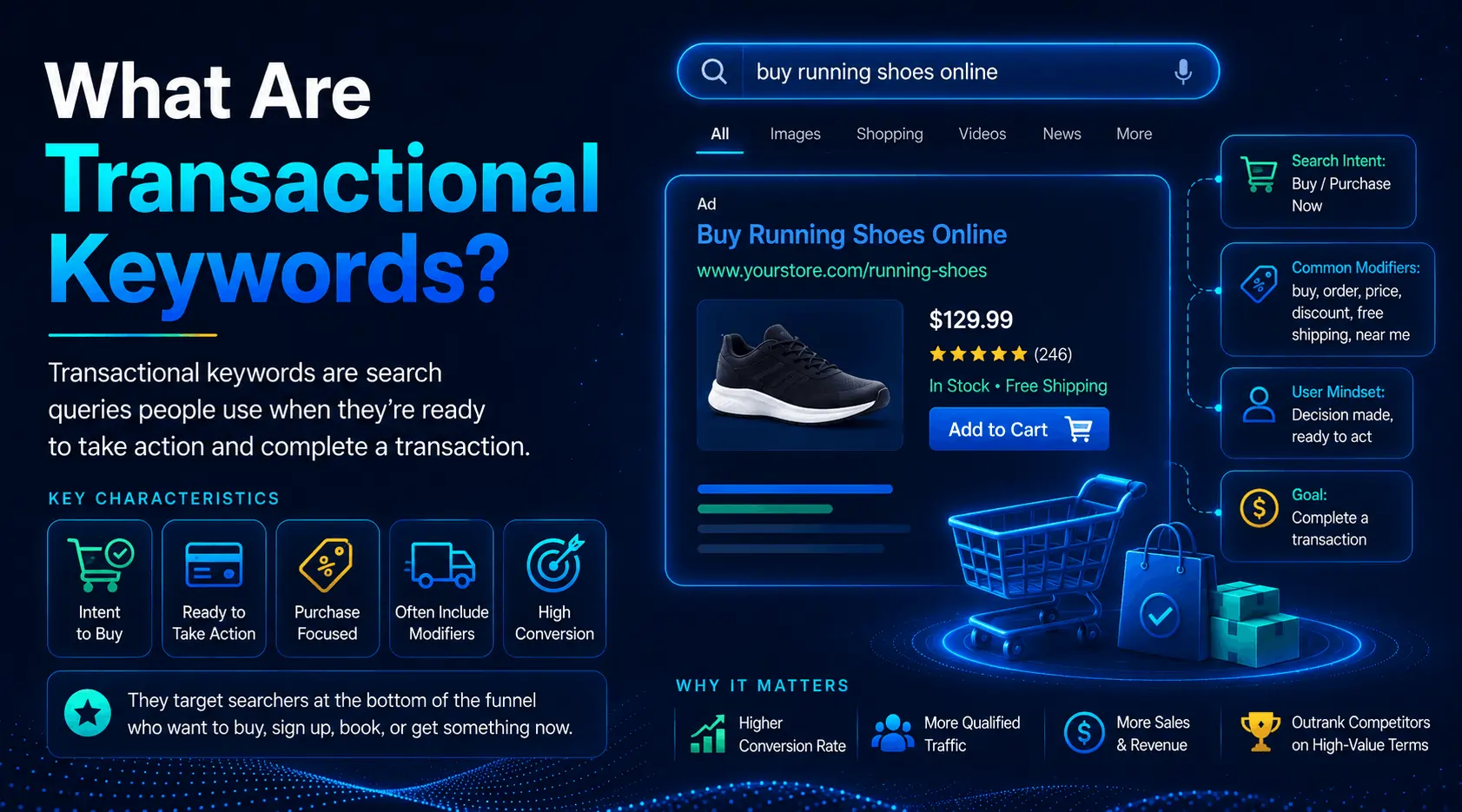
Transactional keywords turn search traffic into sales.
You can rank on Google, attract thousands of visitors, and still struggle to grow revenue. Your dashboard may look healthy, but your bank account tells a different story.
That gap usually comes down to intent. The people landing on your page don’t want to buy yet. They want to read, compare, or learn.
Transactional keywords fix that problem. They capture searchers after they finish researching and start looking for a product, service, trial, quote, or checkout page. In SEO, these keywords often represent the most valuable real estate because they connect your pages with people who are ready to act.
By the end of this guide, you’ll know what transactional keywords are, how to separate them from similar terms that hurt conversions, how to find them in your niche, and how to match each keyword with a page built to sell.
Here’s the irony: “what are transactional keywords” is not a transactional keyword. That searcher wants to learn, not buy. Keep that distinction in mind, because spotting intent is the skill that makes these keywords so profitable.
What are transactional keywords?
A transactional keyword is a search query typed by someone who intends to complete an action. The clue is right there in the word “transaction”: the searcher wants to do something, not just know something.
Most of the time that action is a purchase. But it can also be starting a free trial, booking an appointment, requesting a quote, downloading paid software, or subscribing to a service. The common thread is intent to act.
Compare two searches for the same product:
- “how to choose running shoes” is a reader.
- “buy Brooks Ghost 16 size 10” is a buyer.
The first person might purchase a pair eventually, somewhere, from someone. The second person has a brand, a model, and a size in mind. They want a page with an Add to Cart button, and they want it now.
These keywords sit at the very bottom of the marketing funnel, closer to a sale than any other kind of search. That’s why they matter out of all proportion to their search volume. A term with 200 monthly searches and strong purchase intent can earn more than one with 20,000 searches and none.
The four types of search intent
You can’t really understand transactional keywords in isolation. They’re one of four broad intent categories, and Google has built its entire ranking system around guessing which one you mean.
| Intent type | What the searcher wants | Example query |
|---|---|---|
| Informational | To learn or understand | “what is cold brew” |
| Navigational | A specific site or page | “Patagonia login” |
| Commercial investigation | To compare before buying | “best CRM for small business” |
| Transactional | To act or buy now | “buy HubSpot annual plan” |
Informational and navigational searches rarely convert on the spot, so they belong to blog posts, guides, and brand pages. The money lives in the bottom two rows.
The trouble is that the line between those two rows, commercial and transactional, is where most marketers slip. Sort that out and you’re already ahead of most of your competitors.
Transactional vs. commercial keywords: the distinction that costs the most
Commercial investigation keywords and transactional keywords both involve money, so people lump them together. They shouldn’t, because each one needs a completely different page.
Here’s a one-question test that settles almost every case: would this person happily click “Add to Cart” right now?
“Best wireless earbuds 2026” fails the test. That searcher is still deciding. They want comparisons, pros and cons, a recommendation. Serve them a review roundup and you can influence which brand they pick.
“Buy AirPods Pro 2” passes the test. That searcher has already decided. Serve them anything other than a fast, clean way to buy and you lose them.
A few more, side by side:
- “Mailchimp vs ConvertKit” is commercial. “ConvertKit pricing” is transactional.
- “Are standing desks worth it” is commercial. “Order standing desk free delivery” is transactional.
- “Best running shoes for flat feet” is commercial. “Buy Hoka Clifton 9 size 10” is transactional.
Why does this matter so much in practice? Because a commercial searcher wants content, a guide, a comparison, a review, while a transactional searcher wants a product page, a pricing page, or a signup form. Put a 2,000-word comparison article in front of someone who typed “buy” and you’ve added homework between them and their wallet. Put a bare checkout page in front of someone still comparing and you’ve rushed a decision they aren’t ready to make.
The words that signal buying intent
The fastest way to spot a transactional keyword is to learn the modifiers people attach to a product or service. Once you know them, you’ll see them everywhere.
- Buying words: buy, purchase, order, shop, get
- Price and deal words: price, pricing, cost, how much, cheap, affordable, discount, coupon, promo code, deal, sale, for sale
- Offer words: free shipping, free trial, free download, free quote, in stock
- Action words: subscribe, sign up, book, hire, schedule, download, install
- Local words: near me, open now, in [city], delivery, same day
So “noise cancelling headphones” is ambiguous, but “buy noise cancelling headphones,” “noise cancelling headphones price,” and “noise cancelling headphones near me” are clearly transactional.
Two patterns are worth flagging. First, the more specific the query, the stronger the intent. “Running shoes” is vague. “Buy women’s waterproof trail shoes size 8 free returns” is someone three clicks from checkout. Second, “near me” and other local modifiers are pure gold for service businesses. “Emergency electrician near me” is not a research project. It’s a person with a problem and a phone in their hand.
One caution: modifiers are a clue, not a rule. Plenty of transactional searches carry no obvious signal word at all. “iPhone 16 Pro case” usually means buy one immediately, even though the word “buy” never appears. When in doubt, the SERP settles it, and we’ll get there.
Transactional keyword examples by business type
What counts as transactional looks different depending on what you sell. The pattern holds; only the products change.
Ecommerce and retail: buy wireless earbuds online, leather weekender bag free shipping, size 10 hiking boots on sale, organic dog food delivery.
SaaS and software: Notion paid plan, Slack pricing per user, Ahrefs subscription cost, start Shopify free trial.
Local services: emergency plumber near me, book a dentist appointment online, AC repair same day, wedding photographer quote.
Professional services and courses: hire a tax accountant, enroll in UX design course, buy Photoshop course download, branding consultant pricing.
Use this as a template. Swap in your category, bolt on the modifiers above, and you’ll have a strong starter list in minutes.
Why transactional keywords beat raw traffic
It’s tempting to chase the keywords with the biggest numbers. A term with 50,000 monthly searches feels like a bigger prize than one with 500. For revenue, that instinct is often backwards.
Think in sales, not visits. Transactional keywords convert at a far higher rate because the searcher already wants to buy. A page that gets 500 transactional visitors a month and converts 8% of them produces 40 sales. A page that gets 20,000 informational visitors and converts 0.1% produces 20. Less traffic, more money.
There’s a competitive angle too. Because transactional terms carry lower volume, plenty of content sites ignore them while they fight over traffic-grabbing how-to posts. That leaves room. While competitors battle over “what is project management,” you can quietly own “buy project management software” and “Asana vs Monday pricing,” then collect the buyers they overlook.
High intent also improves the math on paid search. If you run ads, transactional terms are usually where the budget pays off, because you’re buying clicks from people ready to act rather than people who are merely curious.
None of this makes informational keywords worthless. They build awareness, earn links, and feed the top of your funnel. But if conversions are the goal, transactional keywords are where you start.
How to find transactional keywords, step by step
You don’t have to guess. Run this process for any product or service.
1. Start with seed terms. List what you actually sell in plain language: every product, service, and category. If you sell standing desks, your seeds are “standing desk,” “adjustable desk,” “sit-stand desk.” These are starting points, not final keywords.
2. Add transactional modifiers. Combine each seed with the signal words from earlier. “Standing desk” becomes “buy standing desk,” “standing desk price,” “standing desk deals,” “standing desk near me.” Now you’re generating buyer queries instead of broad terms.
3. Pull data from a keyword tool. Drop your list into a research tool to check search volume, difficulty, and related suggestions. Free options like Google Keyword Planner work to start; tools such as Ahrefs and Semrush add richer intent and competition data. Google Search Console is the quiet winner here, because it shows queries already bringing people to your site, which often surfaces transactional terms you didn’t know you ranked for.
4. Read the SERP. This is the real intent test. Most people skip this step, and it’s the best one. Search your target keyword and look at what Google already ranks. Product pages, category pages, shopping ads, and “buy” language confirm transactional intent. If the first page is full of blog posts and how-to guides instead, Google reads that query as informational, no matter how buy-ready it looks to you. Google has spent years and a fortune learning what searchers want, so trust its results over your gut.
5. Watch the SERP features. Shopping carousels, price filters, and “in stock near you” boxes all point to transactional intent. Their presence tells you Google expects buyers, not browsers.
Once you have your list, prioritize it by a blend of intent strength, achievable difficulty, and business value. A modest-volume keyword that maps to a high-margin product usually beats a high-volume term that barely converts.
How to use transactional keywords once you have them
Finding them is half the job. Converting them is the other half.
Map each keyword to the right page. Transactional keywords belong on conversion pages: product pages, category pages, pricing pages, and dedicated landing pages, never blog posts. When someone searches “buy ergonomic office chair,” send them to a page where they can do exactly that. Match single-product searches to product pages, broad category searches like “running shoes for women” to category pages, “pricing” searches to a clear pricing page, and “near me” searches to a location page with your address, hours, and a map.
Write for the decision, not the education. A buyer doesn’t need 2,000 words of background. They need clear pricing, a strong product description, trust signals, and an obvious next step. Cut the preamble and surface what closes the sale.
Optimize on-page, naturally. Work the keyword and its variations into the title tag, H1, URL, meta description, and body copy. Keep it human. Stuffing “buy ergonomic office chair” into every other sentence reads like spam, and Google treats it that way.
Make the call to action impossible to miss. Match the CTA to the keyword. Someone searching “free trial” should land on a page with a prominent “Start free trial” button. Someone searching “get a quote” should see a short quote form above the fold.
Remove friction. Ranking a page is wasted if it doesn’t convert. Show price and availability without a hunt, add reviews and a clear return policy, keep the page fast, and strip out anything that distracts from the action.
Don’t sleep on long-tail terms. The shortest transactional keywords, like “buy headphones,” are also the most competitive, owned by huge brands. Long-tail variations like “buy open-back headphones for mixing under $200” have lower volume but lower competition and sky-high intent. You may never outrank a major retailer for the head term, but the specific one is often wide open. Stack enough long-tail pages and they add up.
Funnel your readers toward your buyers’ pages. Your guides and comparison posts don’t have to convert on their own. Use internal links to pass visitors from a “best running shoes for flat feet” roundup straight to the product pages it recommends. That’s how top-of-funnel content earns its keep.
A quick worked example
Say you run an online store selling ergonomic office chairs. The full process looks like this:
- List your offerings: office chairs, desk chairs, lumbar cushions, chair mats.
- Add modifiers: “buy ergonomic office chair,” “ergonomic chair price,” “best office chair deal,” “lumbar cushion for sale.”
- Check the SERP: “buy ergonomic office chair” returns product pages and shopping ads, so transactional is confirmed. “How to fix back pain at a desk” returns only articles, so that one becomes blog content instead.
- Map each keyword to a page: the category page targets “buy ergonomic office chair,” a specific product page targets a model like “Herman Miller Aeron price,” and a clearance landing page targets “office chair deal.”
- Optimize for the decision: each page gets clear pricing, real photos, reviews, a visible Add to Cart button, and shipping details near the top.
- Layer in paid search: run ads on the strongest term while the organic ranking climbs.
Six steps, and every transactional keyword now lands on a page built to close.
Common transactional keyword mistakes to avoid
A few errors show up again and again. Sidestep these and you’ll outperform most competitors.
- Targeting transactional terms with blog posts. A buyer who lands on an article instead of a product page usually leaves. Match the page format to what the searcher wants to do.
- Chasing volume over intent. The biggest keyword isn’t the best keyword. A high-volume informational term can send thousands of visitors who never buy.
- Confusing commercial and transactional intent. “Best” and “review” terms need content. “Buy” and “price” terms need product pages. When in doubt, let the SERP decide.
- Ignoring long-tail keywords. Specific, lower-volume terms often carry the highest intent and the least competition. Collect them on purpose.
- Keyword stuffing. Repeating the exact phrase everywhere hurts readability and rankings. Use natural variations and let related terms do the rest.
- Skipping the SERP check. Never commit to a keyword without seeing what already ranks. The results page tells you the intent for free.
The bottom line
Transactional keywords are where search traffic stops being a vanity metric and starts being a revenue channel. They’re the terms your future customers type at the exact moment they’re ready to act, and capturing them is often easier than ranking for the crowded, high-volume keywords everyone else fights over.
The rule that ties it all together: chase intent, not just traffic. A few hundred visitors with their wallets out will do more for your business than tens of thousands who are only curious.
Here’s your move this week. Pull up your three most important product or service pages, search the keywords you want them to rank for, and check whether the page Google rewards matches the page you’ve built. Fix the mismatches first. That single audit usually surfaces the fastest, most profitable win in your entire keyword strategy.
Frequently Asked Questions About Transactional Keywords
Here are quick answers to the most common questions about transactional keywords.
What is a transactional keyword?
A transactional keyword is a search query used by someone who is ready to take action. That action could be buying a product, booking a service, signing up for a free trial, requesting a quote, downloading software, or subscribing to a plan. These keywords usually sit near the bottom of the marketing funnel because the searcher is close to converting.
What is an example of a transactional keyword?
An example of a transactional keyword is “buy barbecue accessories online.” This search shows the person is not just researching barbecue accessories; they are likely ready to make a purchase. Other examples include “shop merino sweaters,” “hire caterers near me,” “book a dentist appointment,” and “start Shopify free trial.”
What are the 4 types of intent?
The four main types of search intent are informational, navigational, commercial, and transactional.
Informational intent means the user wants to learn something, such as “how to choose running shoes.” Navigational intent means they want to find a specific website or page, such as “YouTube login.” Commercial intent means they are comparing options before buying, such as “best CRM for small business.” Transactional intent means they are ready to act, such as “buy HubSpot annual plan.”
What is the difference between informational and transactional keywords?
Informational keywords are used by people who want to learn, research, or answer a question. For example, “how to choose running shoes” is informational because the searcher is still gathering advice.
Transactional keywords are used by people who are ready to take action. For example, “buy Brooks running shoes size 10” is transactional because the searcher likely wants a product page where they can make a purchase.
The key difference is intent: informational searches are about learning, while transactional searches are about doing or buying.
How do you find transactional keywords?
You can find transactional keywords by starting with the products or services you sell, then adding buyer-focused modifiers. Common modifiers include buy, order, shop, price, pricing, discount, coupon, deal, free trial, book, hire, schedule, quote, near me, and free shipping.
For example, if your seed keyword is “standing desk,” you could create transactional keyword ideas like “buy standing desk,” “standing desk price,” “standing desk deals,” and “standing desk near me.”
After building your list, check the search results. If Google shows product pages, pricing pages, shopping ads, local packs, or booking pages, the keyword likely has transactional intent.
Last Updated on 2 months ago by Alipio Umiten IV
