





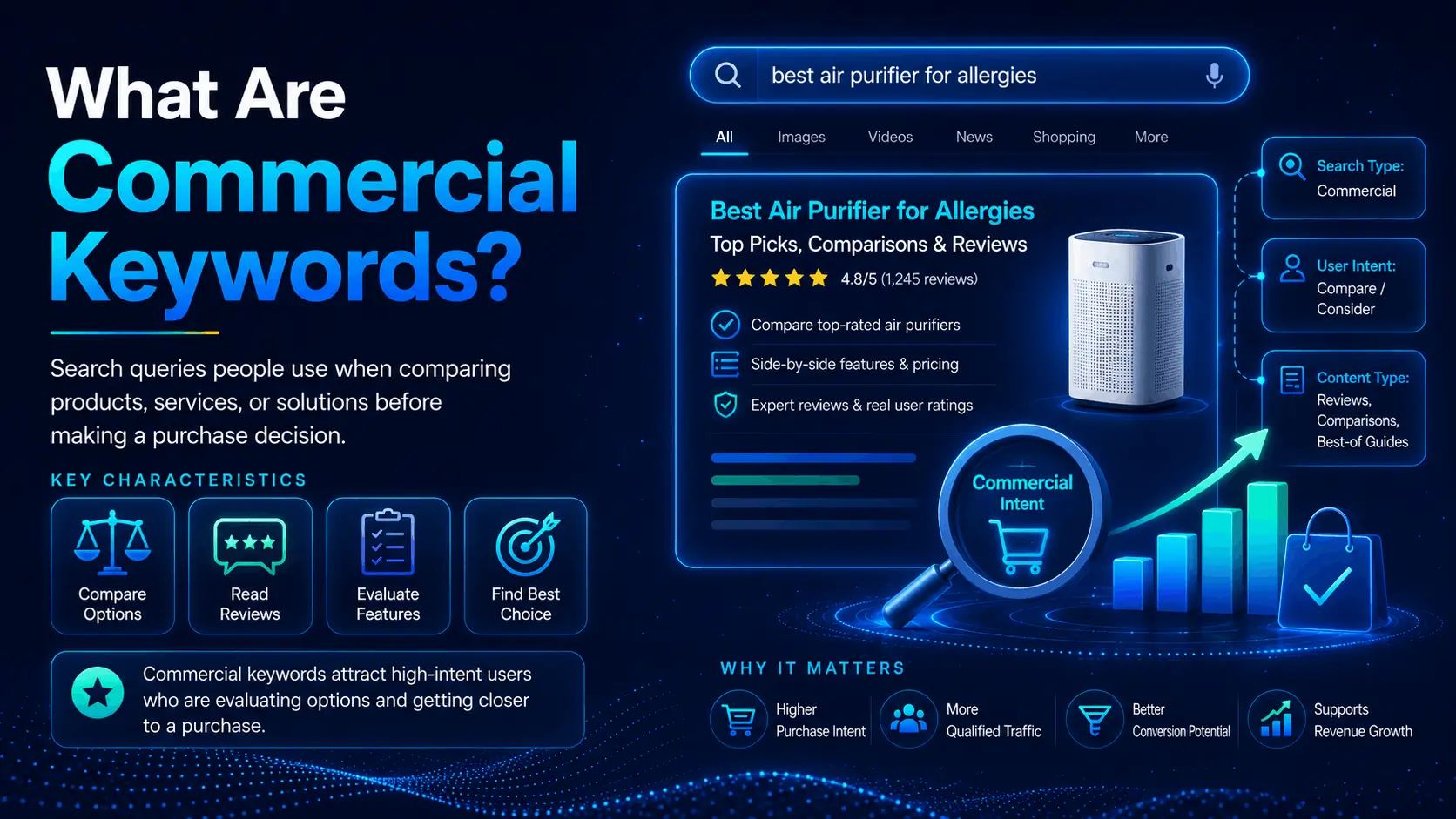
Commercial Intent Keywords turn rankings into revenue by putting your content in front of people who are actively comparing options and deciding where to spend.
Ranking first on Google does not guarantee sales. You can win traffic from a popular keyword and still see flat revenue when visitors never planned to buy. The right keywords fix that problem.
Commercial intent keywords reveal buyers in the consideration stage. These searchers compare products, read reviews, weigh alternatives, and look for the best choice before they make a purchase. When you target these terms, you reach people at the exact moment your content can influence their decision.
In this guide, you’ll learn what commercial intent keywords are, how they differ from other keyword types, and how to find the ones worth targeting. You’ll also learn how to read intent from a search query, prioritize terms you can realistically rank for, and build pages that convert.
By the end, you’ll know how to look at any keyword and decide whether it attracts casual readers or potential customers.
What Are Commercial Intent Keywords?
Commercial intent keywords are the search terms people use when they’re researching a purchase but haven’t committed yet. The searcher has a problem, knows a solution exists, and is now deciding which option to trust. They’re shopping, not just browsing.
Consider two searches. Someone typing “what is an air purifier” wants to learn. Someone typing “best air purifier for pet allergies” wants to buy, and is figuring out which one. The second search carries commercial intent.
These keywords sit in the consideration stage of the buying journey, one step before the actual transaction. That position is what makes them valuable. You’re no longer convincing the reader they have a problem. You’re convincing them you have the answer.
If you want what commercial keywords are in a single sentence: they’re the keywords of the comparison shopper, the person with their wallet half open.
A few examples across niches:
- “best CRM for small business”
- “Ahrefs vs Semrush”
- “Allbirds alternatives”
- “is the Dyson air purifier worth it”
- “top noise-canceling headphones under $200”
Each one signals money on the table and a decision still in play.
The Four Types of Search Intent (and Where Commercial Sits)
Every search maps to a goal. Sorting those goals into four buckets shows why commercial intent is the one tied most directly to revenue.
Informational. The searcher wants to learn. Queries like “how does HEPA filtration work” or “what is email marketing” signal curiosity, not purchase readiness. High volume, great for authority, low conversion.
Navigational. The searcher wants a specific page or brand, such as “Coway login” or “Nike returns policy.” Unless the brand is yours, these are hard to win and rarely worth chasing.
Commercial. The searcher is comparing options before buying: “best air purifier for large rooms,” “Coway vs Levoit.” Buying motivation is high, but the decision is still open, which means your content can tip it.
Transactional. The searcher is ready to act now: “buy Coway Airmega 400,” “Levoit Core 600S price.” Conversion potential is highest, competition is fierce, and the volume is usually small.
Here’s the quick version:
| Intent | Searcher’s goal | Example | Buying readiness |
|---|---|---|---|
| Informational | Learn | “how do air purifiers work” | Low |
| Navigational | Find a page | “Levoit login” | Varies |
| Commercial | Compare options | “best air purifier for allergies” | High |
| Transactional | Buy now | “buy Levoit Core 300” | Highest |
Commercial intent lives in the high-value middle, where a reader has the budget and the motivation and just needs a reason to choose you.
Commercial vs. Transactional Keywords
Marketers blur these two constantly, and the mix-up costs conversions.
Transactional keywords catch people at the checkout line. They lean on words like buy, order, coupon, pricing, and near me. The searcher has already chosen, so these terms map to product pages, pricing pages, and checkout flows.
Commercial keywords catch people one step earlier, while they’re still choosing. They lean on best, review, vs, and alternative. These map to comparison posts, buying guides, and roundups.
The difference dictates your content. Send a “best air purifier” searcher to a bare product page and they bounce, because you skipped the comparison they came for. Send a “buy Levoit Core 300” searcher to a 3,000-word guide and you bury the button they were ready to click. Match the page to the intent and both your rankings and your sales improve.
Why Commercial Intent Keywords Are Worth Targeting
Commercial keywords usually draw less volume than broad informational terms. Fewer people search “best air purifier under $300” than search “why is my air bad.” So why prioritize the smaller pool? Three reasons.
Conversion rate. Commercial searchers are closer to buying, so a larger share take action. A hundred visitors on a buying-guide keyword can outsell a thousand on a definition keyword.
Revenue per visit. Because these readers are in spending mode, each visit is simply worth more. That’s also why advertisers bid up these terms in paid search. A high cost per click is the market telling you a keyword has buyers behind it.
Competitive position. Rank for “best ” and you reach buyers at the exact moment they choose. Own that page and you intercept demand your competitors are still spending money to create.
The tradeoff is that everyone wants these terms, so the results are crowded and difficulty runs high. The way through is specificity, which the next sections cover.
How to Read a Keyword Like a Buyer
You don’t need a tool to sense commercial intent. You need to read the query the way the searcher meant it. Three signals do most of the work.
Start With the Modifiers
Certain words attach themselves to buying research. Group them by what they reveal:
- Comparison: vs, versus, or, compared to (“Coway vs Levoit”)
- Ranking: best, top, leading (“best air purifier for smoke”)
- Validation: review, worth it, legit, honest (“Molekule review”)
- Alternatives: alternatives, competitors, like, similar to (“Dyson alternatives”)
- Qualifiers: for [use case], under $[price], for beginners (“best air purifier for nurseries”)
When you see these attached to a product or category, you’re almost certainly looking at commercial intent. “Air purifier” alone is ambiguous. “Best air purifier for pet allergies under $200” is a buyer comparing options with a budget. The modifier does the work.
Read the SERP
Modifiers are signals. The search results page is proof. Google has studied billions of clicks to learn what satisfies each query, so the page it serves tells you the intent.
Search your keyword and read page one. Comparison articles, roundups, review sites, shopping ads, and product carousels mean Google sees commercial intent. Dictionary definitions and how-to guides mean it’s informational, and a sales-focused page will struggle there no matter how good it is. Matching the dominant format is one of the highest-leverage moves in SEO. Fighting it almost never works.
Check the Cost Per Click
Pull the keyword into any tool that shows CPC. Advertisers only pay for clicks that convert, so a high CPC means real buyers sit behind the search. Treat it as a buyer-demand thermometer. A $0.15 CPC suggests browsers. A $14 CPC suggests a market full of people ready to spend.
How to Find Commercial Intent Keywords (Step by Step)
Spotting intent is the skill. Here’s how to build a list worth acting on.
- Start with what you sell. List your core products, services, and categories in plain language. An air purifier store starts with “air purifier,” “HEPA filter,” “air quality monitor.”
- Layer on commercial modifiers. Combine each seed with the modifiers above. “Air purifier” becomes “best air purifier for allergies,” “Coway vs Levoit,” “air purifier for large rooms.” A keyword tool will surface hundreds of variations automatically.
- Mine the comparisons you already trigger. Search “[your product] vs” and “[competitor] alternatives” and watch what autocompletes. These reveal the exact matchups your buyers are researching.
- Check volume and difficulty together. Use a tool like Ahrefs, Semrush, Moz, or Google Keyword Planner to pull search volume and a difficulty score. You want steady volume and a difficulty your site can realistically challenge.
- Validate every candidate on the live SERP. Before committing, confirm the top results match the page you plan to write. If you’re building a comparison post and the first page is full of comparison posts, you’ve matched the intent. If it’s full of product pages, rethink the format.
Run that loop across your product line and you’ll end up with a prioritized list of terms that point straight at people ready to buy.
Prioritize the Money Keywords (Intent × Difficulty)
Not every commercial keyword deserves your time. Beginners make the mistake of chasing the highest-volume, most obvious terms, the ones every competitor with a bigger budget already owns. You’ll spend months stuck on page four.
A smarter filter weighs two things against each other: commercial intent and keyword difficulty. Picture a simple grid.
- High intent, low difficulty. Your quick wins. Target these first. They’re usually specific long-tail terms like “best air purifier for nurseries.”
- High intent, high difficulty. Worth pursuing over the long term, once you’ve built authority. “Best air purifier” lives here.
- Low intent, low difficulty. Useful for top-of-funnel content and internal linking, not for conversions.
- Low intent, high difficulty. Skip it.
Long-tail commercial keywords are where smaller sites win. “Best air purifier” might draw heavy volume and brutal competition. “Best air purifier for cigarette smoke in apartments” draws fewer searches, but the person typing it knows exactly what they want, and you can actually rank for it. Lower volume, higher conversion, achievable difficulty. That trade is almost always worth making. Stack up enough of those specific, winnable terms and the combined traffic rivals the head terms, with far better conversion.
A Worked Example, Start to Finish
Say you run a small online store selling air purifiers. Here’s the loop in action.
You start with a seed: “air purifier.” On its own the term is broad and the intent is mixed, so you layer modifiers and land on “best air purifier for pet allergies.”
You run the search. Page one is full of roundup articles comparing specific models, plus a couple of shopping ads. That’s a clear commercial signal. The searcher wants a recommendation tied to a constraint, not a lesson on how filtration works.
You check the metrics. The CPC sits in a healthy range, which confirms advertisers see buyers, and the difficulty is moderate rather than crushing, which a focused store can compete for.
Now you build the page to match. You write a roundup of five or six purifiers that perform well on pet dander, each with room size, filter type, noise level, price, and a clear “best for” line. Your own bestseller earns a spot, positioned for the use case it actually fits. The recommendation and buy link sit right after the comparison, where the reader’s conviction peaks.
That single page now targets a commercial keyword, matches the searcher’s intent, and gives a buyer everything they need to decide. Repeat across your catalog and you’ve built a library of pages that earn revenue, not just pageviews.
How to Use Commercial Keywords in Content
Ranking does nothing if the page doesn’t match what the searcher came to do. Intent dictates format.
Match the content type to the query. A “best ” query wants a roundup that compares several options and names winners for different needs. A “vs” query wants an honest head-to-head with a verdict, not a fence-sit. A “review” query wants depth: hands-on detail, real pros and cons, and who should skip it.
Place your keyword where it carries weight. Put it in the title tag, the H1, the first 100 words, at least one subheading, and the meta description. Then weave natural variations through the body so the page reads like a person wrote it.
Earn trust with specifics. Commercial searchers are skeptical by default, because they’re about to spend money. Real prices, named tradeoffs, and honest mentions of downsides do more to convert them than vague praise ever will. A review that admits a flaw is more persuasive than one that gushes.
Point the reader to a next step. Add a clear call to action that fits the stage: a comparison table with buy buttons, a free trial, a demo, an email signup. You attracted a buyer, so make the path obvious.
Common Mistakes to Avoid
A few errors quietly drain the return on commercial keywords.
Chasing volume over intent. A keyword with 50,000 searches and no buying signal is worth less than one with 500 searches and a credit card behind every query.
Ignoring the SERP. Aiming a sales page at an informational keyword is a fight you’ve already lost. Let the results tell you what to build.
Biting off terms that are too competitive. New and mid-size sites win by getting specific first, then climbing as their authority grows.
Stuffing keywords. Repeating your target phrase twenty times won’t help you rank, and it trains readers to leave. Write for the human and use variations naturally.
Forgetting the journey. If every page targets ready-to-buy terms, you skip the readers still building awareness and lose them to competitors who showed up earlier. Capture them with informational content, then link to your commercial pages.
The Takeaway
Commercial intent keywords are the bridge between traffic and revenue. They reach people in the act of choosing, when your recommendation carries the most weight, which makes them the highest-leverage terms in your strategy and the most competitive. You win them by reading intent honestly, getting specific enough to rank, and matching every page to what the searcher wants to do.
Start small. Pull up your three best-selling products or services, run them through the steps above, and find five high-intent, low-difficulty keywords you can target this month. Then build one genuinely useful comparison or buying guide around the strongest one.
Your move: open Google, type “best [your product],” and study who shows up. That page is the one you’re about to outrank.
Frequently Asked Questions About Commercial Intent Keywords
Here are quick answers to common questions about commercial intent keywords.
What is an example of a commercial keyword?
An example of a commercial keyword is “best natural dog food.” This keyword shows that the searcher is comparing options before buying. They are not just looking for general information about dog food; they are trying to find the best product, brand, or recommendation.
Other examples of commercial keywords include “best organic dog food for puppies,” “natural dog food brands compared,” “Ahrefs vs Semrush,” and “best air purifier for allergies.”
What is the difference between commercial and transactional keywords?
Commercial and transactional keywords both show buying intent, but they happen at different stages of the customer journey.
Commercial keywords are used when someone is still researching or comparing options. Examples include “best natural dog food,” “Semrush vs Ahrefs,” and “Dyson air purifier review.”
Transactional keywords are used when someone is ready to take action. These often include words like buy, order, pricing, coupon, discount, book, or near me. Examples include “buy organic dog food online,” “Semrush pricing,” and “book dentist appointment near me.”
In short, commercial keywords help users decide what to buy, while transactional keywords help users complete the purchase.
What are the four types of keywords?
The four main types of SEO keywords are informational, navigational, commercial, and transactional. These categories are based on search intent, which means the reason behind a user’s search.
Informational keywords are used when someone wants to learn something, such as “how does air purification work?”
Navigational keywords are used when someone wants to find a specific website, brand, or page, such as “Amazon login” or “Nike returns policy.”
Commercial keywords are used when someone is comparing products, services, or brands before buying, such as “best air purifier for pet allergies.”
Transactional keywords are used when someone is ready to buy, sign up, book, or take another direct action, such as “buy air purifier online.”
What are examples of high-intent keywords?
High-intent keywords are search terms that suggest the user is close to taking action, such as buying a product, booking a service, requesting a quote, or signing up for a trial.
Examples of high-intent keywords include:
- buy car insurance in Maryland
- best natural dog food for allergies
- buy organic dog food online
- Semrush vs Ahrefs
- HubSpot pricing
- emergency plumber near me
- get a home insurance quote
- book dentist appointment near me
These keywords are valuable because they attract people who are not just browsing. They already have a need and are comparing, evaluating, or preparing to buy.
Last Updated on 3 weeks ago by Alipio Umiten IV