





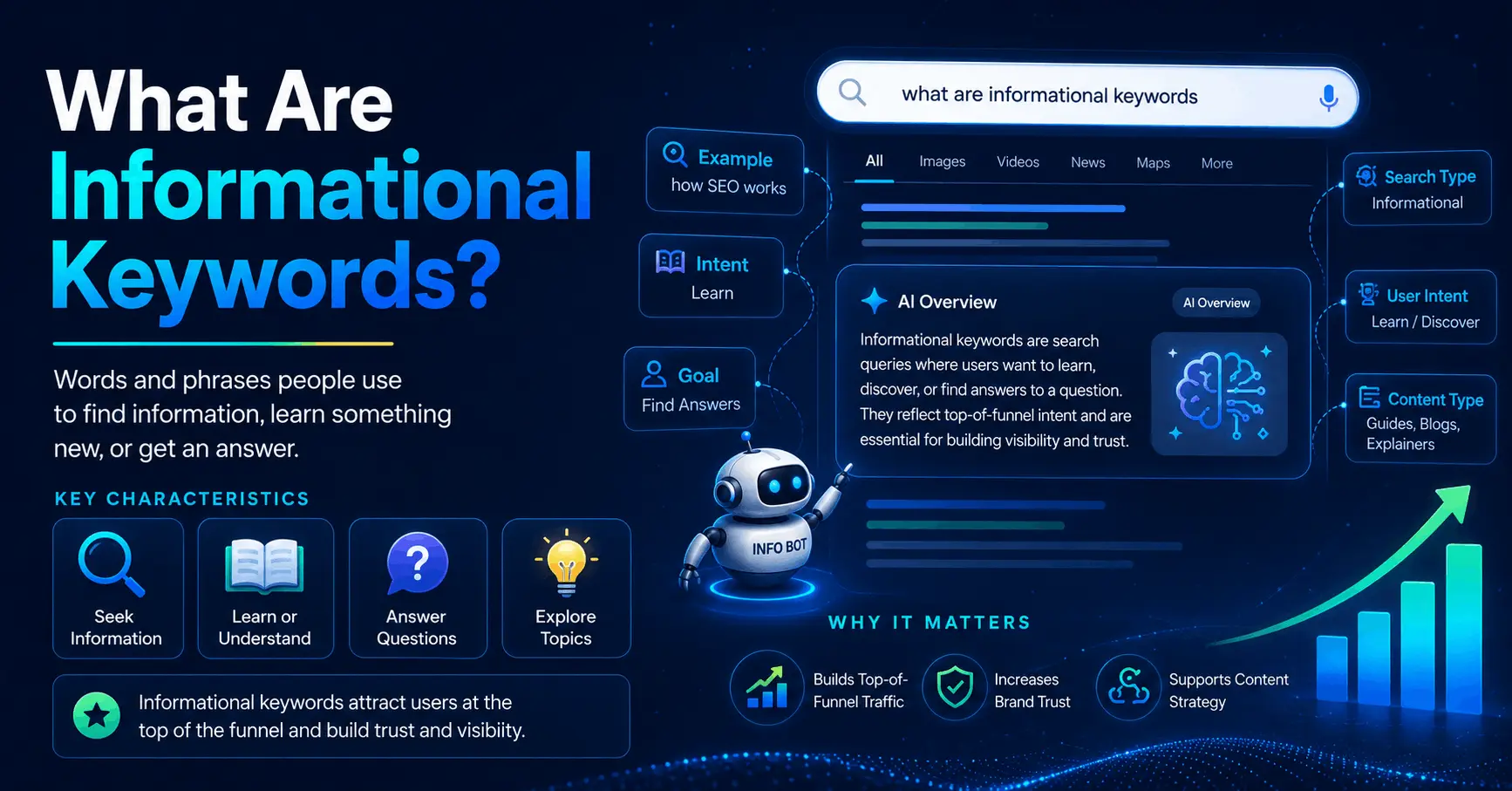
Informational keywords bring people to your site when they want answers, not a checkout page.
That is exactly why they matter. Most future customers do not start with a credit card in hand. They start with a question. They search because they want to learn something, understand a problem, compare ideas, or find a clear next step.
But many writers get keyword strategy wrong. They target keywords without knowing which ones build an audience and which ones close a sale. As a result, they publish helpful guides that attract traffic but never convert, or they chase buying terms with thin pages that never rank.
This guide will fix that. You will learn what informational keywords are, how to spot them quickly, where to find the ones worth targeting, and how to turn them into content that earns trust, even on a results page increasingly shaped by AI answers.
What Are Informational Keywords?
Informational keywords are the search terms people use when they want to learn, understand, or solve a problem. The searcher is gathering knowledge. They want a definition, a method, an explanation, or a quick fact, not a checkout page.
A few examples across different niches:
- “how to descale a coffee machine”
- “what is compound interest”
- “why is my sourdough so dense”
- “best practices for email subject lines”
- “signs of burnout”
Notice what is missing: words like “buy,” “price,” “near me,” or a specific product name. Nobody searching these is ready to spend. They have a question, and the search engine’s job is to hand them the clearest, most trustworthy answer it can find.
Informational keywords often take the form of questions, but not always. “Beginner yoga routine” has no question word in it, yet the intent is clearly to learn. The test is not grammar. It is what the searcher hopes to walk away with.
The four types of search intent
To use informational keywords well, you need to see where they sit beside the other kinds of searches. Search intent, the reason behind a query, usually splits into four buckets.
| Intent type | What the searcher wants | Example query | Funnel stage |
|---|---|---|---|
| Informational | To learn or understand | “what are informational keywords” | Awareness (top) |
| Navigational | To reach a specific site | “spotify login” | Any |
| Commercial | To compare before buying | “best running shoes for flat feet” | Consideration (middle) |
| Transactional | To buy or act now | “buy nike pegasus 41” | Decision (bottom) |
Informational queries make up the largest share of everything typed into Google, because curiosity is far more common than a wallet in hand.
That breadth is the opportunity, and also the catch. The traffic is huge, but it is early. Treat an informational visitor like a buyer and you lose them. Treat them like someone who needs help, and you start a relationship that can pay off later.
Why intent matters more than the keyword itself
Here is the mistake that quietly kills rankings: matching the words but missing the intent.
Say you sell project management software and you target “what is a Gantt chart.” A beginner types that wanting a plain explanation. If your page is a hard pitch for your tool, Google sees the mismatch, visitors bounce, and your rankings slip. The searcher wanted a teacher and you showed up as a salesperson.
Google has become very good at reading intent. It watches what people click, how long they stay, and whether they bounce back to the results. Match the intent and you earn the ranking. Fight it and you lose, no matter how many times the keyword appears on your page.
How to spot an informational keyword
You do not need a tool to recognize informational intent. You need two shortcuts.
First, watch for signal words. Certain modifiers mean someone wants to learn almost every time:
- Question words: what, why, how, when, where, who
- Learning words: guide, tutorial, tips, ideas, examples, meaning, definition
- Process words: how to, steps to, ways to
So “how to compost at home,” “email marketing tips,” and “examples of metaphors” all wave the informational flag.
But modifiers alone will fool you. “Best CRM software” reads like research, yet the results page is full of comparison posts and product roundups, which is commercial intent. The word “best” usually means the searcher is already close to buying.
So lean on one reliable test: search the keyword yourself and read the first page. The results tell you what Google believes the searcher wants. If page one is blog posts, how-to guides, and definitions, the intent is informational. If it is product pages, pricing, and “buy now” buttons, it is not. The search results are the answer key, and checking them is free.
Examples of informational keywords, grouped by pattern
Once you know the patterns, you see informational keywords everywhere. Here they are by the shape they usually take.
- “How to” queries: “how to start a podcast,” “how to fix a leaky faucet.” The searcher wants a method.
- “What is” and definition queries: “what is RAM,” “meaning of a bear market.” The searcher wants an explanation. This is the pattern most exposed to AI answers, more on that shortly.
- “Why” queries: “why is the sky blue,” “why won’t my car start.” The searcher wants a cause.
- “Best way, tips, ideas” queries: “tips for better sleep,” “small bathroom storage ideas.” Broad, practical, and easy to scan as a list.
- Problem and symptom queries: “lower back pain after sitting,” “laptop fan loud.” People describing something they want to understand.
Informational modifiers are the small words people attach to a topic to get specific: tutorial, checklist, template, examples, for beginners, step by step. Bolt one onto a seed topic and you usually get a long-tail informational keyword. “Budgeting” is broad. “Budgeting template for beginners” is a specific query you can actually build a page around.
Those longer phrases, the long-tail keywords, carry lower search volume but clearer intent and far less competition. They are the easiest wins for a newer site.
Informational vs. commercial and transactional keywords
The clearest way to understand informational keywords is to put them next to the keywords built to make money directly.
Picture one buyer’s journey for someone shopping for a standing desk:
- Informational: “are standing desks good for you” (deciding whether the category is worth it)
- Commercial: “best standing desks under $500” (comparing specific options)
- Transactional: “buy uplift v2 standing desk” (ready to purchase)
The same person moves through all three over days or weeks. An informational keyword catches them early, when they are forming opinions and trust no one yet. A transactional keyword catches them late, when they have decided and just need a place to click.
This is why expecting informational content to convert like a product page is a mistake. Informational keywords are not weak. They are early. Their job is reach, trust, and being remembered, not closing the sale on the same visit.
How to find informational keywords (5 practical methods)
Recognizing intent is step one. Now you need an actual list worth targeting. Here are five reliable methods, from free to paid.
1. Mine Google autocomplete
Start typing a topic into the search bar and read the suggestions. They come from real searches. Type “intermittent fasting” and you will see “intermittent fasting schedule,” “intermittent fasting benefits,” and more. Each suggestion is a validated query.
2. Harvest People Also Ask
The expandable question boxes in the results are a goldmine. Open one and Google loads more, giving you a branching tree of related questions your audience is actively asking. Each becomes a section or an FAQ entry.
3. Read the related searches
Scroll to the bottom of any results page for the cluster of related terms. These surface adjacent angles and long-tail variations you would never brainstorm alone.
4. Use keyword tools, but read the intent
Tools like group queries by question word and show search volume and keyword difficulty. They turn the manual methods above into a sortable list in seconds. Filter for informational intent, then confirm against the live results page, because a tool estimates intent while the search results prove it.
5. Open Google Search Console
This source is badly underused. In the Performance report, look at the queries you already get impressions for. You will often find informational searches where you rank but barely get clicked. That gap is your most actionable list, and the next section explains exactly why it exists.
A simple workflow: pick one topic, gather 30 to 50 informational queries with these methods, then group them by subtopic. You have just outlined a full content cluster instead of a single post.
The 2026 reality: informational keywords and AI Overviews
Here is the part the older guides skip.
Ranking number one for an informational keyword no longer guarantees traffic. Google increasingly answers the query right on the results page with an AI Overview, a featured snippet, or a knowledge panel, and the user never clicks through.
This is why that Search Console gap exists. You can hold position one for “what is compound interest” and watch your click-through rate sit near zero, because the AI summary already handed the searcher a clean four-sentence answer.
Not all zero-click results are equally bad, though. There is “good” zero-click, where your brand gets cited inside the AI Overview and earns visibility without the click. And there is “bad” zero-click, where Google fully answers a simple factual query and you get nothing. The distance between those two outcomes is the whole game now.
So is informational content dead? Not even close. The goal moved.
How to win with informational keywords now
A few adjustments keep these keywords valuable in a zero-click world.
Target the queries AI cannot fully answer. Simple lookups like “what year did the Berlin Wall fall” or “how many ounces in a cup” are exactly the ones an AI summary resolves completely, leaving you nothing. Prioritize informational queries that demand depth, judgment, or experience: multi-step processes, nuanced comparisons, “it depends” questions, and topics where first-hand expertise shows. “How to choose a CRM for a 10-person sales team” pulls a reader deeper. “What is a CRM” gets answered and closed on the results page.
Optimize to be the cited source, not just the ranked one. AI Overviews pull from pages they consider authoritative and easy to parse. Put a direct, quotable answer near the top, then expand beneath it. Use clear headings, relevant schema where it fits, and a clean structure a machine can lift. The page Google trusts to summarize is usually the one it can read fastest.
Add value a model cannot generate on its own. AI summaries repackage what already exists. They cannot run your original test, share your proprietary data, or report your first-hand result. Original research, real screenshots, expert opinion, and genuine case studies are what make a page worth citing and worth clicking. This is the experience and expertise Google groups under E-E-A-T.
Win the featured snippet. Structure key answers in a snippet-friendly format: a direct definition, a numbered process, a short list. Owning the snippet keeps you visible even when overall clicks drop.
A quick checklist before you publish an informational page in 2026:
- Does it answer the core question within the first 100 words?
- Does it go deeper than an AI summary can, with original detail?
- Is it structured for extraction, with clear H2s, direct answers, and relevant schema?
- Does it demonstrate real experience or data?
- Does it give the reader a logical next step?
How to measure success (change the scoreboard)
Judging informational content by raw clicks alone will tell you it is failing when it is not. That is like judging a first date by whether you got a marriage proposal.
Track a fuller picture instead:
- Impressions and AI Overview citations, for visibility
- Branded search growth: are more people Googling your name afterward
- Assisted conversions, where the informational post was an early touch on a path that later closed
- Email signups, downloads, and return visits captured from the traffic
- Featured-snippet and ranking wins across the whole topic cluster
One upside worth knowing: when an AI Overview is present, the clicks that survive tend to come from higher-intent readers who already saw the summary and still wanted more. Those visits often convert better even as volume drops.
Common mistakes to avoid
Even with the right keyword, a few habits sink results.
- Pitching when you should be teaching. A hard sell breaks the intent match and sends an informational reader straight back to the results.
- Ignoring the search results. If you do not check what already ranks, you are guessing at intent. Page one is right there. Read it.
- Chasing only high-volume head terms. The biggest keywords are the most competitive. A handful of well-ranked long-tail posts often beats one page fighting an impossible term.
- Publishing thin content. A 400-word post that restates the obvious will not rank, and it will not get the click when an AI summary says the same thing for free. Depth and originality are the price of entry now.
The takeaway
Informational keywords are how people find you before they are ready to buy, which makes them the foundation of almost any content strategy. They bring in the top-of-funnel audience, build the trust that leads to sales later, and signal the topical authority that lifts your whole site.
What changed is the scoreboard. In 2026 the win is being the answer and the cited source, not merely the blue link. Target queries that demand real depth, write the page so Google and AI can lift it cleanly, and measure brand lift and assisted conversions instead of clicks alone.
Want a fast first step? Open Google Search Console, sort your queries by impressions, and find the informational searches where you show up but rarely get the click. That list is your content roadmap. Each one is a query where you are already visible and just need a deeper, more citable answer to recapture the value AI Overviews are keeping for themselves.
Frequently Asked Questions About Informational Keywords
Here are quick answers to common questions about informational keywords and how they help improve your SEO strategy.
What is an example of an informational keyword?
An example of an informational keyword is “how to descale a coffee machine.” The searcher wants to learn how to solve a problem, not buy a product immediately.
Other examples include “coffee calories,” “National Coffee Day,” “what is compound interest,” and “why is my sourdough so dense.” These keywords usually signal that the user wants a definition, explanation, guide, fact, or step-by-step answer.
What are the 4 types of keywords?
The four main types of keywords are informational, navigational, commercial, and transactional.
Informational keywords are used when someone wants to learn something, such as “what are informational keywords.” Navigational keywords help users find a specific website or brand, such as “Spotify login.” Commercial keywords are used to compare options before buying, such as “best running shoes for flat feet.” Transactional keywords show that someone is ready to take action, such as “buy Nike Pegasus 41.”
Understanding these four types helps you create content that matches what the searcher actually wants.
What are good keywords?
Good keywords are search terms that attract the right audience and match the goal of your page. The best keywords balance relevance, search volume, ranking difficulty, and search intent.
A good keyword should be specific enough to answer clearly, realistic for your website to rank for, and closely aligned with what your audience is actually searching for. For example, “coffee” is broad and highly competitive, while “how to descale a coffee machine” has clearer intent and is easier to target with useful content.
Last Updated on 2 months ago by Alipio Umiten IV
