




Types of SEO
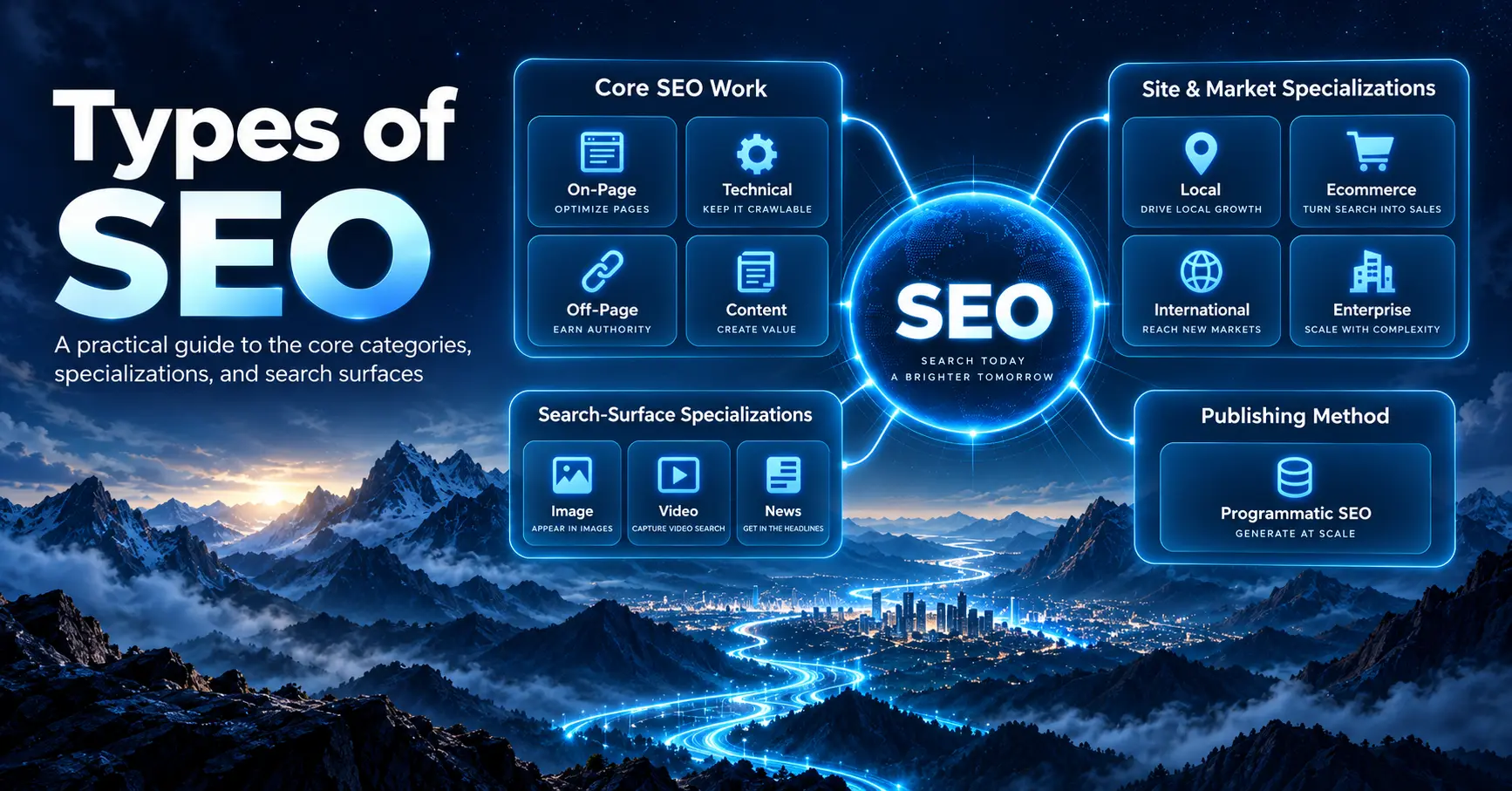
The most useful starting point for understanding the types of SEO is on-page SEO, technical SEO, and off-page SEO. These cover your page content, your website’s accessibility to search engines, and the links and attention you earn elsewhere.
Local, ecommerce, and international SEO apply those core disciplines to particular businesses and audiences. The categories overlap. A retailer with a physical store and an online shop may need both local and ecommerce SEO.
SEO stands for search engine optimization. It helps search engines understand your content and helps people discover it through unpaid search results. Google’s SEO Starter Guide explains the underlying principles.
The important decision is which work will address your website’s current needs. Here is how the types fit together and how to choose a starting point.
The three core types of SEO
| Type | Main focus | Example task |
|---|---|---|
| On-page SEO | Making individual pages useful, relevant, and understandable | Rewrite a service page to answer customers’ questions |
| Technical SEO | Helping search engines access and process a working website | Correct an instruction that accidentally prevents indexing |
| Off-page SEO | Earning relevant attention and links beyond your website | Publish a useful resource that an industry publication references |
These are working categories. Internal linking, for example, supports both content understanding and technical discovery.
On-page SEO: Improve what each page offers
On-page SEO covers a page’s content, title, headings, internal links, images, and meta description. A meta description is a short page summary that Google may use in a search snippet; it can also select text from the page itself.
Start with search intent, meaning what someone wants to accomplish by searching. A person looking for repair instructions needs steps they can follow. Someone looking for a repair service needs to know what the business fixes, where it operates, and how to book.
For an important page:
- Answer the reader’s main question early, then supply the details needed to act.
- Give the page a descriptive title and headings that organize the information.
- Use relevant search terms naturally where they clarify the subject.
- Link to related pages when they help readers understand something or take the next step.
Content SEO, a label you may also encounter, focuses on researching, creating, and improving this material. Google’s content guidance emphasizes useful information, clear sourcing, and value beyond rewriting other pages.
Common mistake: treating SEO as a keyword insertion task. A service page that omits essential details still needs editorial work, even if its keyword appears in every heading.
Technical SEO: Make important content accessible
Technical SEO addresses how search engines discover, access, and process your pages. Two terms matter here:
- Crawling: a search engine fetches a page.
- Indexing: it analyzes the page and may store information about it in its search index.
A page can be crawled without being indexed. Google identifies content quality and indexing instructions among the factors that can prevent indexing. See how Google Search works.
Typical technical work includes fixing server errors, maintaining working navigation, managing duplicate URLs and redirects, and improving loading and usability. An XML sitemap, a file listing URLs, can also help search engines discover pages.
For a missing page, start with Search Console’s URL Inspection tool. Review its indexing status and test the current page. Look for issues such as an accidental noindex instruction, which tells a search engine to exclude the page from its index.
Common mistake: making a perfect speed score the entire strategy. Google recommends evaluating the overall page experience. Prioritize problems that prevent access or make the site difficult to use.
Off-page SEO: Earn relevant coverage and links
Off-page SEO focuses on activity beyond your website that supports its visibility and reputation. A central part is earning backlinks, meaning links from other websites to yours. Google uses links to discover pages and as a signal of relevance, as explained in its link best practices.
Useful work can include publishing resources worth citing, contributing genuine expertise to industry coverage, and helping relevant organizations discover your work. For a local business, accurate listings in directories customers actually use may also be worthwhile.
Give another publisher a concrete reason to reference your page: a useful explanation, original evidence, a tool, or information their audience needs.
Common mistake: buying links intended to pass ranking credit. Google classifies this as link spam. Advertising and sponsorship links are allowed when appropriately qualified, such as with rel="sponsored" or rel="nofollow". See Google’s link spam policy.
Specialized types of SEO
Specializations tell you which audience, content, or business situation to focus on. They usually combine on-page, technical, and off-page work.
Local SEO: Reach customers in a specific area
Local SEO suits businesses such as restaurants, repair shops, and contractors serving a defined area. It covers relevant website pages and local search visibility, including Google Maps and Google Business Profile.
Start with accurate business information: your real business name, category, hours, address or service area, and contact details. Maintain useful service or location pages, and collect and respond to genuine customer reviews.
Google describes local ranking in terms of relevance, distance, and prominence, or how well-known a business is. Your distance from the searcher remains a constraint. Google’s local ranking guidance explains these factors.
Important exception: Google Business Profile has eligibility requirements. Businesses generally need in-person customer contact; online-only businesses are listed as ineligible. Check the business eligibility guidelines before creating a profile.
Ecommerce SEO: Help shoppers find and evaluate products
Ecommerce SEO applies to online stores, particularly their category and product pages.
Priorities include clear product information, useful category organization, and navigation that lets people and crawlers reach products. Google specifically recommends linking through categories to product pages; products available only through a site’s search box may be difficult to discover. See its ecommerce navigation guidance.
Product structured data is code that describes product details in a format search engines can process. Appropriate markup can make pages eligible for richer displays of information such as prices and availability. Appearance depends on Google’s requirements and systems, as described in its product structured data documentation.
Where to start: improve the product or category pages most important to customers. Make specifications, availability, shipping, and returns easy to understand.
International SEO: Serve different languages or markets
International SEO helps a website serve people across languages or countries. It involves maintaining appropriate content and helping search engines understand relationships between localized pages.
For example, a business may need separate versions for U.S. and U.K. customers because prices, delivery options, or terminology differ, even though both pages are in English.
The hreflang annotation identifies alternate language or regional versions of a page. It does not translate the content. Google’s localized page guidance explains implementation options.
Invest in this specialization when you serve those audiences and can maintain accurate content for them.
Image, video, and mobile SEO: Adapt to the format
These labels focus on how people find or use content:
- Image SEO helps search engines understand images and their context. Use relevant images, descriptive alternative text where appropriate, and nearby text that explains their role. Google covers this in its image optimization guidance.
- Video SEO helps videos become discoverable. For Google’s video features, pay attention to a watch page centered on the video, an accessible video, and a valid thumbnail. See Google’s video SEO requirements.
- Mobile SEO focuses on content access and usability on phones. Google uses the mobile version of content for indexing and ranking, so important information must remain accessible there. See its mobile indexing guidance.
A video publisher may need substantial video SEO work. Mobile usability deserves attention whenever people use your site on phones.
Other labels you may encounter
National SEO describes reaching customers across a country. Enterprise SEO describes managing SEO across large or complex websites and organizations, where templates, coordination, and change management become important.
Voice SEO focuses on spoken search queries. Treat it as a reason to investigate how your audience asks questions and which devices or services they use.
AI SEO is ambiguous: it can mean using AI to perform SEO work or improving visibility in AI-generated answers. Related labels include answer engine optimization (AEO) and generative engine optimization (GEO).
For Google’s AI Overviews and AI Mode specifically, Google says existing SEO practices apply and no special optimization or additional technical requirements are necessary. Its guidance does not establish requirements for every other AI service. See Google’s guidance on AI features.
White hat, black hat, and gray hat SEO
These labels describe approaches to search engine rules:
- White hat SEO: practices that serve users and follow search engine guidelines.
- Black hat SEO: manipulative practices that violate those guidelines.
- Gray hat SEO: an informal label for tactics whose acceptability is disputed or presented as uncertain. The label itself offers no assurance that a tactic complies.
Google prohibits practices including keyword stuffing, deceptive cloaking, and scaled content created primarily to manipulate search rankings without helping users. Violations may lead to reduced visibility or exclusion from results. Evaluate the actual tactic against Google’s spam policies.
Which type of SEO should you work on first?
Start with evidence of a problem on a page that matters to your audience. A symptom can have several causes, so use this table to choose your first check.
| What you observe | First check | Likely area of work |
|---|---|---|
| An important page is absent from Google’s index | Inspect the URL’s status, access, and indexing instructions; also review content quality | Technical and on-page SEO |
| A page gets search impressions but answers a different question from the relevant queries | Compare the page’s purpose and content with the reader’s task | On-page SEO |
| Local customers encounter incorrect hours or service details | Review the Business Profile, website, and relevant listings | Local SEO |
| Some products are hard to reach through store navigation | Follow category links and inspect affected product URLs | Ecommerce and technical SEO |
| Useful, accessible content has little relevant external exposure | Review who would benefit from it and whether there is a credible reason to reference it | Off-page SEO |
If visitors arrive but do not buy or inquire, investigate the offer, information, and conversion process too. More search traffic alone may not solve that problem.
Worked example: An Austin bike repair shop
Hypothetical assumptions: the business has one shop, serves local customers, and takes repair inquiries through its website. URL Inspection reveals an accidental noindex instruction on its repair page. That page also omits key service details, and the Business Profile shows outdated hours.
A sensible order of work would be:
- Technical SEO: remove the accidental indexing restriction, test the page, and request indexing. This addresses a confirmed barrier; the request does not ensure indexing.
- On-page SEO: explain the repairs offered, supported bike types, how estimates work, and how customers can book.
- Local SEO: correct the hours and other business information so customers can plan a visit accurately.
- Off-page SEO: create a useful maintenance resource based on the shop’s actual expertise and share it with relevant local cycling organizations. Any editorial link remains the publisher’s choice.
The first task addresses a known indexing problem. The next two improve what potential customers learn and whether they can act on it. If the shop later starts selling products online, ecommerce SEO becomes relevant too.
To assess progress, use Search Console’s Performance report for impressions, clicks, and relevant queries. Track completed repair inquiries separately in website analytics, and consider seasonal demand when comparing periods. This example illustrates a decision process, not measured results.
Your next step
Choose one important page and record four things: the reader’s task, its indexing status, the most useful missing information, and any relevant specialization such as local or ecommerce SEO.
Address the clearest problem, record what changed, and monitor both search visibility and the action you want visitors to complete. That gives each SEO task a specific purpose.
Frequently Asked Questions About the Types of SEO
What are the four types of SEO?
The four main types of SEO are on-page SEO, off-page SEO, technical SEO, and local SEO. On-page SEO focuses on optimizing website content and individual pages, off-page SEO builds authority through backlinks and external signals, technical SEO improves site performance and crawlability, and local SEO helps businesses rank in location-based searches.
What are the top 5 SEO strategies?
The top five SEO strategies are keyword optimization, high-quality content creation, on-page SEO, link building, and technical SEO. A strong SEO strategy combines these methods to improve search visibility, attract relevant traffic, build website authority, and provide a better user experience.
What are the top 5 SEO tools?
Five of the most popular SEO tools are Semrush, Ahrefs, Google Search Console, Screaming Frog SEO Spider, and SE Ranking. These tools can help with keyword research, competitor analysis, backlink monitoring, technical SEO audits, rank tracking, and website performance analysis.
What are the 3 C’s of SEO?
The 3 C’s of SEO are Content, Code, and Credibility. Content refers to useful and relevant information for users, Code covers the technical and on-page elements that help search engines understand a website, and Credibility comes from authority signals such as quality backlinks, brand reputation, and trust.
What are the four pillars of SEO?
The four main pillars of SEO are Technical SEO, On-Page SEO, Content, and Off-Page SEO. Technical SEO ensures search engines can crawl and index a website, on-page SEO optimizes individual pages, content satisfies search intent, and off-page SEO builds authority through backlinks and other external signals.
What are the three main categories of SEO techniques?
The three main categories of SEO techniques are on-page SEO, off-page SEO, and technical SEO. On-page SEO improves content and page elements, off-page SEO strengthens authority through external signals, and technical SEO improves a website’s structure, speed, crawlability, and indexability.
How many seos are there?
There is no official number of SEO types, as SEO can be divided into different categories depending on the strategy being used. However, SEO is most commonly grouped into four core types: on-page SEO, off-page SEO, technical SEO, and local SEO.
On-page SEO focuses on optimizing content, headings, keywords, internal links, and HTML elements on individual pages.
Off-page SEO focuses on improving website authority through backlinks, brand mentions, digital PR, and other external signals.
Technical SEO improves website infrastructure, including crawling, indexing, page speed, mobile usability, and site architecture.
Local SEO helps businesses improve their visibility in location-based searches, Google Maps, and local search results.
Which type of SEO is best?
There is no single best type of SEO because the most effective SEO strategy usually combines on-page, off-page, technical, and local SEO when relevant. Each type serves a different purpose: technical SEO creates a strong foundation, on-page SEO improves page relevance, off-page SEO builds authority, and local SEO helps businesses attract customers from specific geographic areas.
Related Articles:
- Why Is SEO Important? 9 Reasons It Pays Off in 2026
- SEO Pricing: How Much Does SEO Cost in 2026?
- How to Do SEO: A 5-Step System for Beginners
- How to Learn SEO: A Step-by-Step Roadmap for Beginners
- Is SEO Dead in 2026? No, But These 5 Tactics Are
- How to Work in SEO: Skills, Jobs & Career Roadmap
- SEO Terms: 225 SEO Glossary Every Beginner Should Know
Last Updated on 4 days ago by Alipio Umiten IV
