





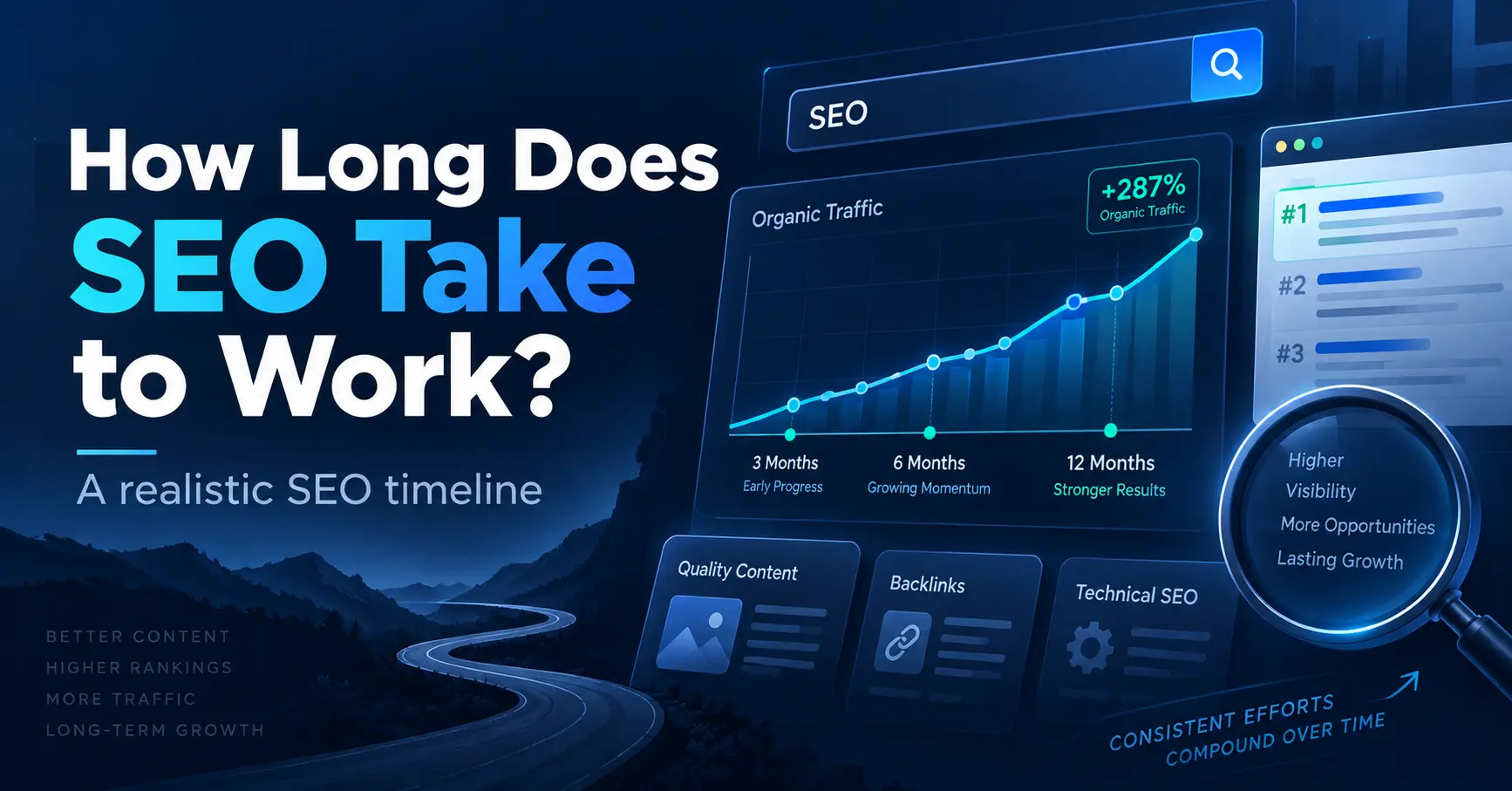
How Long Does SEO Take to Work
Plan on about three to six months to assess initial SEO progress, with the possibility of a longer wait for meaningful business results. This is a working range, not a delivery deadline. Ahrefs reports this range based on social media polls with 3,680 responses. Those responses reflect individual judgments, so they cannot predict your website’s outcome.
Individual changes can have an effect sooner. Google says some changes take a few hours, while others take several months. It advises allowing a few weeks before assessing their impact and cautions that some changes may have no noticeable effect.
To make that timeline useful, define what should improve first and what you will do if progress stalls.
What does “SEO is working” actually mean?
Search engine optimization, or SEO, aims to help people find your website through unpaid search results. Progress can mean several different things:
- Indexing: Google has included an important page in its index.
- Search visibility: Your pages appear for relevant searches. These appearances are measured as impressions.
- Organic traffic: People click through from unpaid search results.
- Business results: Those visitors take a valuable action, such as making a qualified inquiry or buying a product.
Google Search Console reports impressions and clicks, which help distinguish visibility from visits.
These milestones measure different things. An indexed page has cleared one hurdle, but that does not guarantee it will appear for the searches you want.
Before judging your SEO timeline, choose the outcome that matters. A service business might prioritize qualified inquiries. An online store might track purchases and the revenue associated with organic visits.
Why some SEO projects take longer than others
A new website has a different starting point
An established site may already have useful pages, organic visitors, and links from relevant websites. Improving those assets can be a smaller job than building a new site’s content and navigation from scratch.
That is a practical reason to plan differently for new and existing websites. Assess what the site already has instead of assigning it a waiting period based only on its age.
Links are part of the picture: Google uses link analysis to understand pages and assess which may be helpful for a query. A link count alone, however, cannot tell you when results will arrive.
Competition and search intent change the work required
A narrowly defined customer question may offer a more realistic opportunity than a broad topic with strong competing pages. Examine the results for each target query. Are people being served tutorials, product listings, comparisons, or local businesses?
Build the kind of page that fulfills that task. Evaluate competing pages instead of assuming a longer keyword phrase will be easy.
Then identify what your page can contribute: a clearer explanation, a useful comparison, original evidence, or details that help someone make a decision. Google’s content guidance specifically asks whether a page provides original information and substantial value compared with other results.
Local search adds another consideration. Google describes relevance, distance, and prominence as local ranking factors. For planning purposes, that means a city-specific target should not automatically receive a shorter deadline.
Recommendations need to become live changes
Track both the project kickoff date and the dates when improvements go live.
For example, if approvals take two months and a rewritten page has been published for one week, distinguish the delivery delay from the time available to assess that page. Both matter when evaluating the project.
More resources can help a team complete work sooner. They do not establish a deadline for Google to respond.
A practical SEO timeline with review checkpoints
Use this as a suggested review schedule for a project where implementation begins promptly. These are management checkpoints, not predicted ranking dates.
| Review window | Work to prioritize | Question to answer |
|---|---|---|
| Weeks 1–4 | Establish tracking, identify important pages, fix critical access problems, and publish priority improvements. | Are the changes live, and do we have a reliable baseline? |
| Months 2–3 | Check indexing and relevant search visibility for the pages you changed. Refine content where evidence shows a gap. | Is the obstacle discovery, visibility, or getting people to click? |
| Months 3–6 | Compare relevant clicks, organic visits, and qualified inquiries or purchases across comparable periods. | Is useful progress recurring, or are we reacting to one spike? |
| After six months | Review the goal, implementation, competition, and business outcomes before committing to another phase. | Does the evidence support continuing, narrowing the target, or changing the approach? |
Fix an obvious problem as soon as you identify it. There is no reason to leave a broken page untouched until its scheduled review.
A new site or difficult target may need longer than this initial window. Still, “SEO takes time” should come with an explanation of what has been delivered, what is improving, and what remains unresolved.
How to measure useful progress
Use Google Search Console to review the queries and pages bringing visibility and clicks. For a US audience, examine US performance so changes elsewhere do not obscure your target market.
Track searches containing your brand name separately where possible. This helps you see whether visibility is expanding beyond people already searching for your business.
In your analytics, measure organic visits and meaningful actions on the landing pages you are improving. Agree on what counts as a qualified inquiry. Test forms, purchases, and other tracked actions before trusting the report.
Compare equal periods, such as the latest 28 days with the previous 28 days. Where history allows, also check the equivalent period a year earlier. Google identifies seasonality and changing search interest as possible causes of traffic changes.
Keep a simple change log containing the page, publication date, change made, and intended outcome. It gives each review a concrete starting point.
What to check when SEO seems stuck
Treat the following explanations as hypotheses to investigate, not automatic diagnoses.
| What you observe | Possible explanation | What to check next |
|---|---|---|
| Important pages are not indexed | An access restriction, a discovery problem, or Google selecting another version of the page. | Use URL Inspection to check the reported reason, page access, indexing restrictions, and selected canonical URL, meaning Google’s preferred version. |
| Pages are indexed but receive few relevant impressions | Limited demand, strong competing pages, or a mismatch between the page and the searcher’s task. | Revisit the target queries and compare the usefulness and format of your page with the results currently being shown. |
| Impressions rise but clicks do not | More appearances at low positions, an unclear search listing, or changes in competing results. | Compare the same queries and pages. Review their positions, titles, and the surrounding search results before rewriting everything. |
| Organic visits rise but qualified inquiries or purchases do not | An unsuitable audience, an unclear offer, friction on the page, or a tracking problem. | Test forms and checkout, review the landing pages, and inspect the quality of incoming inquiries. |
A sudden decline deserves a separate investigation. Check recent site changes, technical errors, demand shifts, and relevant ranking updates instead of waiting for the next campaign milestone.
Worked example: more traffic, the same conversion rate
Hypothetical example: A service business improves several service pages. It compares two equal 28-day periods using the same analytics settings and definition of a qualified lead. Assume no major seasonal change, promotion, or change in the offer.
| Metric for those pages | Before | Later review |
|---|---|---|
| Organic sessions, meaning visits recorded by analytics | 200 | 300 |
| Qualified leads attributed to those sessions | 4 | 6 |
| Qualified leads divided by organic sessions | 2% | 2% |
The business received more visits and more leads, while its lead conversion rate stayed the same.
That is encouraging, but it does not establish that the SEO changes caused the increase. Two additional leads also provide limited evidence of a lasting trend. The next review should check whether the pattern continues and whether those leads become customers.
If traffic had increased while inquiries stayed flat, the next task would be to investigate the audience, offer, page experience, and tracking. Publishing more articles would not automatically resolve those problems.
Can you make SEO work faster?
You can reduce avoidable delays. Get priority pages approved, implement important fixes promptly, and connect useful new content to relevant existing pages. Choose work that addresses the obstacle you have actually identified.
Google’s processing time is a separate matter. It says crawling can take a few days to a few weeks. Repeated requests to crawl the same URL do not make it happen faster, and requesting a crawl does not guarantee inclusion in search results.
Paid advertising is also separate from organic rankings. Running Google Ads does not improve your site’s placement in Google’s organic results.
Set a useful first review
Choose one business goal and a small group of priority pages. Record their current performance, the dates your changes go live, and the obstacle each change is meant to address.
Set a monthly review. At each one, decide what the evidence supports: continue the work, fix a specific problem, or revise the target. That gives you a way to manage the waiting period while holding the project accountable.
Last Updated on 4 days ago by Alipio Umiten IV
